Worn Truck Suspension Bushings: Symptoms and Checks
The federal condition standard for suspension never names the bushing, but a worn one is what turns an axle loose or out of alignment. Here is how it shows up and what to look for in the yard.
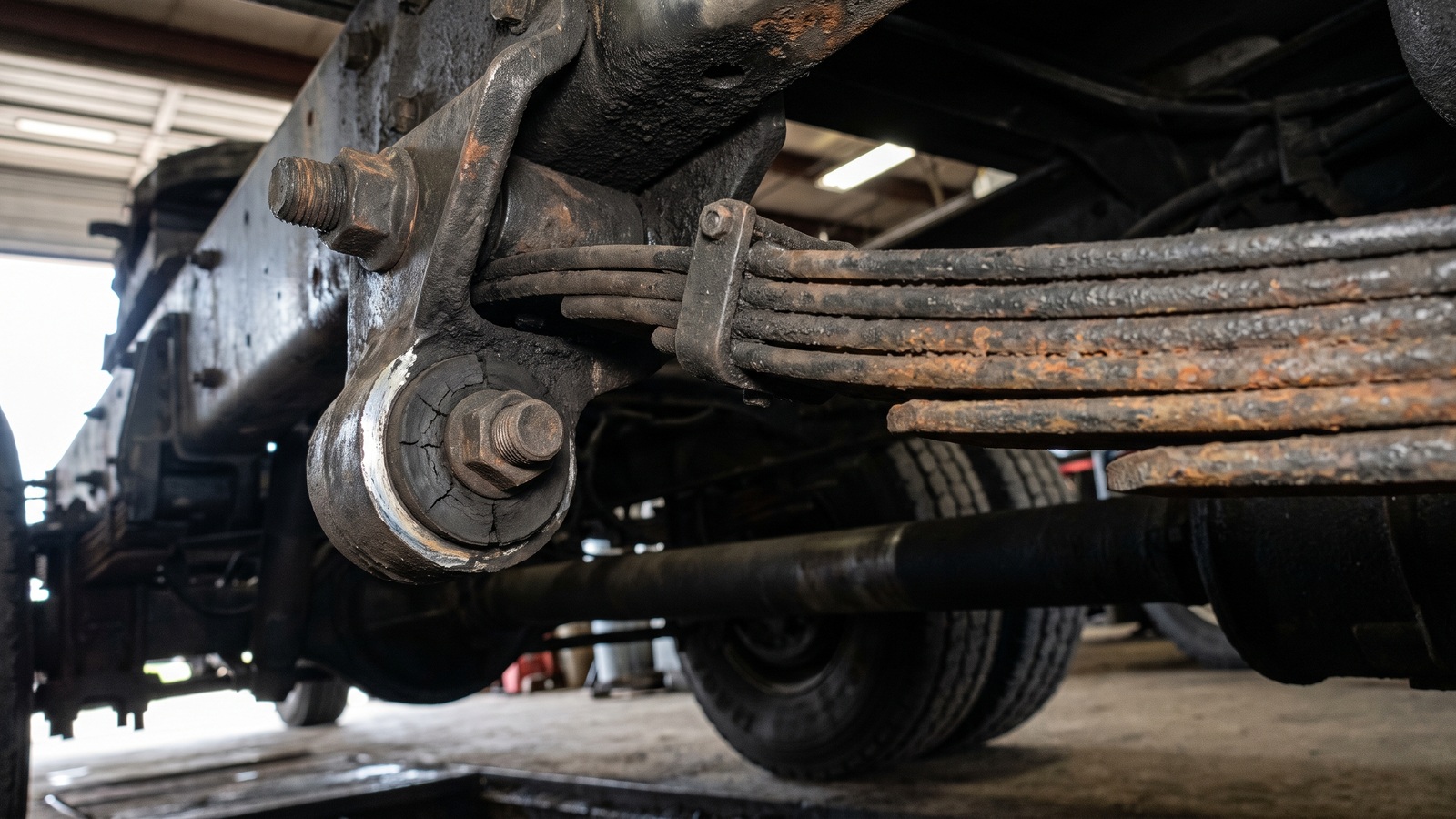
There is a part on your suspension that the federal condition standard never names, and it is the part that decides whether the ones it does name pass or fail. The bushing does not appear anywhere in the rule. A worn bushing is still what an inspector ends up writing down, just under a different name.
What the rule actually lists
The condition standard for suspension systems is 49 CFR 393.207, and it is short. It covers axle positioning parts, which cannot be cracked, broken, loose or missing, and it requires axles to be in proper alignment. It covers locking pins on adjustable axles. It covers leaf springs, which cannot be cracked, broken, missing or shifted out of position, and coil springs and torsion bars, which cannot be cracked or broken.
For air suspension it gets specific in a different way: the regulator valve must not feed air into the suspension until the brake system is holding at least 55 psi, the vehicle has to sit level rather than leaning, and leakage cannot exceed 3 psi over five minutes at normal operating pressure.
Read that list again and notice what is missing. Torque rod bushings, spring eye bushings, equalizer bushings, shackle bushings — none of them are called out. That is not an oversight. The rule is written around condition and position, not around the wear items that produce them.
Why that matters on a real inspection
A bushing is a sacrificial part. It sits between a rod, a spring or a hanger and the frame, and it absorbs the movement that would otherwise beat the mount to death. When it hardens, cracks or wallows out, the part it was cushioning starts to move where it was never supposed to.
That movement is what shows up on paper. The torque rod is now loose at the frame — an axle positioning part that is loose. The spring has shifted in its seat. The axle no longer sits square, so it is out of alignment. Each of those is a line the rule already covers, and none of them will say the word bushing.
The practical consequence: you cannot argue a bushing case. There is no threshold to cite, no tolerance to point at. The component is either holding things where they belong or it is not.
The symptoms you already know
Most drivers meet a failed bushing long before anyone measures it, and usually mistake it for something else:
- A clunk over expansion joints or driveway aprons, worse unloaded than loaded, and often coming from the same corner every time.
- Steering that wanders on a straight road, where the truck needs constant small corrections that it did not need last year.
- Uneven tire wear that returns after an alignment. If the axle will not stay where the alignment put it, the alignment was never the problem.
- A pull that changes with load. Empty it tracks acceptably, loaded it drifts, because the load is what forces the worn joint to move.
- A shudder under braking that feels like it comes from the axle rather than the wheel end.
Those symptoms overlap with other causes, which is exactly why they get chased in the wrong order. If the truck shakes at road speed, work through the causes in sequence — that is covered in why a semi vibrates at highway speed. If it will not track straight, start with the pulling checklist. If the noise is at the wheel end rather than the frame, the pattern to compare against is in the wheel bearing signs.
The check you can do in the yard
You are not measuring anything here. You are looking for movement where there should be none, and for the evidence that movement has already been happening.
- Look for the rust halo. A joint that has been working loose grinds off paint and leaves a bright or rust-stained ring around the mount. That mark is the most honest thing on the whole assembly.
- Check for squeeze-out. Rubber bulging past the sleeve, or a gap on one side of the bushing and none on the other, means the material has already given up its center.
- Read the spring seat. A leaf pack that has walked out of its seat, even slightly, is both a rule item and a strong hint that the bushings let it move.
- Compare left to right. On the same axle, at the same age, the two sides should look the same. One side that looks different is telling you which one to work on.
- Watch the truck settle. On air suspension, park level and look again after five minutes. A lean that develops while parked is a leakage question, and the rule puts a number on that one: 3 psi over five minutes.
What you cannot do alone is the pry-bar test with the axle loaded. That belongs on a rack, with the weight taken off correctly, because the amount of stored energy in a loaded spring pack is not something to learn about by accident.
Where the shop comes in
A bushing is cheap. Everything downstream of a bushing is not. A torque rod mount that has been pounded oval is a frame repair. An axle that has been running out of square eats a set of tires quietly and continuously, and by the time the wear pattern is obvious the money is already gone.
That is the case for treating a vibration or a pull as a diagnostic appointment instead of a parts purchase. A proper vibration and suspension inspection puts the truck on a rack, checks each joint under controlled conditions and tells you which component actually moved. Inspection and shop resources for operators are collected at thetrucksavers.com, and if you are choosing a shop away from your home terminal, the screening process is worth five minutes before you hand over the keys.
The habit that prevents the whole thing
Bushings do not fail suddenly. They fail over a season, and they announce it with a noise that gets normal because you hear it every day. The operators who catch them are the ones who notice when a familiar sound changes, and who look at the same four mounts every time they are under the truck for something else.
A clunk you have stopped hearing is not a clunk that went away.
Original source
Regulation text read directly from the current federal record: Electronic Code of Federal Regulations, 49 CFR 393.207 Suspension systems.