Free or reserved truck parking: compare access, cost and restrictions
Compare permission, charges, equipment and reservation terms before choosing parking. A decision matrix without promises of free or available spaces.
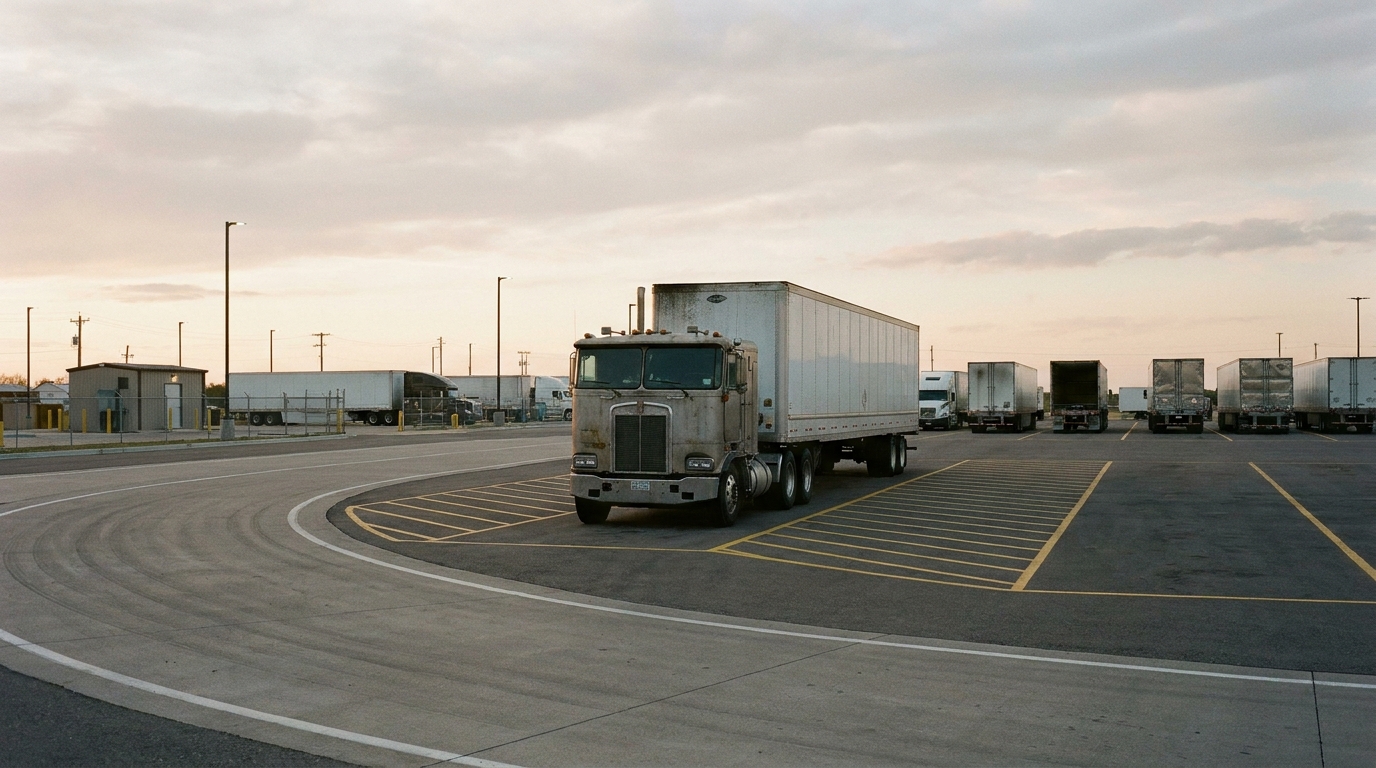
“Free truck parking” and “reserved truck parking” answer different questions. Free describes a charge; reserved describes an arrangement with an operator. Neither word by itself establishes permission to stay, suitable equipment dimensions, access at your arrival time or personal security. Compare those conditions before choosing a location. This guide is a decision worksheet, not a list of supposedly free spaces or a promise that a place will be available when you arrive.
Start with permission, not the price label For each option, write who authorizes the stay and what the permission covers. A customer yard may permit waiting for an appointment but prohibit an overnight break. A travel center may have different areas and rules for paid reservations and unreserved spaces. A public rest area may impose restrictions posted by the responsible authority. Do not transfer permission from one location to another because both appear under “parking” on a map.
If the rule is unclear, contact the operator or authority responsible for that location. A fuel purchase, restaurant receipt or nearby business address does not establish permission to leave a trailer. Keep the confirmation with your trip plan and identify a fallback that you can reach within your operating limits.
Use a four-column comparison Create one row per candidate, with four working columns: total charge and conditions; authorized use and maximum stay; equipment and access; confirmation and fallback. Leave an unknown field blank until someone verifies it. Do not replace a missing price with zero or a missing restriction with “no restrictions.” The blanks tell dispatch which questions still need an answer.
| Option | Charge and terms | Permission and stay | Equipment and access | Confirmation and fallback |
|---|---|---|---|---|
| A | To confirm | To confirm | To confirm | To confirm |
| B | To confirm | To confirm | To confirm | To confirm |
For a paid option, ask what the charge covers, whether fees apply, how cancellation works and whether a specific reservation is confirmed. For a no-charge option, ask whether permission depends on an appointment, a purchase or a particular parking area. These questions are more useful than comparing a headline daily rate with an unverified “free” search result.
Compare the trip cost, not only the parking fee Consider an illustrative choice between a no-charge location that requires a detour and a paid location already on the route. Use your actual mileage, fuel use, confirmed charges and business value of time. The arithmetic can show that the cheaper posted rate is not the cheaper trip. It can also show the reverse. Do not assume that paying is always worthwhile.
Keep estimates separate from receipts. A decision made before arrival may include an estimated queue or detour; the trip record should later replace those inputs with what happened. This creates a useful comparison for dispatch without turning one driver's experience into a claim about every future visit.
Check equipment before you commit Tell the operator whether you have a tractor-trailer combination, bobtail, straight truck or detached trailer. Confirm length, loaded status and any commodity restrictions that matter to the site. Ask about the entrance, turning space, parking position and whether leaving a trailer requires a particular support arrangement. A lot that accepts one kind of equipment may not accept another.
Do not use a passenger-car navigation pin as proof of truck access. Ask for the truck entrance and approach instructions, then check them against the route constraints for your vehicle. A booking screen is useful evidence of a transaction; it is not a substitute for the site's equipment rules or the driver's route planning.
Access hours are not inventory A gate described as open around the clock does not mean a parking space is always available. At the Denver Kearney Street location, the operator provides a physical address, access information and a booking process. Our listing identifies it as paid and reservable. Check the current operator page for the space, dates and equipment you need; the directory does not hold inventory.
Save the reservation reference and arrival instructions where the driver can retrieve them. Confirm how late arrival, changes and cancellations are handled. If an online result fails or the transaction is uncertain, look for the receipt before booking again. Avoid creating two charges while trying to solve a slow confirmation screen.
Keep security claims in proportion Lights, a fence or a gate describe features, not an assurance against loss. Review the operator's current terms and your carrier's cargo-security procedures. Ask what is actually monitored and which contacts are available if access fails. Avoid treating a star rating, a photograph or the word “secured” as a guarantee that equipment or cargo cannot be stolen.
Do not publish your live parking location or load details to ask for general advice on social media. Share operational information through the channels your company uses. The goal is to choose a suitable authorized stop, not to produce a public record of where a valuable load will sit overnight.
Agree on a fallback before the first stop fails A workable comparison includes a second location, its conditions and the point at which dispatch should reconsider the plan. Coordinate while there is still time to choose safely. Do not extend driving just because a reservation exists, and do not treat shoulder parking or an unapproved customer lot as a substitute for a failed plan.
For planning around the driving clock, use our separate guide to finding legal parking before time runs out. This article concentrates on comparing price, permission and reservation terms. Keeping those tasks separate helps a driver avoid a good-looking bargain that does not fit the day's equipment or schedule.
Turn the comparison into a reusable routine Before each trip, complete the four columns for the realistic options. After the trip, update the record with actual charges and useful access notes, dated so they can be checked again. Choose the option that meets the operating requirements at an acceptable total cost. If you also need mechanical work, arrange that appointment separately with the appropriate provider, including The Truck Savers™ where its service fits your route.
Continue with these tools
Related guide: context and next step
Denver · 4255 Kearney St · paid, reservable parking
Ask The Truck Savers™ about the mechanical service appropriate for your equipment. Confirm scope and appointment directly.
Official sources and verification
Practical guide checked November 6, 2026. AI-generated illustrative cover; it does not depict a specific branch or customer.