Diesel Flattens at $5.348 After a 77-Cent Month
Diesel flattened this week at $5.348 a gallon, but the diesel move over four weeks is 77 cents. The gap between the priciest and cheapest reported regions is nearly a dollar.
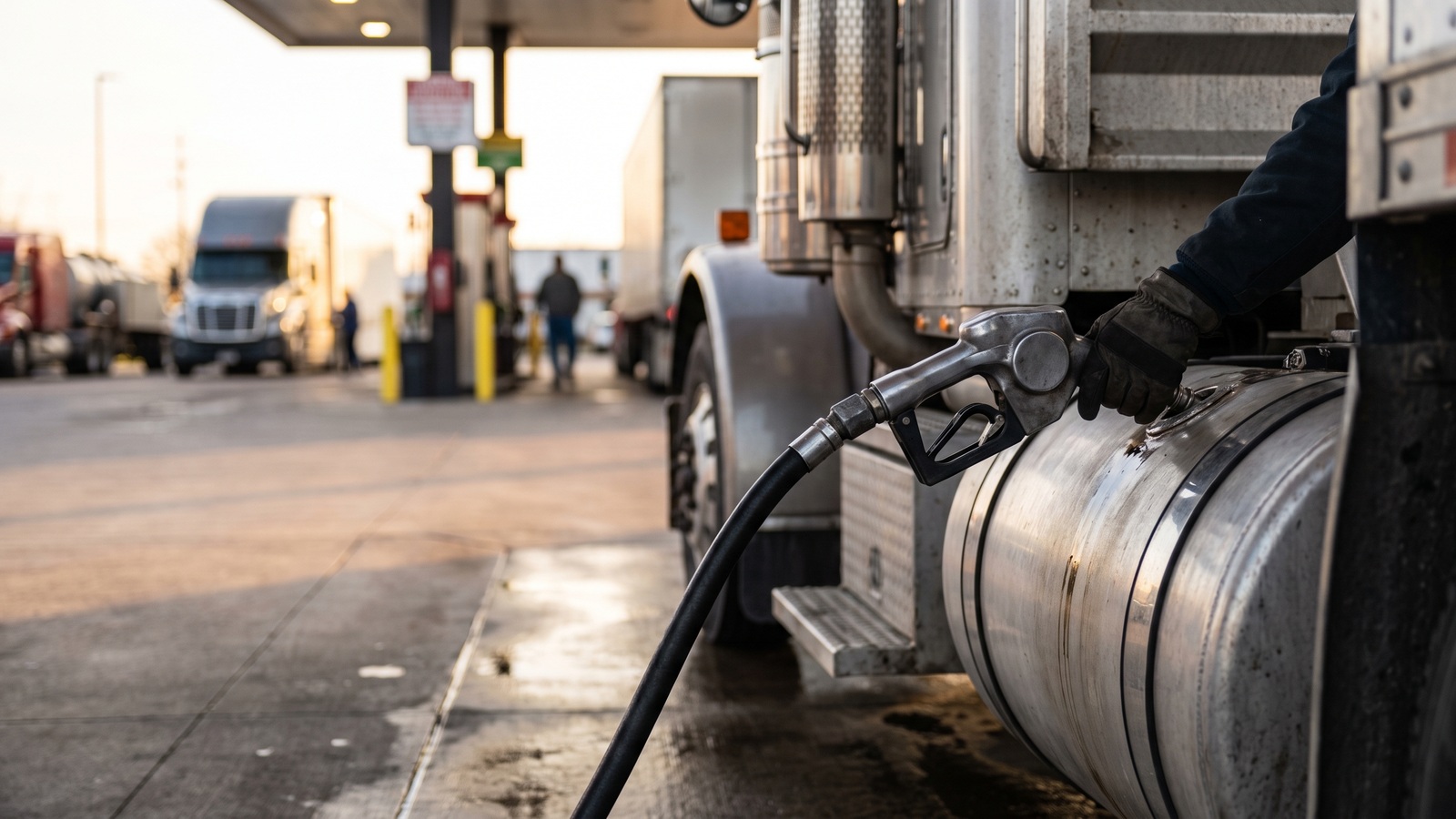
Diesel barely moved this week. That is not the number that should worry you. The national average went up three and a half cents — and it is still seventy-seven cents higher than it was four weeks ago.
What the print says
Weekly retail on-highway diesel for the period ending August 3, 2026 came in at $5.348 per gallon nationally. That is up $0.035 from $5.313 the week before, a move of 0.66%.
Now put it next to the month. Four weeks earlier the national average was $4.578. The four-week change is +16.82%, or seventy-seven cents a gallon.
Those two facts together are the whole story. The climb has flattened, but it flattened at a level nobody was running at in early July. A quiet week does not give the money back.
What it costs a real truck
Take a tractor that burns 6.5 miles per gallon and runs 2,500 miles a week. That is about 385 gallons. At $4.578 that week of fuel was roughly $1,762. At $5.348 it is roughly $2,059.
Nearly $300 a week on the same lane, the same truck, the same driver. Over four weeks it is about $1,186. If your rate per mile did not move in that window, that difference came straight out of the only place it can come from.
Run the arithmetic with your own mpg and your own miles before you accept anyone's average. The method matters more than the example.
Where you buy it changes the math
The reported areas are not close to each other. The most expensive region in the print sits at $6.130 and the cheapest at $5.141. That is a spread of $0.989 a gallon between one part of the country and another.
On a 150-gallon fill, that gap is about $148. Fuel routing is not a rounding exercise at this spread — it is one of the few line items an owner-operator can still move without renegotiating anything.
One caution that matters: this dataset does not publish all fifty states. It reports national, regional and a small number of individual areas. California, the only individual state carried in the series, printed $6.716. A regional figure is not a state figure, and treating one as the other will send you to the wrong pump.
What to do with a flat week
- Re-check your fuel surcharge against the new base, not the old one. A surcharge built on a July average is under-recovering at this level.
- Price the lane, not the stop. With nearly a dollar between regions, where you fill is worth planning before you leave.
- Recalculate cost per mile this week. Seventy-seven cents a gallon changes the floor under every rate you accept.
- Look at idle hours. Every hour the main engine runs parked is now billed at the new price, and that is the one cost you control without asking anyone.
That last point is where the money hides. If you want the worksheet for what parked hours actually cost at today's price, we keep it updated in our guide on how much fuel an APU can save, and you can request a system assessment built around your own duty cycle from Go Green APU. Practical cost guidance for owner-operators and small fleets is collected at The Truck Savers.
Original source
Prices and periods taken from the weekly series: U.S. Energy Information Administration, Weekly Retail On-Highway Diesel Prices, national series, period ending August 3, 2026.