APU Fuel Systems Fall Under the Same Rules as Your Tank
Both federal fuel system sections say they cover equipment installed on the truck, not just the engine tank. Two of the requirements are measurable with a tape: two inches of clearance on unprotected line and three quarters of an inch on bottom fittings.
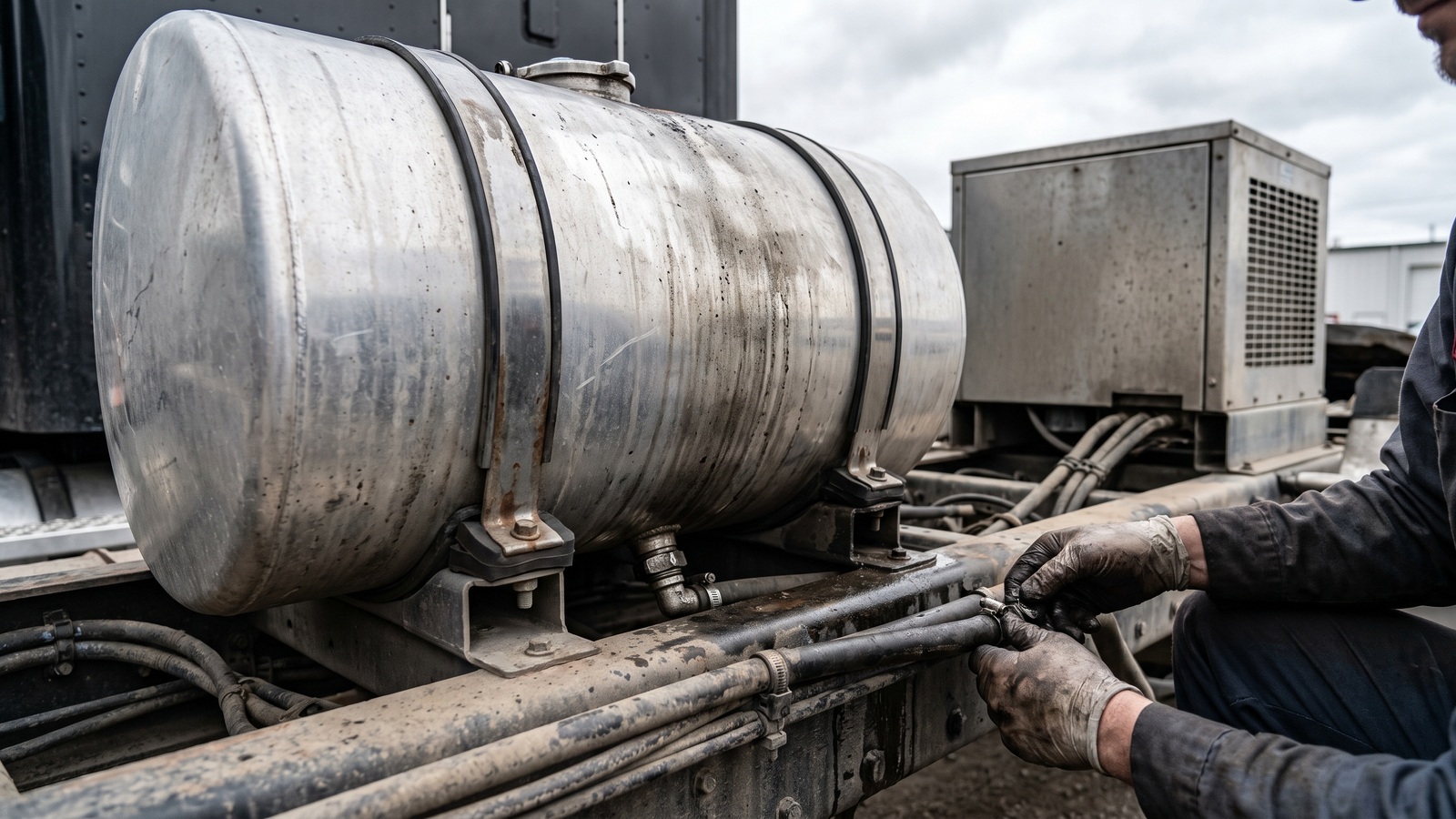
The federal fuel system rules do not stop at the tank that feeds your engine. Both sections that govern fuel on a commercial vehicle say, in their own first paragraph, that they also cover whatever contains and supplies fuel for auxiliary equipment installed on the truck. That is your APU. Most people who buy one never find that out until somebody else points at it.
The sentence almost nobody reads
49 CFR 393.65 opens by saying the rules apply to systems for containing and supplying fuel for operating the vehicle or for operating auxiliary equipment installed on, or used in connection with, the vehicle. 49 CFR 393.67, the section for liquid fuel tanks, opens the same way.
So the mounting, the clearances, the routing and the fittings on an auxiliary setup are not a workmanship preference between you and your installer. They are the same requirements the main tank answers to.
Two numbers you can check with a tape measure
Almost nothing else in this part of the rulebook is measurable from a crouch beside the frame. These two are:
- Two inches. A fuel line that is not completely enclosed in a protective housing must not extend more than two inches below the fuel tank or its sump. If a line loops low under the rail on its way to an auxiliary unit, that is where it gets caught.
- Three quarters of an inch. Drains and other bottom fittings must not extend more than three quarters of an inch below the lowest part of the tank or sump, and they have to be protected against impact damage.
Get under the truck with a tape and you can settle both in about two minutes. On a factory tank they are almost always fine. On anything added later, they are exactly what is not fine.
Where the tank is allowed to sit
The location rules are short and absolute, and they are worth reading against any aftermarket bracket:
- No part of the system may extend beyond the widest part of the vehicle.
- No part of a fuel tank may sit forward of the front axle of a power unit.
- Fuel spilled straight down while the tank is being filled must not reach any part of the exhaust or the electrical system — the only thing it is allowed to touch is the fuel level indicator assembly.
- Fill pipe openings go outside the cab and outside the cargo compartment.
- No fuel line runs between a towed vehicle and the vehicle towing it while the combination is moving.
That last one is the one that catches trailer-mounted equipment. If the plan is to feed something on the trailer from the tractor, the rule says no while you are rolling.
How it has to be held on and plumbed
Each fuel tank must be securely attached in a workmanlike manner. Vague on purpose, and it still gives an inspector everything needed when a strap is improvised.
The fittings are not vague at all. Threads must be the Dryseal taper pipe type the rule names, and at least four full threads have to be in engagement in each fitting. Tank body joints must be welded, brazed, silver soldered or closed by something at least as strong, and they cannot be closed by crimping alone or with soft lead-based solder. Every fuel line has to be long enough and flexible enough to take the normal movement of whatever it is attached to, and secured against chafing and kinking.
On a diesel tank holding more than 25 gallons, the fill pipe and vents have to accept fuel at 20 gallons per minute without spilling. If your tank burps back at the pump, that is not just annoying.
The small-pump exception people misread
Gravity and syphon feed straight to the injector are prohibited. There is one narrow exception, and it is narrower than it gets quoted: an auxiliary pump with a nominal tank capacity of not more than five gallons, mounted on the trailer chassis frame or trailer bed, for purposes other than operating the truck, and operated only when the vehicle is not in motion.
Three conditions, all at once. Drop any one of them and the exception is gone.
What to do before the next inspection
- Take the tape under the truck. Two inches on unprotected line, three quarters of an inch on bottom fittings.
- Look at the straps and the brackets on anything added after the truck left the factory. That is where workmanlike gets argued.
- Follow the line the whole way and look for a spot rubbing on a rail, a crossmember or a clamp. Chafing is a written requirement, not an opinion.
- Check the fill neck path. Nothing spilled straight down should be able to land on exhaust or wiring.
- If it is on the trailer, check the three conditions before assuming the small-pump exception covers you.
None of this is a reason to skip an auxiliary unit — an APU is still the cheapest way to stop burning a gallon an hour at a truck stop, and there is a full breakdown of that math in our APU savings guide. It is a reason to ask the installer about clearances and fittings before the invoice, not after a roadside stop. If you are pricing a unit, Go Green APU is a place to start, and there is more operator-side maintenance and compliance coverage at thetrucksavers.com.
Original source
Electronic Code of Federal Regulations — 49 CFR 393.65, together with 393.67 of the same subpart, text in force August 2026.