393.75 Has No Minimum PSI. Your Load Table Does
The federal tire rule bans a flat tire, not a soft one. There is no minimum PSI in 393.75, so the correct number has to come from the load-and-inflation table and your real axle weights.
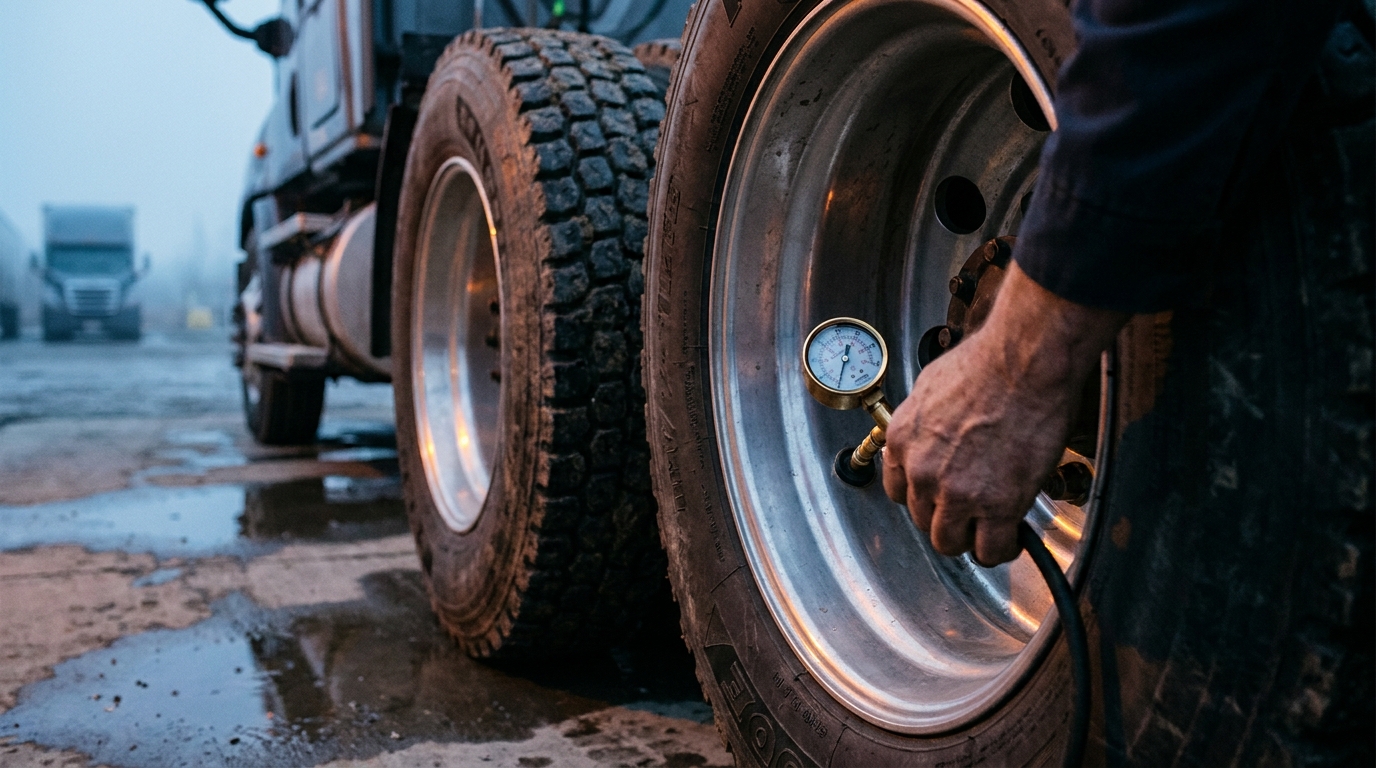
There is no minimum tire pressure anywhere in the federal rulebook. Section 393.75 of the Federal Motor Carrier Safety Regulations is the tire rule, and an inspector can write you up under it for a dozen things. A soft tire is not one of them. You can roll across a scale twenty pounds under where that tire should be, pass the inspection clean, and still be burning the casing from the inside.
That gap is worth understanding, because most operators run their tires on a number somebody told them once, and nobody ever told them where the number was supposed to come from.
What 393.75 actually says
The rule bans specific, visible conditions. Under paragraph (a), no vehicle may be operated on a tire that has body ply or belt material exposed through the tread or sidewall, has any tread or sidewall separation, is flat or has an audible leak, or has a cut deep enough to expose ply or belt material.
Tread depth is paragraph (b) and (c): 4/32 of an inch in a major groove on the front wheels of a bus, truck or truck tractor, and 2/32 of an inch everywhere else. Paragraph (d) keeps regrooved, recapped and retreaded tires off the front wheels of a bus. Paragraph (e) keeps a regrooved tire rated at 2,232 kg (4,920 pounds) or more off the front wheels of a truck or truck tractor.
The only pressure language in the whole section is a ceiling: you may not operate loaded beyond the weight marked on the sidewall, unless you are running under a state special permit at reduced speed, capped at 50 mph.
Read that list again. Flat is illegal. Audible leak is illegal. Overloaded past the sidewall is illegal. Underinflated is not mentioned. The regulation tells you what will get you a violation. It does not tell you what the tire needs.
The number the rule will not give you
The correct cold pressure is a function of the load that tire is actually carrying, and it comes off the manufacturer's load-and-inflation table. Michelin lays the method out in four steps: know the actual load, know the tire size and configuration, go to the table, then adjust for the application and operating conditions.
Notice what step one requires. You cannot set pressure correctly without knowing what your axles actually weigh, and that means a scale, not a guess. A tractor pulling a loaded reefer and the same tractor bobtailing home are two different inflation problems, and the steer axle barely changes while the drives change a lot.
The practical version for most owner-operators: weigh the truck loaded the way you normally run it, take the per-axle numbers, divide by the number of tires on that axle, and read the table. If you have never seen your real axle weights, that is the first job, not the second.
The sidewall number is a ceiling, not a target
Michelin states it plainly: the maximum pressure marked on a tire should not automatically be treated as the appropriate operating pressure for every application. That stamped number is the most the tire is built to hold at its rated load. It is not a recommendation, and airing every position to it is a decision, not a default.
Overinflated tires ride on the center of the tread, wear a strip down the middle, and give up grip and ride quality. Underinflated tires flex at the shoulders, build heat in the sidewall, wear the outer ribs, and cost fuel through rolling resistance. Both look fine from ten feet away.
Cold means cold, and that is stricter than it sounds
Every load-and-inflation table in the industry is written for cold pressure. The U.S. Tire Manufacturers Association defines that as a tire that has been parked at least three hours and has not been driven more than a mile. Anything else reads high.
Ambient temperature moves it too: pressure rises or falls roughly one to two pounds for every 10 degrees Fahrenheit of change. A truck set to spec on a 95-degree Texas afternoon and driven into a 45-degree morning has quietly lost pressure in every position, and nobody touched a valve.
This is where the classic mistake happens. A driver checks warm tires at a truck stop, sees a number above spec, and bleeds air out to "correct" it. The next cold morning that tire is genuinely low. Never bleed a hot tire down to a cold-pressure number.
The check that finds it
- Use a calibrated gauge on every position, including both inner duals. A visual inspection cannot tell you pressure; a radial can be 20 percent down and still look round.
- Check cold — first thing, before the wheels turn, or after three hours parked.
- Write the target on the truck. Steer, drive and trailer usually take different numbers. A sticker in the cab beats memory.
- Match the duals to each other. A 5 psi split between mates makes the higher tire carry the load and the lower one scrub.
- Re-check when the season turns. First real cold front, first real heat wave: reset to the table.
- Treat a repeat low as a leak, not a habit. A valve core, a slow bead leak or a cracked stem does not fix itself.
Your scale ticket is the input the whole table depends on, which is why the two jobs belong to the same morning.
A tire almost never fails without warning. It fails after weeks of running soft, hot and unmeasured, and the only thing standing between you and that bill is a gauge that costs less than one hour of downtime. The irons never lie, but you have to read them. If you want the steer, drive and trailer positions measured and set against your real axle weights, The Truck Savers can put the truck on the rack and do it.
Original source: Michelin — Commercial Truck Tire Pressure.