Your Tow Rating Is a Subtraction, Not a Number
The door sticker carries payload, not tow rating. What you can pull is GCWR minus what your loaded truck already weighs today.
Somebody is about to buy a trailer this week based on a number they half remember from a commercial. That number is almost never the number that applies to their truck.
Tow rating is not a fact you look up once. It is a subtraction you do with your own truck, loaded the way you actually drive it.
The door sticker does not carry it
The label on the driver's door jamb is the Tire and Loading Information placard, and it answers a different question: how much weight you can put in the truck. Occupants and cargo, added together, up to the figure printed there.
What it does not tell you is how much you can pull behind you. That number is not on the door, and looking for it there is how people end up guessing.
Where the number actually lives
Two ratings decide it, and both come from the manufacturer:
GCWR, gross combination weight rating: the most the truck and the trailer are allowed to weigh together, fully loaded, at the same time.
The tow rating table for your exact configuration. Not for the model — for your engine, axle ratio, cab, bed length and whether it is two- or four-wheel drive. Two trucks that look identical in a parking lot can be thousands of pounds apart because of the axle in them.
Both live in the owner's manual and in the manufacturer's towing guide for that model year. Neither is on the door.
The subtraction nobody does
Here is the part that changes the answer: GCWR is not what you can tow. It is what the whole combination can weigh.
So the real math is GCWR minus what your truck already weighs, right now, the way it sits. And "right now" includes the things people leave out: a full tank, the toolbox, the tie-downs, the generator in the bed, the two passengers, the dog.
Every pound of that comes off the trailer side of the equation. A truck rated to pull a lot empty pulls considerably less once it is a working truck.
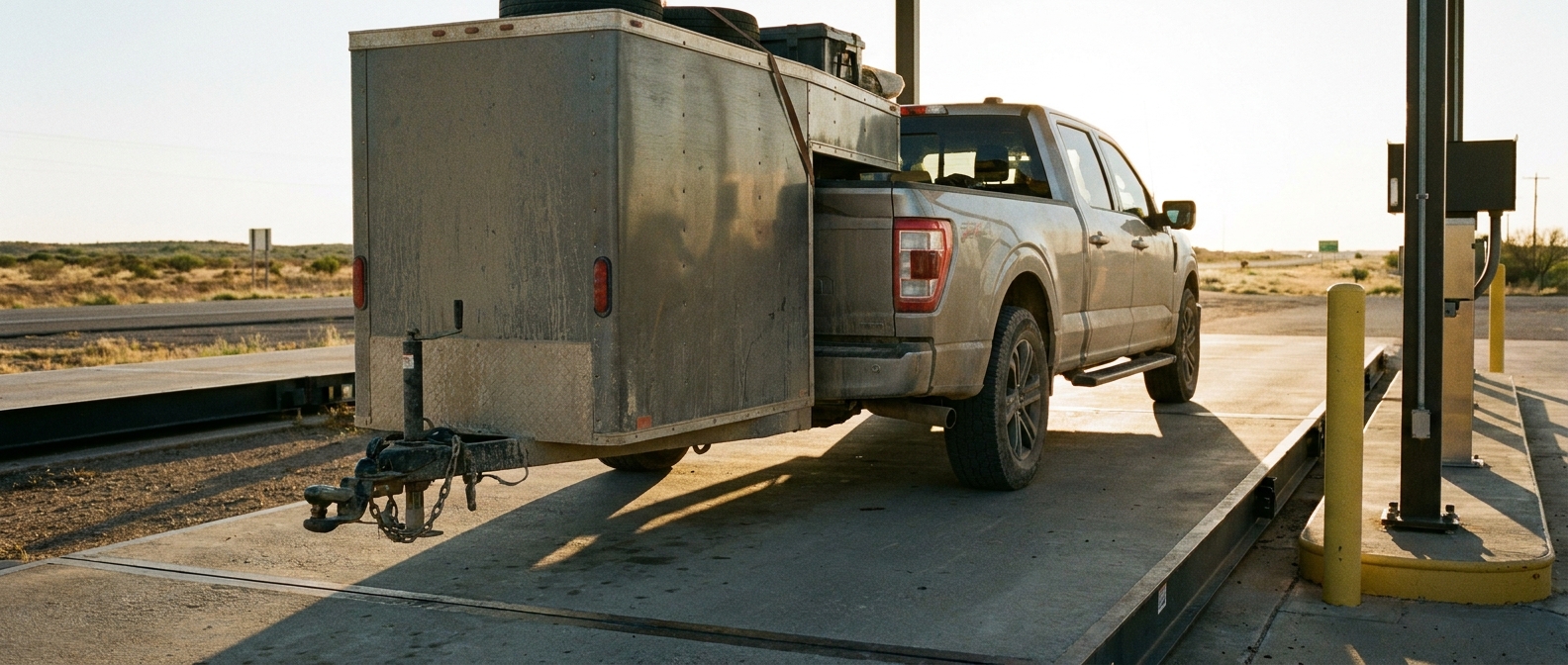
You do not have to estimate it. Drive onto a certified scale loaded the way you leave the yard, get the weight, and subtract. It costs a few dollars and it replaces a guess with a fact you can use for years.
Why the published numbers can be compared now
There is one piece of good news, and it is newer than most drivers realize.
Tow ratings used to be marketing. Each manufacturer tested its own way, so a number from one brand and a number from another were not measured against the same thing.
SAE J2807 fixed that. It sets minimum performance requirements — acceleration, braking, handling, parking brake and launching on a grade — that a truck has to meet before a tow rating can be published. SAE released it in 2008 as a voluntary standard, and it took until 2014 for every manufacturer to agree to apply it, starting with the 2015 model year.
So for anything 2015 or newer, the ratings are measured the same way and are worth comparing. For older trucks, they are not.
The weight that comes off your payload
One more thing that catches people, and it connects the two labels.
The trailer does not only pull on the hitch. It presses down on it. That downward weight lands on your truck, and it counts against the payload figure on the door sticker — the same figure that already has your passengers and your gear in it.
That is how a combination can be under its tow rating and still be over the truck's own limits. The trailer was legal. The truck was not.
Before you hitch anything
Get three numbers written down and keep them in the glovebox: your GCWR, your truck's actual loaded weight from a scale, and your payload figure from the door.
With those three, every trailer question after that is arithmetic instead of hope.
And if the truck already pulls a trailer and it wanders, sways or eats tires on one edge, that is not a rating problem — that is suspension, alignment or a worn component talking. We do that work in Houston, Dallas and Monterrey: thetrucksavers.com.