Your Rear Guard Has Four Numbers. One Moves
Width, height, setback and profile are in the rule. Three never change; the height moves on its own, and that one fails.
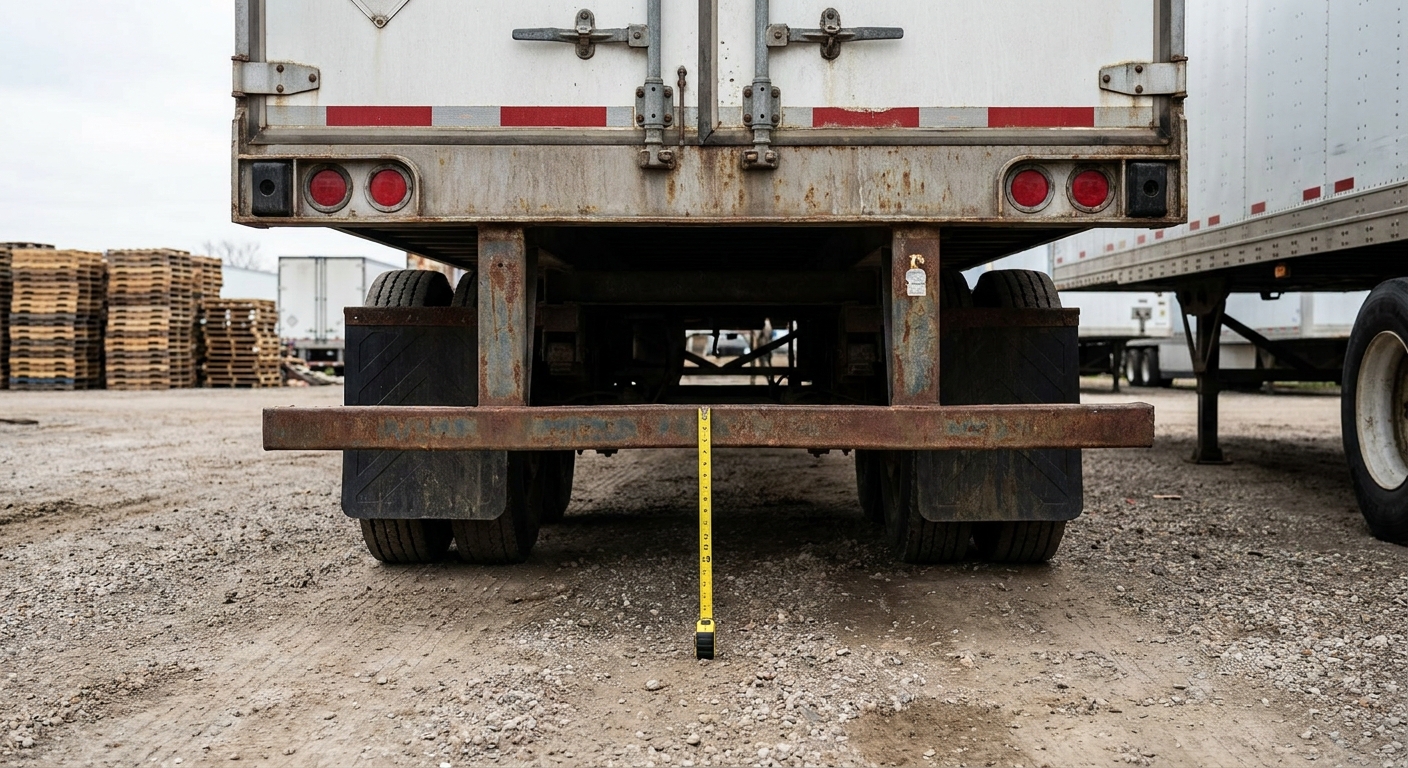
Your rear impact guard has to meet four measurements, and most drivers can name one.
They are all in 49 CFR 393.86, and an inspector can check every one of them with a tape measure in about ninety seconds.
The four numbers
- Width — within 4 inches. The outer surface of the horizontal member has to reach within 100 mm of the side extremity of the trailer. It also may not stick out past that edge.
- Height — 22 inches, maximum. The bottom edge of the horizontal member cannot sit more than 560 mm off the ground at any point across the full width.
- Setback — within 12 inches. At 22 inches of height or more, the rear face of the guard has to be within 305 mm of the rear extremity of the vehicle.
- Profile — at least 3.94 inches tall. The horizontal member needs a cross-sectional vertical height of 100 mm or more, across the whole guard.
Which one fails first, and why
Three of those four are set the day the guard is installed. Width, setback and profile do not change on their own.
The height does.
Twenty-two inches is measured from the ground, not from the frame. So the guard can be perfectly installed and still fall out of spec because the trailer is riding lower than it used to. Tired springs, air bags that no longer lift the way they did, a leveling valve out of adjustment — the guard never moved, and the number stopped being legal.
That is the one worth measuring yourself, because it is the one that changes while you are not watching.
Why the rule cares about the gap
Every one of those four numbers is describing the same thing from a different angle: how much open space is left under and around the back of the trailer.
The width number closes the sides. The setback number keeps the guard from sitting far forward of the bumper line. The profile number makes sure the member itself is tall enough to catch something instead of slicing past it. And the height number closes the gap underneath.
That is why they get measured together and why fixing one can quietly break another. Raise a guard to correct the height and you may push the rear face out of the 12-inch window.
Who has to have one
Trailers and semitrailers rated at 10,000 pounds GVWR or more, manufactured on or after January 26, 1998. Those have to carry a guard meeting Federal Motor Vehicle Safety Standard 223, and the vehicle has to meet FMVSS 224.
For older equipment the rule works differently, and it is worth knowing if you run anything with age on it. On motor vehicles built after December 31, 1952, the requirement kicks in when the rear bottom edge sits more than 30 inches off the ground with the vehicle empty.
Note the word empty. That measurement is not taken loaded.
What is carved out
The section lists its exceptions plainly: pole trailers, pulpwood trailers, low chassis vehicles, special purpose vehicles, wheels back vehicles, road construction controlled horizontal discharge trailers, and trailers moved in driveaway-towaway operations.
If your equipment is not on that list, the four numbers apply to it.
How to check yours before someone else does
- Measure the height at both corners, not in the middle. The rule says at any point across the full width, and a guard that sags or a trailer that leans will fail at one end while the center still measures fine.
- Measure it on level ground, unloaded. A sloped yard will hand you a number you cannot use.
- Write the number down with the date. If it was 20 inches last year and it is 22 today, that is not the guard. That is the suspension telling you something.
- Check the ends for damage. A dock hit that bends one side changes the width and the setback at the same time, and both are separate violations.
What this rule does not tell you
It does not set a penalty, so we are not quoting one. It also does not tell you how to repair or reinforce a guard — that lives in the FMVSS standards it points to, and we have not read those, so we are not going to tell you what is acceptable to weld on.
What we can tell you is that if your 22-inch number keeps creeping up, the guard is the symptom.
We do suspension, springs and air systems in Houston, Dallas and Monterrey: thetrucksavers.com.
Original source: 49 CFR 393.86, rear impact guards and rear end protection (eCFR)