Your Payload Is on the Door Sticker, People Included
The door sticker counts people AND cargo, not just the bed. Where it sits, and the tire rule that eats your payload.
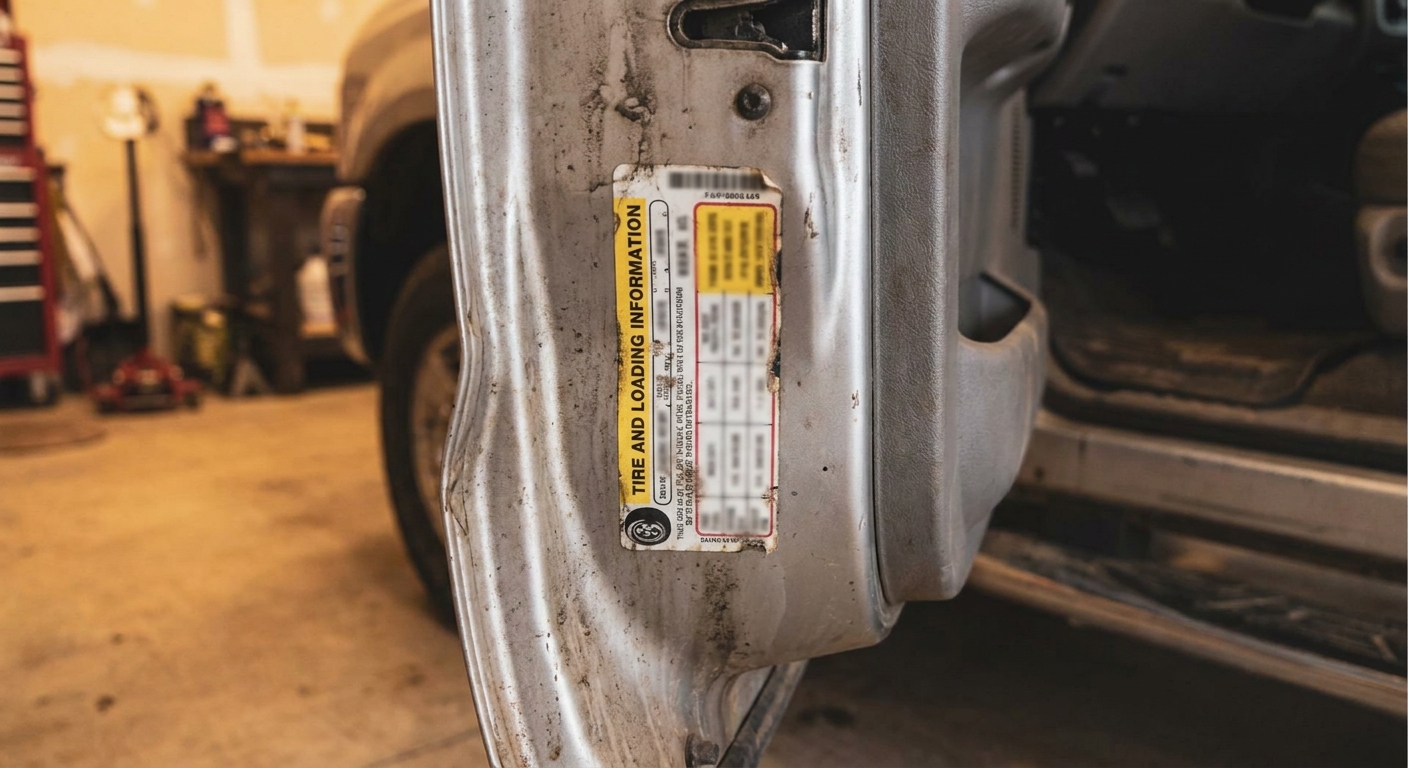
The number on that yellow sticker is not what your truck can haul in the bed. It is what your truck can carry with you and everybody else already sitting in it.
Federal Motor Vehicle Safety Standard 110 tells the manufacturer exactly what to print, and it does not leave the wording up to them.
What the rule makes them say
The placard has to carry the vehicle capacity weight in one specific sentence: the combined weight of occupants and cargo should never exceed so many kilograms or so many pounds.
Read that again. Occupants and cargo. Four passengers at 200 pounds each is 800 pounds that came out of your number before you loaded the first tool.
The same placard has to show the designated seated capacity, broken out by front and rear seats. The manufacturer is telling you how many bodies it planned for, right next to the weight those bodies eat.
Where it has to be
The rule is specific about the location, in order:
- Permanently affixed to the driver's side B-pillar.
- If the vehicle has no driver's side B-pillar and has two doors on that side that open in opposite directions, on the forward edge of the rear side door.
- If neither spot allows a placard that is legible, visible and prominent, on the rear edge of the driver's side door.
- If that still does not work, on the inward-facing surface next to the driver's seating position.
It has to be in English, and it has to match the color and format of the figure in the standard. That is why every one of them looks the same.
The other numbers on it
The placard also carries the manufacturer's recommended cold inflation pressure for front, rear and spare, and the original tire size for the tires that were on it when it was first sold.
Cold is the word people skip. That pressure is the one you check before the truck has been rolling, not after a hundred miles when the air in the tire has expanded and is telling you a number you did not earn.
The tire trap that costs axles
Two rules underneath the placard are worth knowing before you buy replacement tires.
First: the sum of the maximum load ratings of the tires on an axle cannot be less than that axle's rating on the certification label. If you put lighter tires on, the axle is legally over-tired even if the truck feels fine.
Second, and this is the one that catches people buying cheap: when a passenger car tire is installed on a truck or a multipurpose vehicle, its load rating is divided by 1.10 before it counts. A P-metric tire loses roughly nine percent of its rating the moment it goes on a truck. Buy by the number on the sidewall and you can end up short without knowing it.
The motor home footnote
If you run a motor home, the standard settles two arguments. Full propane tanks count as part of the unloaded vehicle weight. On-board potable water is treated as cargo, which means a full fresh-water tank comes straight out of the number on the placard.
Water is a little over eight pounds a gallon. A hundred-gallon tank is most of a small truck's payload, sitting there before you pack a single thing.
How to use it in five minutes
- Open the driver's door and read the pounds figure on the placard.
- Subtract the real weight of every person who rides with you, not the number you wish they weighed.
- Subtract anything bolted on after the truck left the factory: headache rack, toolbox, fifth wheel, tank, bumper.
- What is left is your actual payload. That is the number to load against.
- Check the cold pressures on the same sticker while the door is open. It costs nothing.
One thing this sticker does not tell you
It is not your towing capacity. Pulling a trailer brings in a different rating, and reading the placard as a tow number is how people end up over on paper and over in the mirror.
If your truck sags, wanders or eats the front tires, the load is usually only half of it: springs, shocks and alignment carry the other half. We check all of it in Houston, Dallas and Monterrey: thetrucksavers.com.
Original source: 49 CFR 571.110, FMVSS 110