Your DEF Has an Expiration Date
Your DEF has an expiration date, and heat runs it. Stored above 86 F, shelf life drops from over two years to under six months, and the expired fluid looks exactly the same.
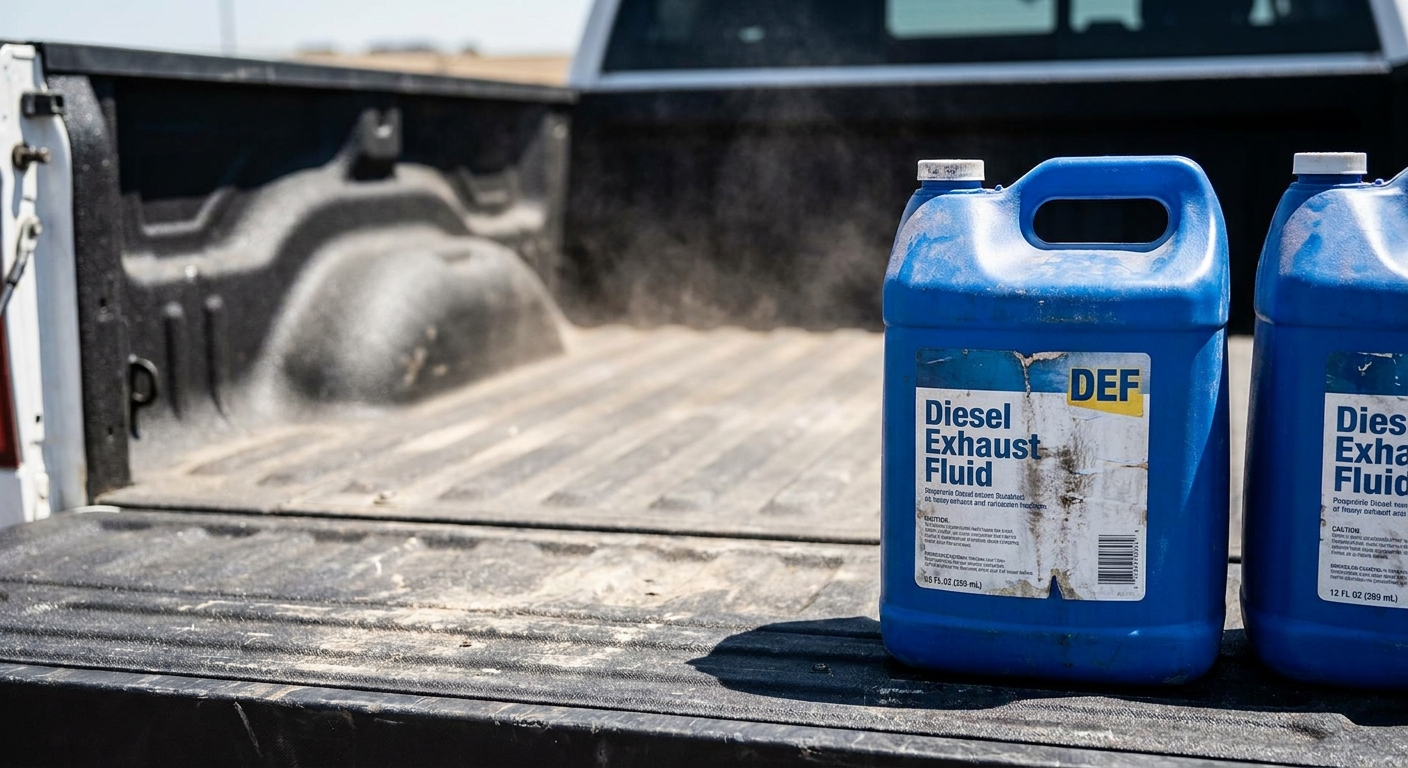
If you run a three-quarter-ton or one-ton diesel pickup — a Ram 2500, a Super Duty, a Silverado or Sierra HD — that jug of DEF riding in your bed since last winter is probably no good anymore, and there is no way to tell by looking at it: expired fluid looks exactly like fresh fluid, clear as water. The catalyst is what pays the difference.
DEF expires, and heat runs the clock
ISO 22241 puts the ideal storage range between 12 and 86 degrees Fahrenheit. Inside that range, shelf life depends on how cool you keep it:
- Between 10 and 90 °F: at least one year.
- Held under 75 °F: two years.
- Held under 60 °F: three years.
And the real problem sits on the other end of the thermometer: stored sustained above 86 °F, the urea starts breaking down into ammonia and biuret, and shelf life collapses from over two years to under six months.
Why this hits a pickup harder in Texas
Think about where your DEF lives in July. A pickup bed in the sun clears 86 °F without trying, and stays there all day, every day. A jug bought in spring and forgotten in back does not reach fall in usable shape, even if it was never opened.
Same goes for the jug sitting in the yard or in a corner of the shop with no shade. It does not evaporate and it does not turn cloudy: the chemistry changes and nothing shows.
What it does to the truck
The ammonia and biuret that show up as it degrades damage the SCR catalyst, which is the expensive part of the system. The quality sensor can throw a fault, the truck can go into derate and lose power, and the diagnosis heads toward the system when the problem was in the jug.
Which is why it is worth treating as what it is: a consumable with a date, not a liquid that takes whatever you give it.
How to store it right
- Shade and sealed. Closed container, out of direct sun. A truck bed in full sun is the worst possible spot.
- Buy what you will use. If you go through it slowly, one jug at a time beats a stack in the yard.
- Look for the date on the container. It carries a production date; if it has spent a full summer in the heat, be suspicious.
- Freezing does not ruin it. DEF freezes around 12 °F and works fine once thawed. What is worth avoiding is repeated freeze-thaw cycling.
- No random funnels or old jugs. Contamination is the other way to ruin it, and that one is instant.
The preventive close
DEF is among the cheapest things you put in the truck and among the most expensive when it fails, because what gets ruined is not the fluid: it is the catalyst. Keeping it in the shade costs nothing and is the difference between two years and six months. Iron never lies, but expired DEF does not warn you either.
If your truck is already throwing a fluid quality fault or went into derate, The Truck Savers checks it in Houston, Dallas and Monterrey.
Original source: American Petroleum Institute — Storage and Handling of Diesel Exhaust Fluid (DEF)