Your Cargo Gets Rechecked at 50 Miles, Then Every 150
The 50 miles happen once. The 150 repeat, and so do three hours and any duty status change, whichever comes first.
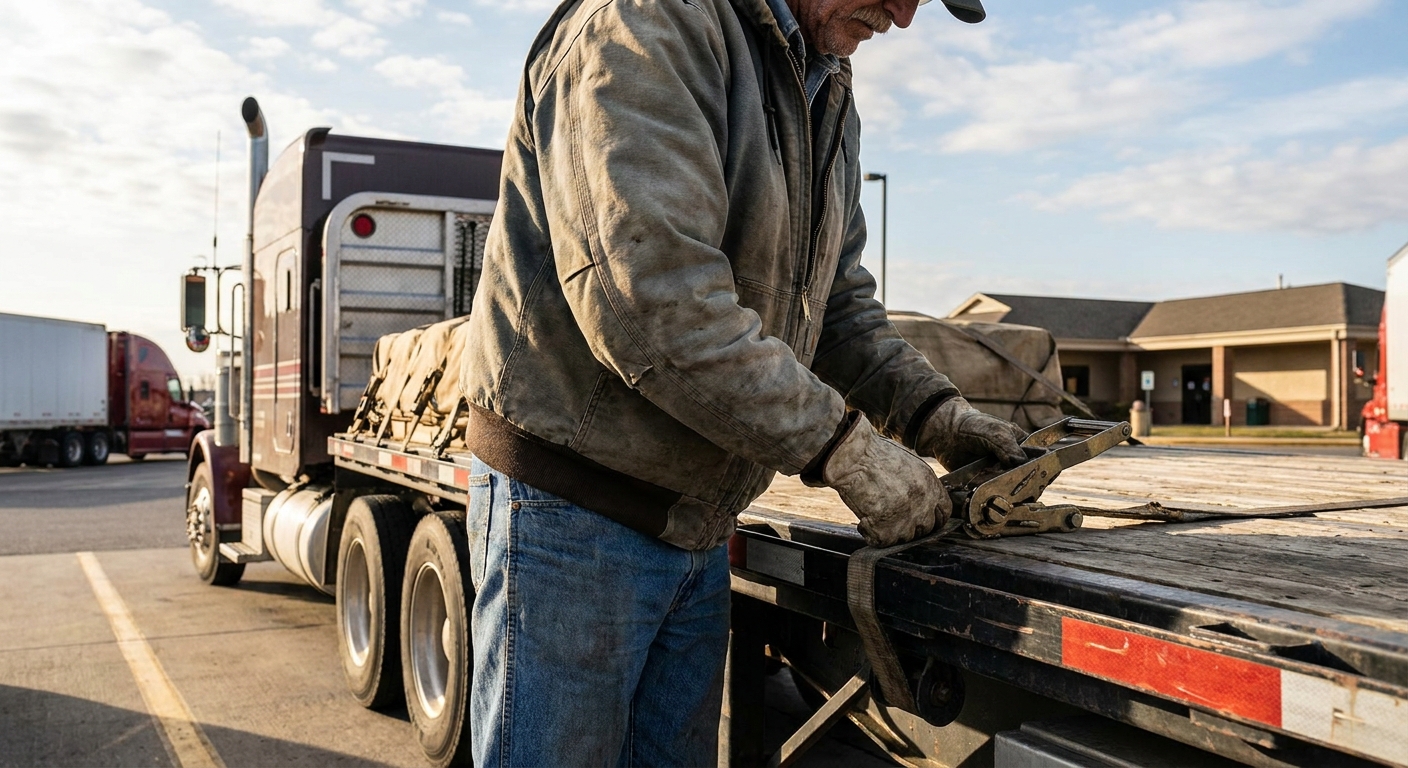
The rule does not say check the load before you leave. It says check it before you leave, again inside the first 50 miles, and then on a clock that never stops.
Section 392.9 is the one that puts the load on the driver, and most of the argument about it comes from people who only know the first half.
The three conditions before the truck moves
A driver may not operate, and a carrier may not require or permit operating, unless:
- The cargo is properly distributed and adequately secured under the securement rules in Part 393.
- The tailgate, tailboard, doors, tarps, spare tire and the fastening means themselves are secured.
- The cargo does not obscure the view ahead or to either side, does not interfere with the free movement of arms or legs, does not block access to emergency accessories, and does not block anyone's exit from the cab.
That third one gets skipped in conversation and it is the broadest of the three. It is not about the load being legal — it is about the load not turning the cab into a place you cannot see out of or get out of.
The 50 and the 150, which are different things
Here is the part people mix up.
The 50 miles is a one-time event. Within the first 50 miles after beginning a trip, the driver inspects the cargo and the securement devices and makes any adjustment needed — including adding more devices. That is written into the rule: adding, not just tightening.
The 150 miles is a repeating cycle, and it is not alone. The reexamination has to happen whenever the first of these three occurs:
- the driver changes duty status;
- the vehicle has been driven 3 hours;
- the vehicle has been driven 150 miles.
Whichever comes first. On a slow urban run, three hours will arrive long before 150 miles. On an open highway, the miles win. And a duty status change can trigger it at any point — which means a stop that had nothing to do with the load still restarts the obligation.
Why the first 50 exists at all
Because that is when a load settles. Straps stretch, chains find their seat, plastic wrap relaxes, and a stack that was tight in the yard is not tight after the first few dozen miles of real road input. The rule is not asking whether you secured it right. It is assuming the load will move a little regardless, and putting a check right where that movement happens.
The exception, and how narrow it is
The reinspection rules do not apply in two cases: the driver of a sealed vehicle who has been ordered not to open it to inspect the cargo, and a vehicle loaded in a manner that makes inspecting the cargo impracticable.
Read that carefully, because it is narrower than it sounds. A sealed trailer is not automatically exempt — the exemption is for a driver who has been ordered not to open it. And "impracticable" describes how the vehicle was loaded, not how inconvenient the stop would be.
Who the rule holds responsible, and it is not only the driver
The opening sentence names two parties: a driver may not operate, and a motor carrier may not require or permit a driver to operate. That second half matters for anybody running under someone else's authority, because it means a dispatch instruction cannot make a load compliant that is not.
It also means the check is not a favor the driver does for the office. It is a duty the regulation assigns to the person behind the wheel, and no schedule pressure moves it to somebody else.
What to do with this
- Treat the first 50 as part of the trip, not as an interruption. Plan where you will stop before you leave, not when the reminder hits.
- Know which of the three triggers fires first on your run. On short local work it is almost always the clock, not the odometer.
- Carry more securement than the load needs. The rule anticipates adding devices on the road; you cannot add what is not on the truck.
- Do not lean on the sealed exception unless you were actually told not to open it.
While you are stopped looking at straps, the same walk covers tires and the front end. If something feels off, the free multi-point inspection is no appointment: The Truck Savers.
Original source
eCFR — 49 CFR 392.9, Inspection of cargo, cargo securement devices and systems