Your Air Tanks Must Hold 70 Percent With the Engine Off
The gauge must not fall below 70 percent with the engine off. Rule 393.50 also wants a drain valve you can work by hand.
There is a number in the federal rules that a driver can check alone, in a yard, in about two minutes, with no tools at all. Almost nobody checks it. The number is seventy percent, and it separates a brake system that actually holds reserve air from one that only feels like it does.
The section is 49 CFR 393.50, and its title is as plain as it gets: Reservoirs required. It is short, it is old, and before it tells you anything it splits trucks into two groups.
Two groups, decided by the build date
Paragraph (a) covers air-braked power units manufactured on or after March 1, 1975, and air-braked trailers manufactured on or after January 1, 1975. Buses, trucks and truck-tractors in that group must meet the reservoir requirements of FMVSS No. 121, S5.1.2, as that standard read on the date the vehicle was built.
That last clause carries more weight than it looks. The requirement is frozen to the build date, not to today's edition of the standard. It is the same logic that decides which trailers need antilock brakes: the calendar that matters is the one on the data plate, not the one on the wall.
Paragraph (b) covers everything else. Air-braked vehicles that were not subject to FMVSS No. 121 when they were built, plus every vacuum-braked vehicle. For those, the rule stops describing hardware and starts describing a result you can measure.
The seventy percent test
In plain terms: the vehicle must have either reserve capacity or a reservoir that lets the driver make one full service brake application, with the engine stopped, without the air pressure or vacuum falling below seventy percent of what the gauge indicated immediately before that application.
The rule even defines a full application, because that is where the test gets softened without anyone meaning to. It means depressing the brake pedal or treadle valve to the limit of its travel. Not a tap. Not a normal stop. All the way down.
So the test is three steps. Build the system up and shut the engine off. Read the gauge and hold that number in your head. Push the pedal to the floor and read the gauge again. If the second number is below seventy percent of the first, the vehicle does not meet 393.50, no matter how good the brakes feel on the road.
The value of the test is that it is honest. A leak that a moving truck hides, because the compressor keeps refilling what is escaping, has nowhere to hide once the engine is off.
The clause about check valves nobody quotes
Paragraph (c) requires that each service reservoir system be protected against a loss of air pressure or vacuum caused by a failure or leak between the service reservoir and the source of pressure. Check valves, or equivalent devices, do that job.
But the rule adds a condition that is really a design requirement: those devices must be ones whose proper functioning can be checked without disconnecting any air or vacuum line or fitting. In other words, a check valve you cannot verify without taking the system apart does not satisfy the section, even if it works.
And the part about water
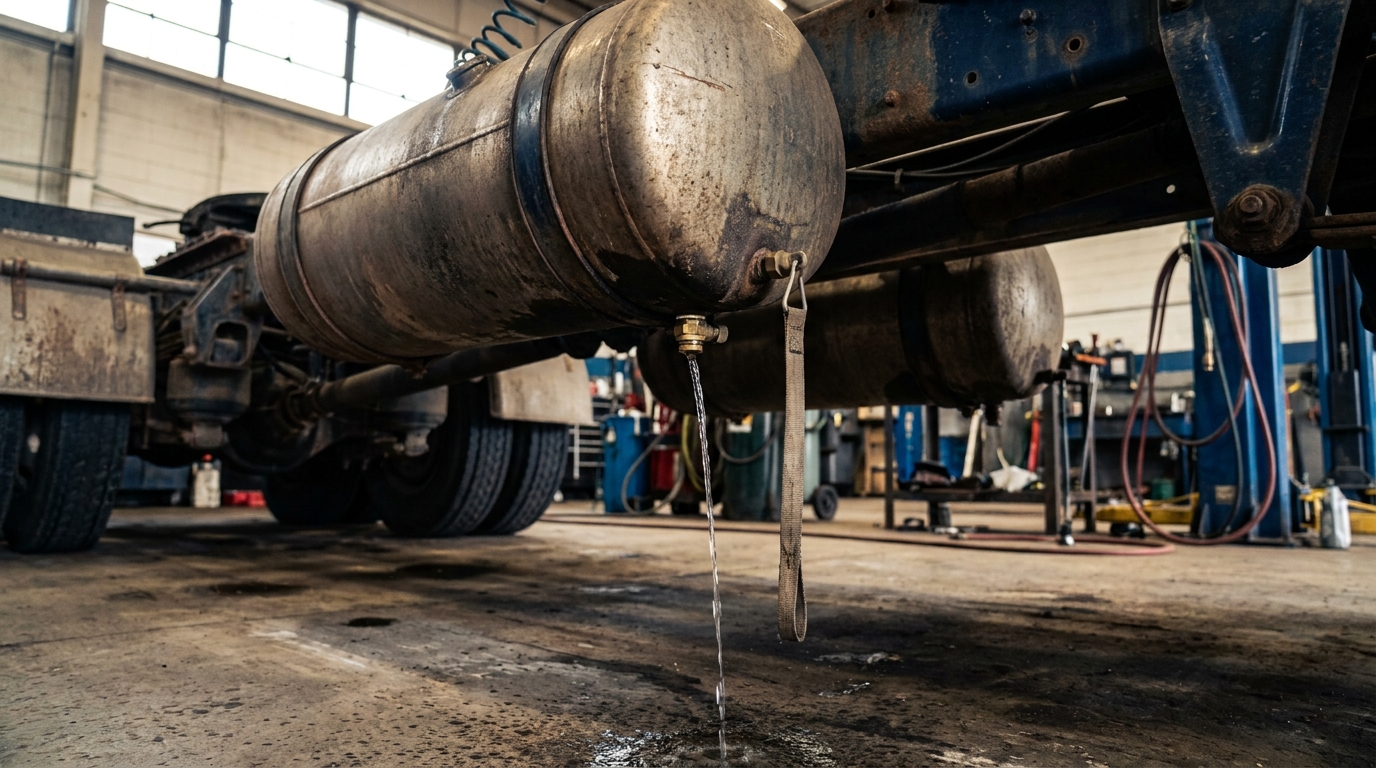
Paragraph (d) is the one most shops meet every week without reading it. Each reservoir must have a condensate drain valve that can be manually operated. Automatic drain valves are allowed, but only if they can also be operated by hand, or if a manual means of draining the reservoirs is retained.
The reason is physics, not paperwork. Compressing air heats it, and the moisture that was in that air condenses as the system cools in the tank. Left alone it collects at the bottom of the reservoir, travels downstream into valves, and in cold weather it freezes where you least want ice.
The rule does not tell you how often to drain. It tells you that the ability to drain by hand has to exist. What you do with that ability is the part the rule leaves to you.
A five-minute routine with a number attached
Pull the lanyard or open the petcock on each tank and watch what comes out. Water, or oily grey emulsion, is information.
Build to cutout, shut the engine off, and run the seventy percent test before you leave the yard.
Confirm you can verify the check valves without breaking a line. If you cannot, that is a finding on its own.
If a tank has an automatic drain, confirm it can still be worked by hand, because the rule treats that as the condition of using one at all.
Note the build date of the unit and the trailer. It decides which half of 393.50 applies to each of them, and they are often not in the same half.
None of this needs a bay, a lift or a scan tool, which is exactly why it tends to get skipped. A shop that knows the sections can go further, and the team at The Truck Savers runs the air system as part of the inspection rather than as a favor at the end of one.