Your 3/4-Ton Has No EPA Number. Here Is Why
The EPA lists the F-150 and the 1500. There is no number for the F-250, the 2500 or the 3500. The cutoff is a weight, not a favor.
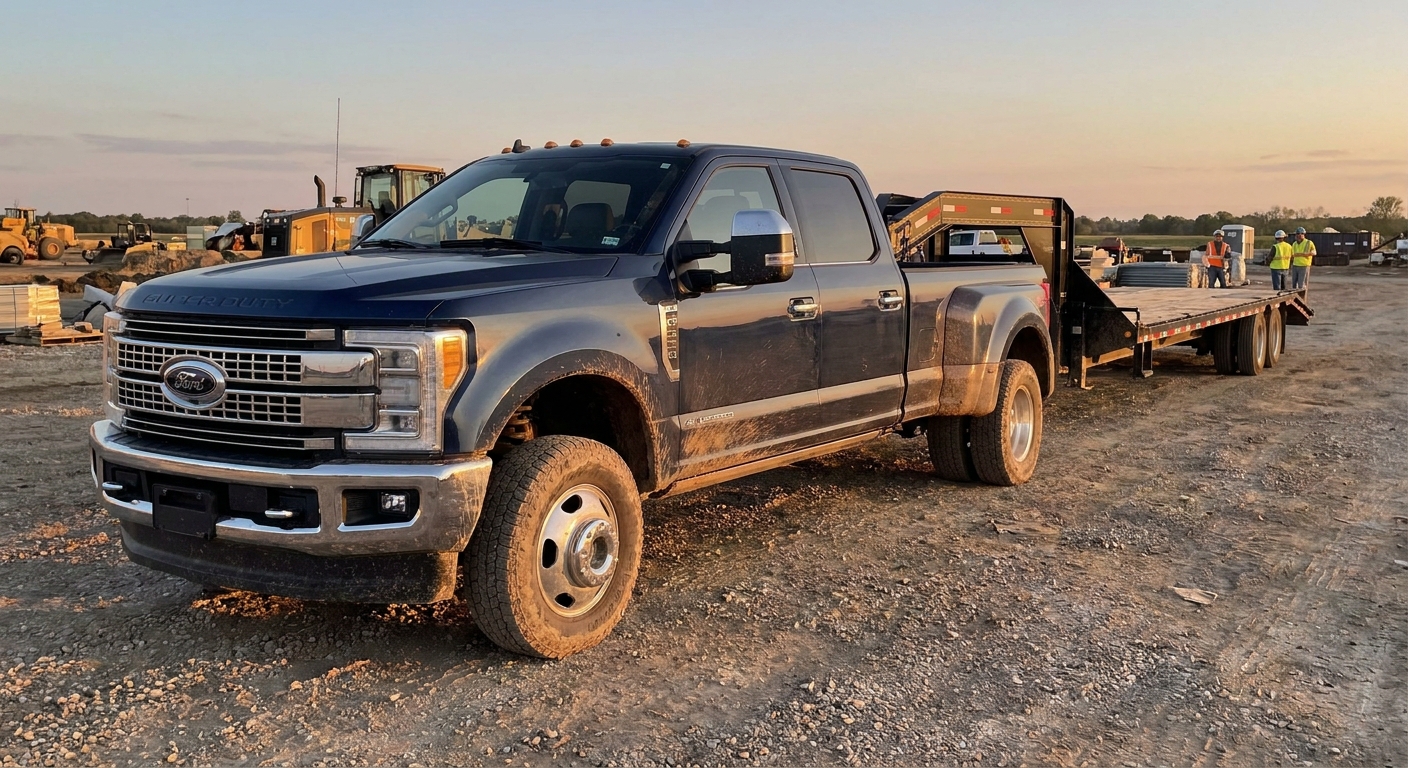
Go look up the fuel economy of a 2026 F-250. You will not find one.
Not a bad one. Not a disappointing one. None at all.
We checked the government's own database on September 6, 2026 — the EPA and Department of Energy list at fueleconomy.gov, the same one that feeds the window sticker. For model year 2026 it carries the F-150 in six versions, the Maverick, the Ranger, the Ram 1500 in five versions, the Silverado, the Colorado, the Sierra and the Canyon.
It does not carry the F-250. Or the F-350. Or the Ram 2500 or 3500. Or the Silverado 2500HD or 3500HD. Or the Sierra HD.
This is not an oversight
The line is drawn by weight, and it is written down.
Under 49 CFR 523.2, a Class 2b vehicle is one rated from 8,501 to 10,000 pounds gross vehicle weight. Class 3 through Class 8 starts at 10,001 pounds. A three-quarter-ton and a one-ton land in that territory; a half-ton does not.
The fuel economy label program covers automobiles, and the definition of what counts leans on 49 CFR 523.5. There is a carve-out for medium-duty passenger vehicles — more than 8,500 and less than 10,000 pounds GVWR — but it applies only to vehicles designed primarily to transport passengers, and explicitly excludes an incomplete truck, meaning one sold without its load-carrying body attached.
A work truck built to haul is not a vehicle designed primarily to transport passengers. So it falls outside, and no sticker is required.
What that actually costs you
Here is the part that matters at the dealership.
When you shop a half-ton, you can compare two trucks on a number that was measured the same way by the same lab under the same rules. When you shop a three-quarter-ton, that number does not exist for either one. What you get instead is a salesman's estimate, a forum post from a guy with a different rear end ratio, and a magazine test towing a different load than yours.
None of those are comparable to each other, because none of them were measured the same way. That is not a small thing: the difference between 12 and 15 miles per gallon, over 25,000 miles a year with diesel at $5, is about $1,730 — every year you own the truck.
So measure it yourself
The truck will tell you, and it takes about a week.
- Fill it completely and write down the odometer. Not close to full — until the pump clicks off, at the same pump if you can.
- Drive the way you actually drive. Loaded like you load it, on your routes. A tank of empty highway is a number you will never repeat in real work.
- Fill it completely again and write down the gallons and the miles. Miles divided by gallons is your real number, and it is worth more than any published figure because it is your truck, your load and your foot.
- Do it three times before you believe it. One tank measures a week's weather and traffic. Three measure the truck.
- Do not trust the dash readout for this. It is a useful trend line, not a measurement. Compare it against your hand math once and you will know how far off yours runs.
The number moves for reasons you control
Once you have your baseline, the same math tells you when something is wrong.
Fuel economy is the cheapest diagnostic instrument on the truck. A drop that shows up over three consecutive tanks, with the same routes and the same loads, is the truck telling you something changed — tire pressure, an alignment pulling the unit sideways, a dragging brake, a load of air the engine is working harder to move.
Operators who track it catch those a month or two before the noise starts. Operators who do not, find out when a part fails.
That is the honest upside of not having an EPA number: nobody hands you a figure, so you end up with a real one.
If your number drops and the truck feels fine, that is exactly when a road simulator inspection is worth the trip — Houston, Dallas and Monterrey: thetrucksavers.com.
Original source: 49 CFR 523.2, vehicle classification definitions (eCFR)