Your 3,000-Pound Trailer Still Probably Needs Brakes
Every wheel needs brakes. The 3,000-pound exception also caps towed axle weight at 40 percent.
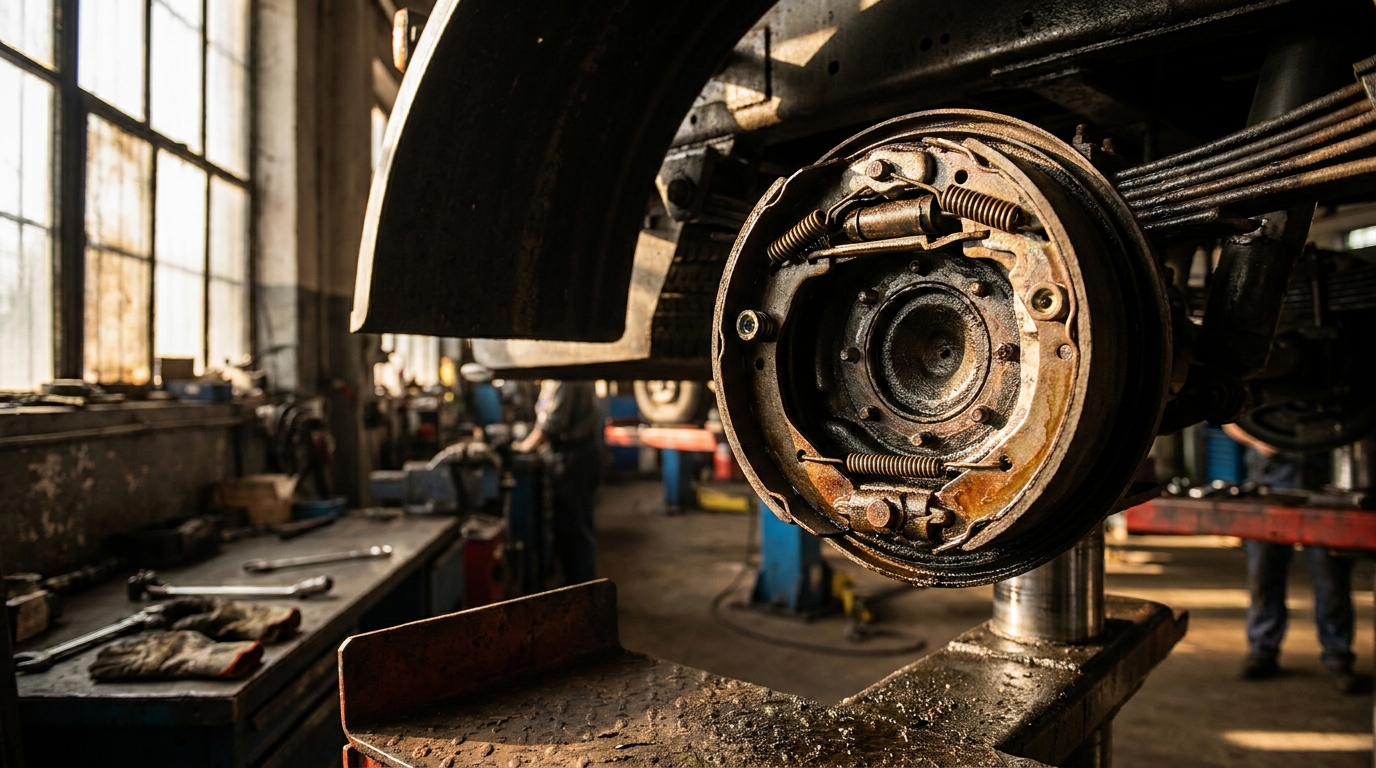
Ask around any yard and somebody will tell you the little trailer does not need brakes. The rule actually agrees with him — but only for a trailer that clears two tests at the same time, and most work trailers clear neither.
49 CFR 393.42 opens without hedging: every commercial motor vehicle must be equipped with brakes acting on all wheels. That is the sentence. Everything else in the section is a narrow list of who gets out of it.
The exception everyone quotes, and the half nobody repeats
There is a small-trailer exception. It has two conditions joined by an "if," and the second one is the one that falls out of the story at the counter.
One, the weight. A semitrailer or pole trailer, laden or unladen, with a gross weight of 1,361 kg — 3,000 pounds — or less.
Two, the 40 percent test. The axle weight of the towed vehicle must not exceed 40 percent of the sum of the axle weights of the towing vehicle.
Both, not either. A 2,900-pound trailer is still inside the weight limit and can fail the second test outright, and when it fails the second test the exception is simply gone.
A full trailer is measured differently, and the difference is real
Read the next paragraph carefully, because it is not a copy of the one before it.
For a semitrailer or pole trailer, the rule looks at "the axle weight of the towed vehicle." For a full trailer or four-wheel pole trailer, it looks at "the sum of the axle weights of the towed vehicle." Same 3,000-pound ceiling, same 40 percent, different quantity going into the comparison.
If your trailer carries its load on two axles of its own, the sum is what counts, and the sum is the bigger number. That is the difference between clearing the test and only feeling like you cleared it.
The other five ways out, and who they belong to
The section lists seven exceptions in total. Five of them have nothing to do with a small utility trailer:
Old three-axle power units. Trucks or truck tractors with three or more axles manufactured before July 25, 1980 are not required to have brakes on the front wheels — but they still have to meet the stopping performance of 393.52.
Driveaway-towaway. Vehicles being towed in a driveaway-towaway operation, including the last truck of a triple saddle-mount combination, are not required to have operative brakes, again provided the combination meets 393.52.
The co-driver dolly. No brakes are required on the steering axle of a three-axle dolly that is steered by a co-driver.
Housemoving and industrial dollies. Loaded housemoving dollies and the specialized trailers used to move industrial furnaces and reactors are exempt only if the combination stays at or under 32 km/h (20 mph) and can stop within 12.2 meters — 40 feet — from that speed, or from 20 mph, whichever is less.
Portable conveyors. Conveyors built before 2010 and used by the aggregate industry get an exemption with three conditions at once: the combination meets 393.52, the towed axle weights stay at or under 40 percent of the towing vehicle's, and the top speed is held to 45 mph on two-lane roads and 55 mph on freeways.
What the list is actually telling you
Look at the shape of it. Every exception either has a hard date on it, a speed cap, a performance requirement it must still satisfy, or a weight ratio that has to be measured. Not one of them says "small trailers are fine."
And notice how many of them still point back at 393.52. Getting out of the brake requirement almost never means getting out of the stopping requirement.
What to do with this before the scale does it for you
The 40 percent test needs two numbers you can actually get: what your trailer weighs on its own axles, and what the towing unit weighs on its axles. Both come off the same scale ticket.
Run it once, write it on the inside of the trailer's toolbox lid, and the argument is over for good. If the trailer is over 3,000 pounds gross, you can stop there — the exception was never available and the brakes are equipment, not an upgrade.
Revisamos suspensión, alineación y llantas en Houston, Dallas y Monterrey: thetrucksavers.com.
Original source: 49 CFR 393.42, Brakes required on all wheels, eCFR