Wet Brake Fluid Boils 117 Degrees Sooner
The standard sets two boiling points, dry and wet. A wet DOT 4 boils sooner than a dry DOT 3.
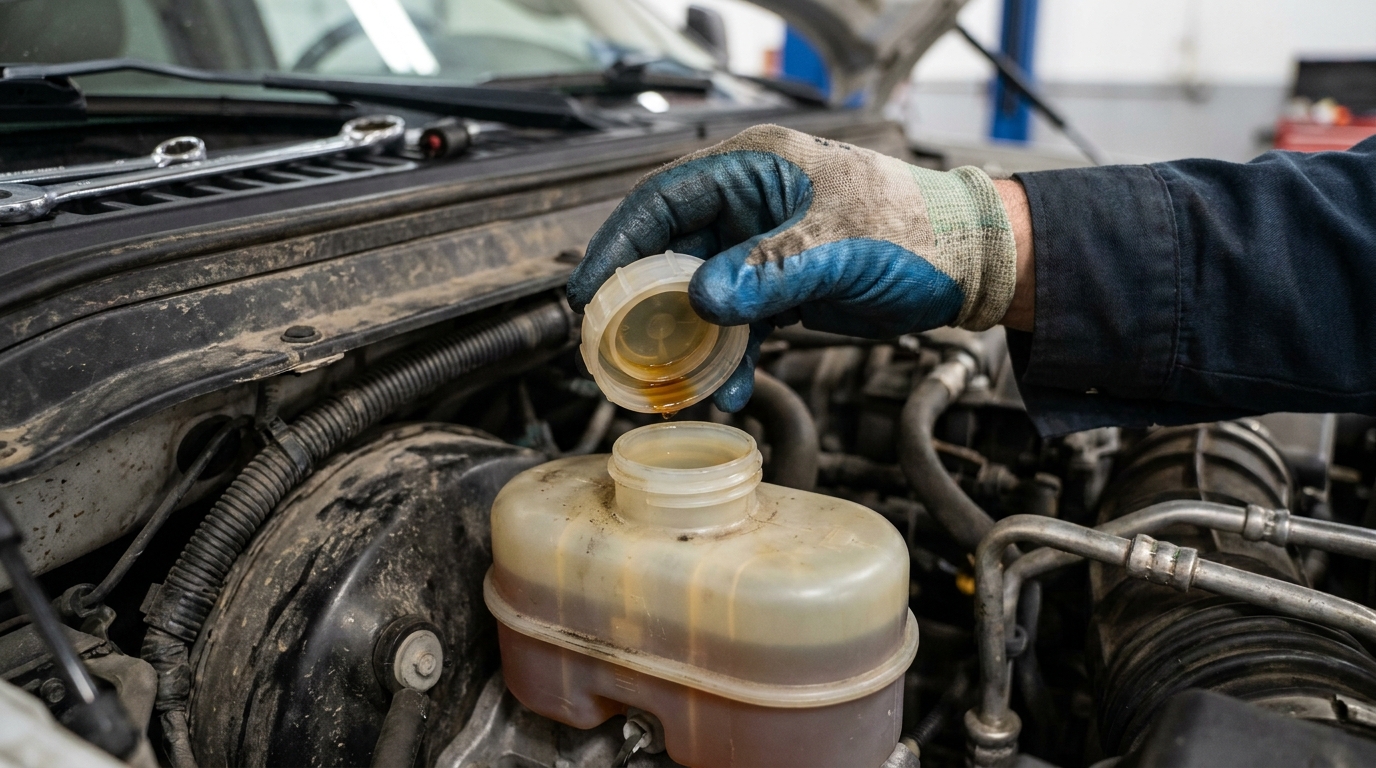
Brake fluid does not wear out. It absorbs water. And the day it matters is the day you are loaded, going downhill, riding the brakes.
Federal Motor Vehicle Safety Standard 116 sets the minimum boiling point for every grade of brake fluid sold in the United States. It sets that number twice, and the second one is the one nobody quotes.
The two numbers in the standard
The first is the dry boiling point, measured on fluid straight out of a sealed container. The standard calls it the equilibrium reflux boiling point:
DOT 3: 205 °C, or 401 °F
DOT 4: 230 °C, or 446 °F
DOT 5: 260 °C, or 500 °F
The second is the wet boiling point, measured after the fluid has taken on water the way it does in a real vehicle:
DOT 3: 140 °C, or 284 °F
DOT 4: 155 °C, or 311 °F
DOT 5: 180 °C, or 356 °F
Subtract them. DOT 3 loses 117 °F. DOT 4 loses 135 °F. DOT 5 loses 144 °F.
The comparison that changes what you buy
Look at those two lists side by side and one line jumps out.
A wet DOT 4 boils at 311 °F. A dry DOT 3 boils at 401 °F.
The higher grade, left in the truck long enough to absorb water, boils ninety degrees sooner than the cheaper grade that was changed. Buying up a grade and never touching it again leaves you worse off than buying the basic grade and replacing it.
That is the whole argument for service intervals in one line, and it comes straight out of the standard.
Why boiling is the failure that scares people
A brake system works because liquid does not compress. Push the pedal, the fluid moves, the caliper clamps.
Boil the fluid and part of that column becomes vapor. Vapor compresses. Now the pedal travels and nothing happens at the wheel, because the pedal is squeezing gas instead of moving liquid.
It does not announce itself. It shows up the one time you needed the brakes most: long grade, heavy trailer, brakes hot from holding speed. The pedal goes soft, and it was fine an hour earlier on flat ground.
What the standard does not say
Being precise about this matters, because most advice you will read online blurs it.
FMVSS 116 sets minimums, not products. A fluid labeled DOT 4 has to clear 230 °C dry and 155 °C wet. Many exceed it, and the standard does not stop them. What it guarantees is a floor.
The standard also says nothing about when to change it. There is no interval in months or miles anywhere in it. That number comes from the vehicle manufacturer, in your owner's manual, and it is different between a half-ton and a three-quarter-ton that tows.
And the grades are not interchangeable by preference. Use what the manufacturer specifies for that system. The standard defines what each grade must do; it does not decide which one belongs in your truck.
What a truck that tows changes
Everything above applies to any vehicle. Two things make a three-quarter-ton different.
Heat lives longer. More weight behind you means the brakes spend more time converting motion into heat, and less time cooling. The fluid closest to the caliper sees the worst of it.
The margin is thinner. A light vehicle that boils its fluid usually does it once, on a mountain, on vacation. A work truck that tows does the same duty cycle every week, and moisture builds with time, not with use. Fluid that sat in the truck through two humid summers is wet whether you drove it or not.
What to do about it
Three things, in order:
Check the manual for the interval and the grade. Not a forum, not the parts counter. Your manual.
Look at the fluid in the reservoir. Fresh fluid is close to clear or light amber. Dark, cloudy or coffee-colored fluid has been in there a while. It is not proof of water content, but it is a reason to ask.
Keep the container closed. Fluid absorbs water from the air, including out of an open bottle on a shelf. A jug that has been open in the shop since last year is not the fresh fluid you think you are pouring in.
If the pedal has ever gone long on a grade and come back afterward, that is worth a conversation with your mechanic, not a wait-and-see.
We do brake service on pickups and heavy trucks in Houston, Dallas and Monterrey: thetrucksavers.com.
Original source: 49 CFR 571.116, FMVSS 116 — Motor vehicle brake fluids