Welding the Frame Is Only Legal the Builder's Way
The frame rule also bans holes in the rail flanges. The only exception is the chassis builder.
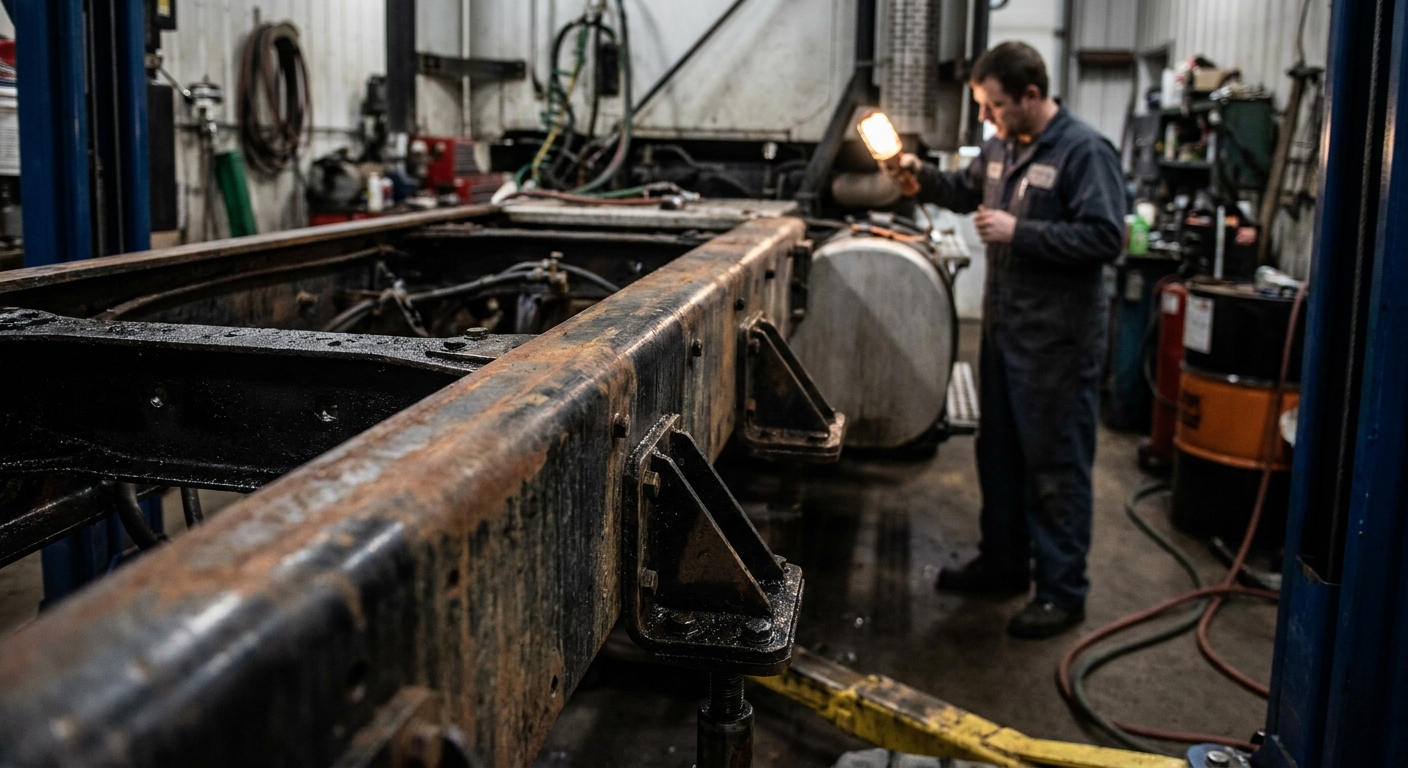
You can weld to a truck frame. You just cannot decide how. The federal rule hands that decision to the company that built the chassis, and it does the same with every hole you drill.
Section 393.201 is five short paragraphs about the frame, and two of them are the ones that surprise owners.
What the section actually requires
- The frame or chassis must not be cracked, loose, sagging or broken.
- The bolts or brackets holding the cab or the body to the frame must not be loose, broken or missing.
- The frame rail flanges between the axles must not be bent, cut or notched, except as specified by the manufacturer.
- Nothing may be welded to the frame except in accordance with the manufacturer's recommendations — and that includes any welded repair of the frame itself.
- No holes may be drilled in the top or bottom rail flanges, except as specified by the manufacturer.
The two that catch working trucks
Almost every truck that earns a living gets something added to it: a headache rack, a toolbox, a tank strap, an auxiliary power unit, a bracket for a hose reel. The mounting has to go somewhere, and the frame rail is right there, flat and convenient.
That is where the rule bites. It does not care what you are mounting or how well you did it. Drilling into the top or bottom flange is out unless the builder specified it, and welding a bracket on is out unless the builder's recommendation covers it.
Why the flange and not the web
This is the part worth understanding, because it explains why the rule looks arbitrary and is not.
A frame rail is a C-shape: a tall vertical face called the web, with a horizontal flange at the top and another at the bottom. When the truck flexes over a dip or takes the weight of a load, most of the tension and compression runs through the flanges. The web mostly resists twisting.
So a hole in the web removes material from the part that is doing less. A hole in the flange removes material from the part carrying the load, and it does it at exactly the place where a stress riser starts a fracture. Same drill, same bit, completely different consequence — and the regulation is written around that difference rather than around the tool.
What "cracked, loose, sagging or broken" is telling you
Note the second word in that list. Loose is in there next to broken, which means the rule treats a frame that has begun to move at its fasteners as the same category of problem as one that has already failed.
That ordering is not decorative. A frame rarely goes from sound to broken in one event. It loosens, it works, it wears the holes, it starts flexing where it used to be rigid, and the crack shows up at the end of that sequence — usually at a bracket, a hole or an old weld. By the time anybody sees the crack, the chain of events that produced it has been running for a long time.
A reader of ours put it better than any regulation does this week: leave it like that and the chassis breaks — and he said it because it happened to him.
The repair trap
Here is the sequence that turns one problem into two. A rail cracks. Somebody welds it. The weld is not the manufacturer's procedure, so now the frame has both a repaired crack and a non-compliant repair, and heat-affected metal beside the original fracture.
The rule closes that door explicitly: a welded repair of the frame must also follow the manufacturer's recommendations. There is no "it is only a repair" exemption, because a bad repair is exactly how a small crack becomes a rail.
What to do
- Before you mount anything, ask where the builder allows it. Most chassis makers publish a body builder guide, and it is the document the rule points to.
- Treat existing holes as inherited risk. A used truck may already carry somebody else's drilling in a flange, and it is yours the day you buy it.
- Look at brackets, not just rails. Loose or missing cab and body bolts are their own paragraph in the same section.
- Do not let a frame crack get welded by whoever is closest. The procedure matters more than the welder.
If something in the chassis has started to move and you would rather find it before it cracks, the road simulator loads the frame and suspension instead of guessing at them: The Truck Savers, free and no appointment.