Water in the Air Tanks: What the Reservoir Rule Demands
Section 393.50 requires a manual drain valve on every reservoir, and the 70 percent test everyone quotes belongs to a paragraph that does not cover a post-1975 truck.
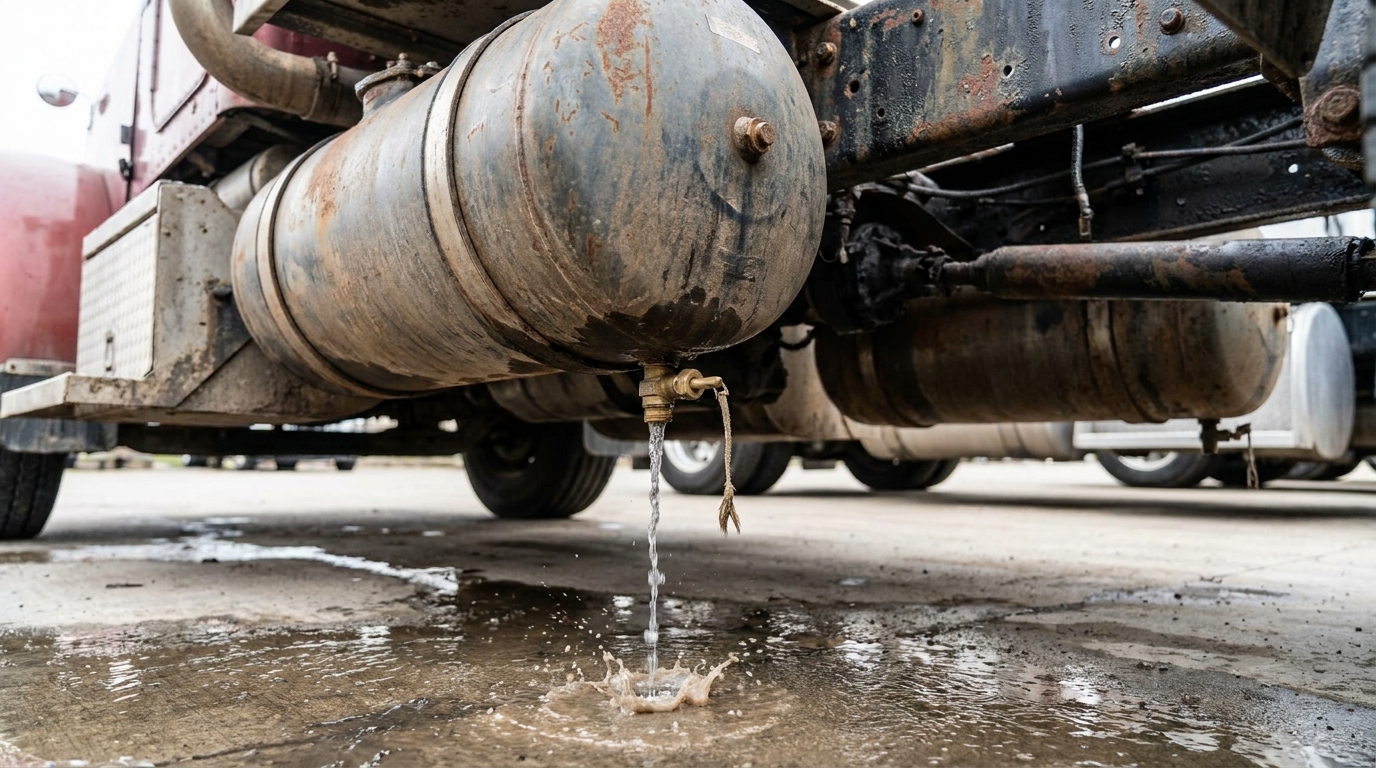
Every air-braked truck makes water. The compressor pulls in whatever the air outside is carrying, squeezes it, and the moisture that was invisible at atmospheric pressure turns into liquid the moment it cools inside a steel tank. That is not a defect. It is physics, and the regulation was written around it.
Most drivers know to pull the drain. Far fewer have read the section that puts the valve there in the first place, and it turns out 49 CFR 393.50 says four separate things — only one of which is the number everybody quotes.
The drain valve is equipment, not a courtesy
Paragraph (d) is the shortest and the one that matters most in a yard: each reservoir must have a condensate drain valve that can be manually operated. Automatic drain valves are allowed, but only on a condition — either they can also be operated by hand, or a manual means of draining the reservoirs is retained.
Read the subject of that sentence again. It is each reservoir, not each truck. The wet tank, the primary, the secondary, and every reservoir hanging off the trailer each carry the requirement on their own.
This is where a well-meant upgrade turns into a finding. An automatic drain gets fitted, the old pull cord gets removed because it was in the way, and now there is a reservoir on the vehicle with no manual means of draining it. The automatic drain did not satisfy the rule by existing; it satisfied the rule only while the manual path was still there.
The 70 percent test, and the truck it does not apply to
Paragraph (b) is the famous one. A vehicle has to be able to make a full service brake application with the engine stopped without dropping below 70 percent of what the gauge read immediately before the application. The rule even defines the term so nobody argues about it: a full service brake application means depressing the brake pedal or treadle valve to the limit of its travel.
Now read the heading of that same paragraph, which is where most repetitions of this number go wrong. It says: reservoir capacity for air-braked vehicles not subject to FMVSS No. 121 on the date of manufacture, and all vacuum braked vehicles.
If your tractor is a 2019, it is not in paragraph (b). It is in paragraph (a), which sends buses, trucks and truck-tractors built on or after March 1, 1975 — and air-braked trailers built on or after January 1, 1975 — to the FMVSS No. 121 S5.1.2 reservoir requirements in effect on the date it was manufactured. The standard that applies to your truck is the one that existed the year it was built.
That distinction is worth carrying, because the 70 percent figure still earns its keep — just as a diagnostic instead of a compliance standard. Run it in the yard and you learn something real about the health of your system. Quote it to an inspector as the requirement for a late-model tractor and you are quoting the wrong paragraph.
The check valve you are allowed to test without breaking a line
Paragraph (c) requires that each service reservoir system be protected against a loss of air pressure or vacuum caused by a failure or leakage between the service reservoir and the source — by check valves or equivalent devices. Then it adds a clause that reads like a design requirement and works like a gift to the operator: those devices' proper functioning must be checkable without disconnecting any air or vacuum line or fitting.
In other words, the rule assumes you can verify the check valve from outside the system. If verifying yours requires cracking a fitting, that is worth a conversation with your shop, because the regulation did not contemplate that as normal.
The five-minute version
- Drain every reservoir, wet tank first, and notice what comes out — water, oil carryover, or nothing at all.
- A tank that never gives water is a finding, not a clean bill of health: suspect a plugged valve or an automatic drain doing something you did not ask for.
- If an automatic drain is fitted, confirm the manual operation still works. That is the condition the rule attaches to it.
- Walk the trailer too. Its reservoirs are covered by the same sentence.
- The 70 percent check with the engine off is a good habit and a real number — for your own diagnosis, not as the standard that governs a post-1975 truck.
Why this one is worth the five minutes
Water in the tanks is a slow problem, and slow problems get postponed. It does not strand anyone the day it starts; it strands them on the first cold morning, or the day a valve that has been sitting in condensate for a year finally decides not to seat. Nothing about it announces itself at 60 miles an hour, which is exactly why the rule bothers to require the drain valve rather than trusting anyone to remember.
At The Truck Savers™ the shop guidance, maintenance coverage and inspection resources are collected in one place, and Truck Savers News keeps the compliance side of the trade documented here. Prevention before repair — the iron never lies.
Original source
Every requirement above was verified directly against the regulation in force: eCFR, 49 CFR 393.50, Reservoirs required.