Wabash Recalls 533 Trailers Over an Unlabeled ABS Lamp
The brakes are fine. The yellow lamp that reports an antilock fault is there and working — it just does not say ABS, and FMVSS 121 spells out the letter height to the millimetre. Three lamps report that system, and most drivers know one.
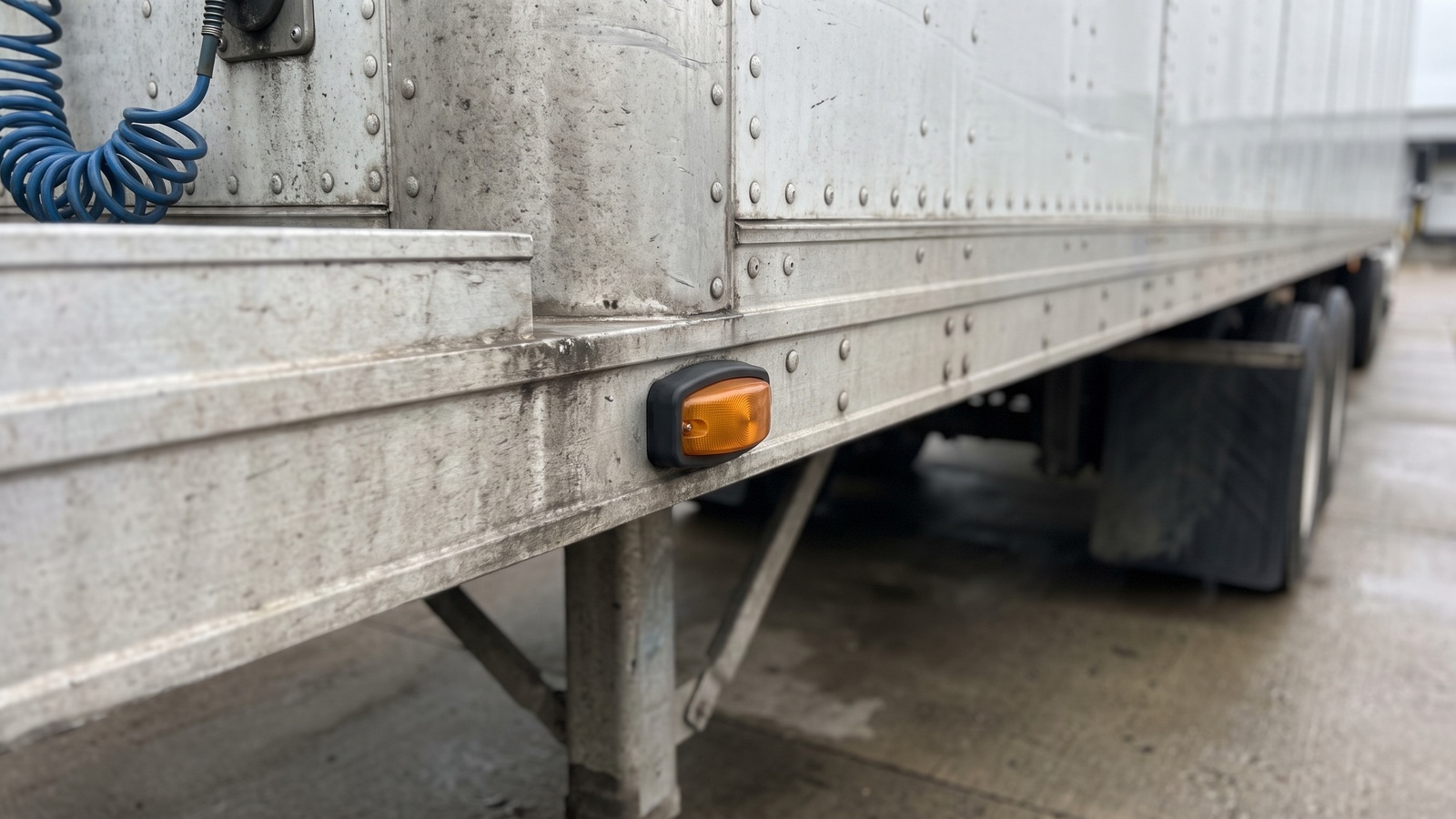
Five hundred thirty-three brand-new trailers were recalled last week over four letters that were never put on. Nothing about the brakes is defective. The lamp that reports an antilock fault is there, wired and working — it simply does not say what it is, and that is enough to make a federal safety standard unmet.
What the filing says
Campaign 26V506000 was received on August 4, 2026. It covers 533 model-year 2027 Wabash van trailers. The stated defect is that the external antilock malfunction indicator lamp may not be labeled, which leaves the trailer out of compliance with Federal Motor Vehicle Safety Standard 121, the air brake systems standard.
The remedy is as small as the defect. Wabash mails identification labels and installation instructions at no charge. Owner letters are expected to go out on September 28, 2026, and owners can call Wabash customer service at 1-765-771-5404 before then.
Why a sticker is a safety standard
The requirement lives in FMVSS 121 at S5.2.3.3, and it is more specific than most operators expect. Every trailer and every converter dolly must carry an external antilock malfunction lamp. It has to be yellow. It has to perform like a combination, clearance or side marker lamp under the SAE practice that governs those, the kind marked PC or P2 on the lens or housing.
And then the marking itself. The letters ABS must be permanently molded, stamped or otherwise marked on the lens or the housing, at least 10 mm — about 0.4 inches — high. There is one alternative: the letters may be painted on the trailer body, or fixed to it on a plaque, at least 25 mm, one inch, high, as long as part of one letter sits no more than 150 mm, 5.9 inches, from the edge of the lens.
Read that back and the logic is obvious. A yellow lamp low on the side of a trailer, on its own, is just another amber light among the marker lamps. The standard is not asking for decoration. It is making sure that when the lamp is lit, whoever sees it knows the trailer is telling them something about its brakes.
The part that lands on the carrier, not the builder
A recall is the manufacturer's obligation, and it is easy to file this one under someone else's paperwork. It is not only that. 49 CFR 393.55(e) puts the same lamp in the parts and accessories rules: every trailer, converter dolly included, built on or after March 1, 1998 must be equipped with an ABS malfunction lamp meeting S5.2.3.3.
Part 393 is the section an inspector applies to the vehicle in the yard that morning, not to the plant that built it. The equipment requirement rides with the trailer for its whole life, whoever is pulling it.
There are three lamps, and drivers usually know one
The rule builds a chain, and each link is its own lamp.
- The tractor's own ABS lamp. Under 393.55(d)(1) and S5.1.6.2(a), a truck tractor built on or after March 1, 1997 — and a single-unit air-braked vehicle built on or after March 1, 1998 — carries an indicator mounted in front of and in clear view of the driver, lit whenever a fault affects the generation or transmission of the antilock system's signals.
- The trailer ABS lamp inside the cab. Under 393.55(d)(2) and S5.1.6.2(b), a tractor built on or after March 1, 2001 that is equipped to tow must carry the towed vehicle's fault signal forward to a separate lamp in the cab.
- The yellow lamp outside on the trailer. That is the one this recall is about.
Two of those are in front of the driver and one is behind. Confusing the first two is the everyday version of the problem: a lit tractor lamp and a lit trailer lamp mean different repairs on different units.
The bulb check is written into the rule
S5.1.6.2(a) does not stop at "the lamp comes on when something is wrong." It also requires the lamp to light as a check of its own function every time the ignition goes to on or run, then go out at the end of that check — unless a fault exists, or a message about one was stored when the key was last turned off.
So the key-on sequence is a test the regulation hands you for free. A lamp that does its check and goes out is reporting health. A lamp that never lights at all is not good news; it is a lamp that has stopped being able to tell you anything.
You cannot unplug the fault away
Under S5.2.3.2 the trailer's malfunction signal has to stay present as long as the fault exists, any time power is supplied. When power goes away, the message is stored. When power comes back, the signal reactivates by itself.
That closes a shortcut people still try. Dropping the pigtail and plugging it back in does not clear a trailer ABS fault; the system was built specifically to remember. The lamp goes out when the fault is repaired.
The other antilock campaign from the same week
Wabash was not alone. Campaign 26V501000, received July 30, 2026, covers 137 Autocar ACTT and E-ACTT terminal tractors from model years 2023 through 2027, where the antilock system's electronic control unit may be improperly secured and can come loose. Autocar replaces the fasteners at no charge, owner letters are set for September 25, 2026, and the number to call is 1-888-218-3611 under manufacturer campaign ACTT-2601.
Yard equipment almost never reaches a small fleet's recall radar, and 137 units is small enough that nobody hears it secondhand. Put the two campaigns side by side and they are the same system taken from opposite ends: one is the control unit that generates the signal, the other is the label on the lamp that delivers it. Both end at the same place — whether anyone finds out the antilock system has quit.
Before the letters go out
Neither manufacturer's letters are scheduled until the last week of September. That is roughly seven weeks in which nothing arrives in the mail and every trailer keeps working normally. A few minutes of walkaround covers the gap.
Walk the left side of each trailer and find the yellow lamp above the landing gear. If neither the lens, the housing, nor the panel within six inches of it says ABS, write it down — and on a 2027 Wabash van, that is very likely the campaign itself. Turn the key on and watch both cab lamps run their check and go out. Treat a trailer lamp that stays lit as a repair, not as a connector to jiggle.
Then put it where it counts. 49 CFR 396.11(a)(1) already requires the driver's written report to cover service brakes including trailer brake connections, and lighting devices and reflectors. An unmarked or dead ABS lamp is a defect that belongs on that report, and a report is what turns a walkaround into a record. Preventive maintenance coverage and shop guidance for operators are collected at thetrucksavers.com, and compliance dates like these arrive weekly in the free Truck Savers News newsletter.
Original source
Recall data verified directly against the federal recall record for campaigns 26V506000 and 26V501000: NHTSA, Wabash National Corporation recall 26V506000. Regulatory text quoted from 49 CFR 393.55, 49 CFR 571.121 and 49 CFR 396.11 as in force August 1, 2026.