Truck Fire Extinguisher Rules: 5 B:C and Three Triangles
One extinguisher rated 5 B:C, or two rated 4 B:C — and the rating has to be readable on the bottle, because the rule is written about the marking, not about what you remember buying. Then there is paragraph (g), which bans fusees over your own fuel.
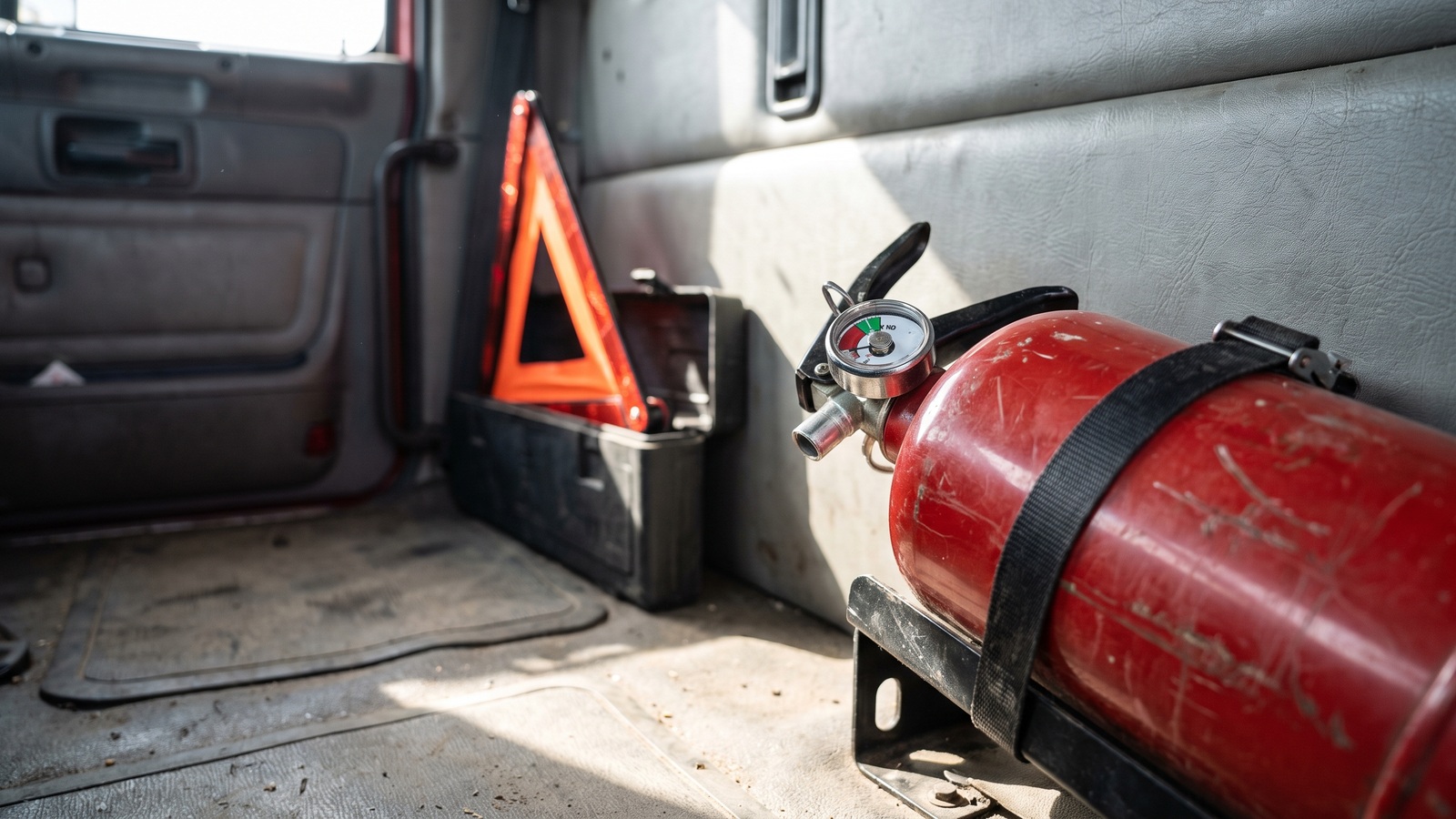
The cheapest violation on a truck is the one nobody looks at again after they buy it. A fire extinguisher gets mounted once and then rides along for years, and the rule it has to satisfy is a good deal more specific than "there is one in the cab."
What "rated" means, in numbers
49 CFR 393.95 applies to each truck, truck tractor and bus, with one exception: the driven unit in a driveaway-towaway operation. Everything else carries an extinguisher, and the required rating depends on the load.
- Not hauling placardable hazardous materials: either one extinguisher rated 5 B:C or more, or two, each rated 4 B:C or more. Two smaller bottles is a legitimate choice, not a workaround.
- Hauling hazardous materials in placardable quantity: 10 B:C or more.
Those are Underwriters' Laboratories ratings, and B:C is the class pair that matters on a truck — flammable liquid and electrical. A bottle sold for a kitchen may carry an A rating and still fall short here.
The rating has to be readable on the bottle
This is the sentence that costs people money. Paragraph (a)(2) requires that each extinguisher be labeled or marked by the manufacturer with its UL rating. The requirement is on the marking, not on your memory of what you bought.
Sunlight through a windshield eats labels. A bottle whose label has faded to nothing may well be a 5 B:C unit, and it can still be written up, because nothing on it says so. If you cannot read the rating standing next to the truck, an inspector cannot either.
You have to be able to see that it is full
Paragraph (a)(3) requires the extinguisher to be designed, built and maintained so that whether it is fully charged can be determined visually. In practice that is the gauge, or the pin indicator on a gaugeless unit.
Note the word maintained. A gauge that has gone cloudy, or a needle that no longer moves, is not a cosmetic problem. It is the specific thing the paragraph asks the equipment to do.
Filled, reachable, and actually bolted down
Paragraph (a)(4) asks for three things at once. The bottle has to be filled. It has to sit somewhere readily accessible when it is needed. And the mounting has to be firm enough that nothing lets it slide, roll, or travel up and down against the vehicle.
Each of those fails in an ordinary way. Behind the seat under a duffel bag is not readily accessible. A bottle that lifts out of a loose bracket on a bad railroad crossing is not securely mounted — and vertical movement is named on purpose, because a strap that stops a bottle sliding forward often does nothing to stop it jumping.
The agent, and the clause about winter
Paragraph (a)(5) has two conditions on what is inside. The agent must not need protection from freezing, and it must meet the toxicity provisions of the EPA's Significant New Alternatives Policy at 40 CFR part 82, subpart G.
The freezing clause is the one with practical bite for anyone who runs north in January. A unit that has to be kept warm to work is not equipment that satisfies this section on a truck that sleeps at a truck stop in Wyoming.
Triangles or fusees — pick one, and do not substitute
Paragraph (f) offers a choice, not a menu:
- Three bidirectional emergency reflective triangles conforming to FMVSS No. 125 at 49 CFR 571.125, or
- At least six fusees, plus as many more as section 392.22 requires for the stop you are actually in.
And the part people get wrong: other warning devices may be added to, but never used in lieu of, the required ones, and only if they do not reduce their effectiveness. An LED flare kit is a fine supplement. It does not replace the triangles.
Fusees have their own spec in paragraph (j). Each one must burn for 30 minutes, conform to UL 912, and carry the UL symbol. Red flags, under (k), must be at least 12 inches square with standards that hold them upright.
Why the number is six and not three
Three devices go out on the road, so six fusees looks like generosity. It is arithmetic. Under 392.22(b)(2)(i), a vehicle equipped with only fusees must keep a lighted fusee at each of the three positions for as long as it is stopped. Each fusee burns half an hour.
So three fusees cover thirty minutes of one breakdown. Six cover an hour. A tow that runs two hours needs twelve, and the rule says to carry as many as the situation requires. Six is the floor, not the plan — which is most of the argument for carrying triangles instead.
The trap in paragraph (g): it is about your fuel, not your freight
Flame-producing signals are prohibited outright in three cases. Two are about the load: a vehicle transporting Division 1.1, 1.2 or 1.3 explosives, and a cargo tank used for Division 2.1 flammable gas or Class 3 flammable liquid — loaded or empty, which catches the run home.
The third is about the truck itself: any commercial motor vehicle using compressed gas as a motor fuel. A CNG or LNG tractor can be pulling an empty dry van, or nothing at all, and it still may not carry fusees. For that truck, triangles are not the preference. They are the only lawful option.
Five minutes in the yard
Pull the bottle out of its bracket and read the rating off it. If you cannot read it, the bottle is finished regardless of how much powder is inside. Look at the gauge and make sure the needle sits in the green. Put the bottle back, then push it sideways and lift it — if it moves, the bracket is the violation, not the extinguisher. Count the triangles to three and open a case to confirm the stands still hold them up. If you run fusees, count to six and look for the UL symbol.
Where those devices go once you are stopped is a separate rule with its own distances and its own ten-minute clock; that ground is covered in our semi-truck breakdown checklist. Extinguishers, brackets, triangles and the rest of the cab kit are in the Truck Savers parts and accessories catalog, and preventive maintenance coverage for operators is collected at thetrucksavers.com.
Original source
Requirements quoted from the federal regulation as in force August 1, 2026: 49 CFR 393.95, Emergency equipment on all power units. Placement distances and the fusee rule for stopped vehicles come from 49 CFR 392.22.