Tire Tread Depth: Where You Measure Changes the Answer
Four conditions fail a truck tire with no gauge at all. And when depth does matter, the rule asks 4/32 on the steer axle and 2/32 everywhere else — but never on a tie bar, which reads deeper than the tire really is.
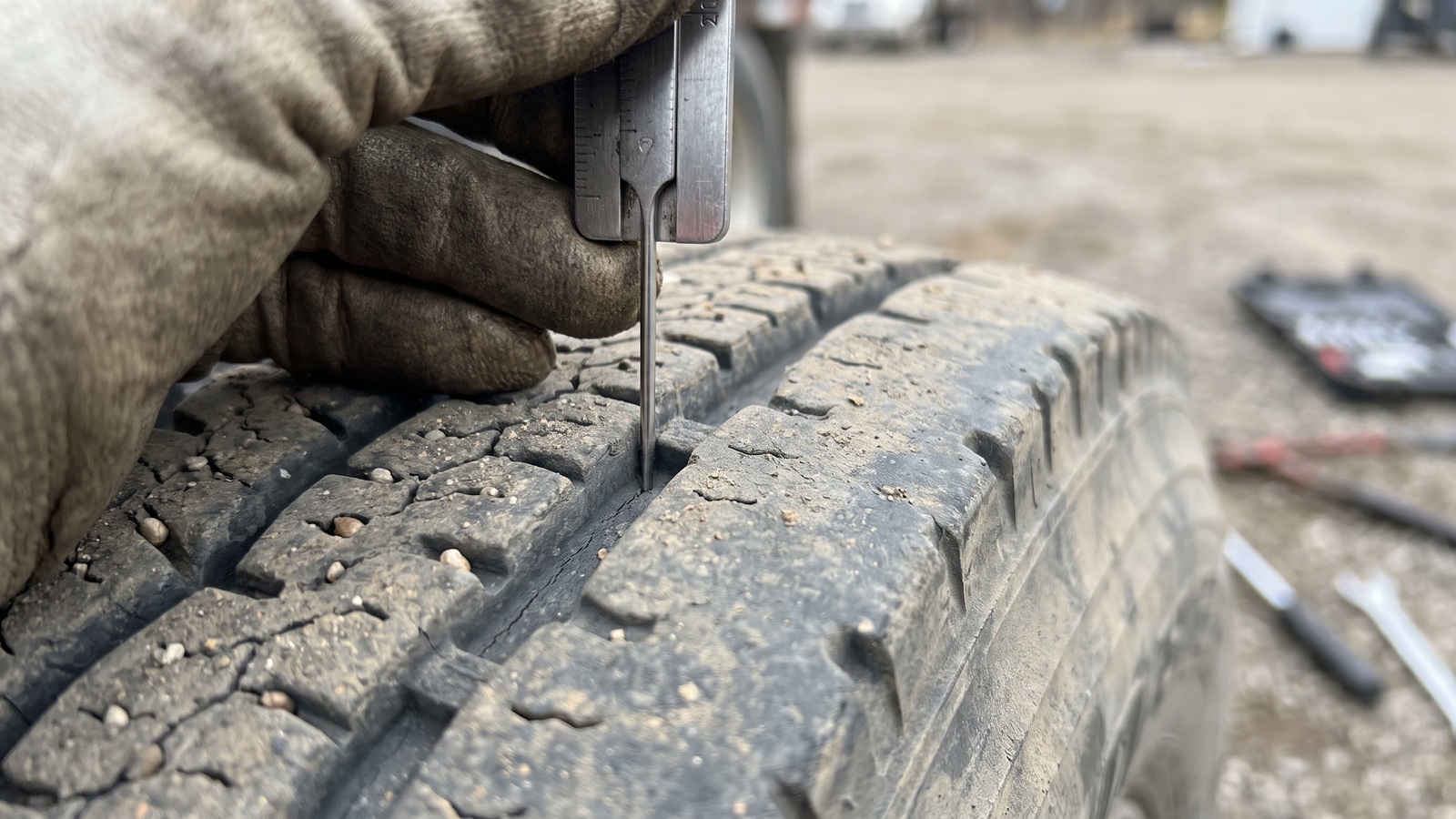
Four things put a truck tire out of service without anybody reaching for a gauge. Most drivers think tires are a measuring problem. The measuring part is real, and there is one sentence inside it that decides arguments — but the fastest failures are the ones you can see standing up.
The four that need no measurement
49 CFR 393.75(a) prohibits operating on a tire that:
- Has body ply or belt material showing through the tread or the sidewall.
- Has any tread or sidewall separation. Any. There is no tolerance written next to it.
- Is flat or has an audible leak. If you can hear it, it is already a violation, not a warning.
- Has a cut deep enough to expose ply or belt. Depth is judged by what the cut reveals, not by how long it looks.
None of those needs a tool. They need a light and thirty seconds per wheel.
The two numbers
Where depth does matter, the rule splits the truck in two. On the front wheels of a bus, truck or truck tractor, the minimum is 4/32 of an inch. Everywhere else — drives, trailer, dolly — the minimum is 2/32.
Both are measured in a major tread groove. That word is doing work: the shallow sipes and decorative channels between the main ribs are not where the number comes from.
The sentence that decides the argument
Read paragraph (b) to the end and you hit this: the measurement shall not be made where tie bars, humps or fillets are located. Paragraph (c) repeats it for every other position.
A tie bar is the small raised bridge of rubber that runs across the bottom of a groove. Its whole purpose is to sit higher than the groove floor. Put a gauge on it and the tire reads deeper than it really is — which is exactly why a driver can walk away satisfied and still get written up an hour later at the scale.
Measure between the tie bars, at the deepest part of the major groove, and take more than one reading around the tire. The worst spot is the one that counts, not the average.
Regrooved tires and the steer axle
This one catches people who buy smart and get surprised. Paragraph (e): a regrooved tire rated at or above 2,232 kg — 4,920 pounds — must not be used on the front wheels of any truck or truck tractor. Not a recommendation, not a fleet policy. Any truck, any tractor.
Buses go further: paragraph (d) bars regrooved, recapped or retreaded tires on the front wheels of a bus outright, regardless of rating.
Speed and load are on the tire too
Two limits ride on the sidewall and get ignored because nobody reads sidewalls at 5 a.m.
Speed-restricted tires. If a tire is labeled with a maximum of 55 mph or less under FMVSS No. 119, running it faster than its rating is its own violation under paragraph (f). These show up on yard equipment, on some retreads and on specialty tires that end up on the wrong unit.
Load. Paragraph (g) says a tire may not carry more than the weight marked on its sidewall. The only way past it is a state special permit and a reduced speed to compensate — and even then, never above 50 mph.
Five minutes before the next trip
- Walk the wheels with a light first. Exposed cord, any separation, a cut that shows belt, a hiss. Those four end the conversation before the gauge comes out.
- Gauge the steer tires separately. They live at 4/32 while everything else lives at 2/32, and they are the ones you cannot limp home on.
- Find the tie bars before you measure. Look down the groove: the raised bridges are obvious once you know they are there. Measure between them.
- Take three readings per tire, spaced around the circumference, and write down the shallowest.
- Check what is actually mounted on the steer axle. If a regrooved tire rated 4,920 pounds or more ended up there, it comes off before the trip, not after the inspection.
The honest bottom line
Tires are the cheapest place on the truck to be caught out and one of the easiest to defend. The rule hands you two numbers, four conditions and one exclusion. Learn where not to put the gauge and the rest is a flashlight and five minutes.
If you are pricing replacements or shop tools, the parts and accessories catalog at The Truck Savers store is a practical place to start, and there is more operator-side maintenance and compliance coverage at thetrucksavers.com.
Original source
Electronic Code of Federal Regulations — 49 CFR 393.75, Tires, text in force August 1, 2026.