Three PSI in Five Minutes: The Air Suspension Test
Lose over three psi in five minutes and it is a defect. The rule hands you the whole test.
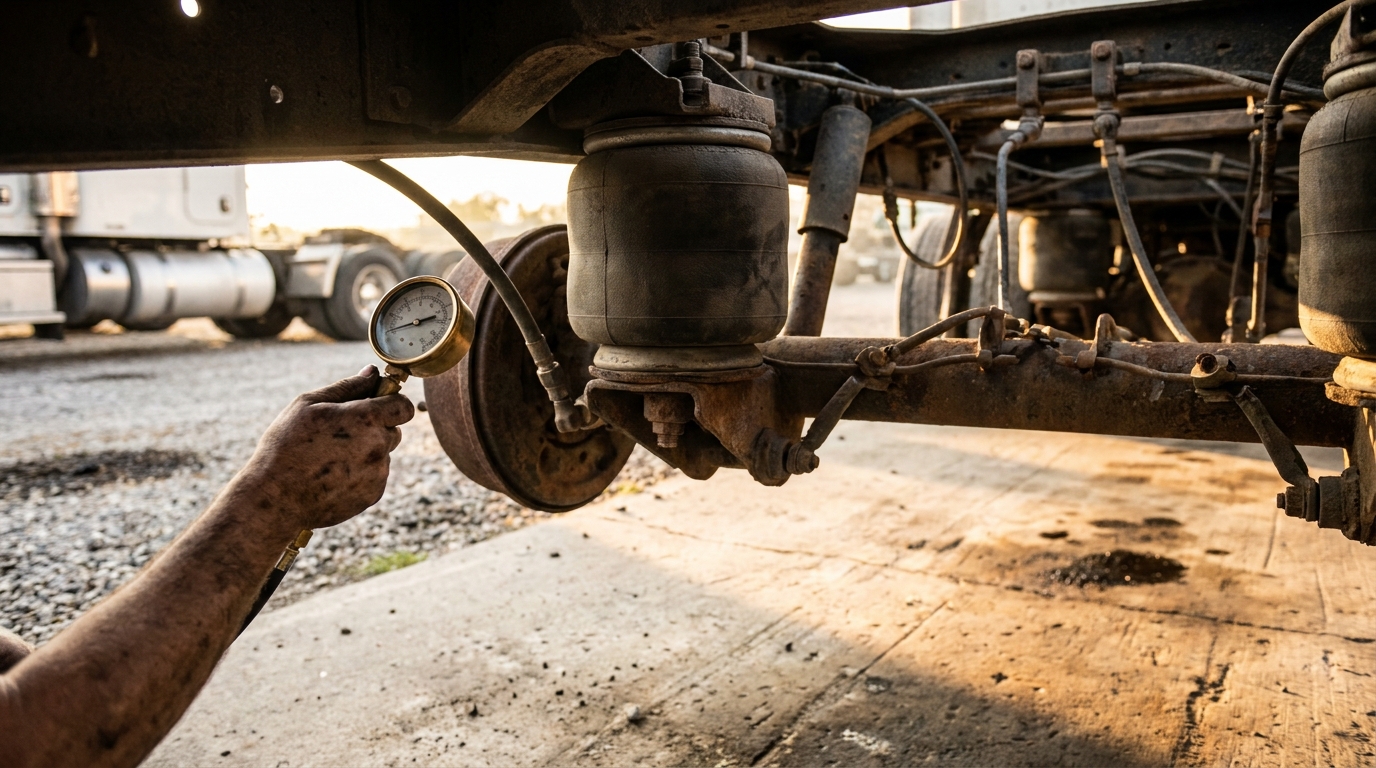
Park the truck level, bring the air up to normal operating pressure, shut it down and look at the gauge for five minutes. If you lost more than three psi, the suspension has a defect — not an opinion, a defect.
That test is written into 49 CFR 393.207. It costs nothing, it needs no scan tool, and almost nobody runs it, because an air leak is usually diagnosed by ear. By the time you can hear it standing next to the truck, it has been costing you for weeks.
The three numbers the rule actually gives you
Section 393.207(f) covers air suspensions, and it hands the operator three hard numbers instead of a judgement call:
- 55 psi. The air pressure regulator valve must not let air into the suspension system until at least 55 psi is in the braking system. Brakes get the air first. A suspension that fills early is stealing from the system that stops you.
- Level. The vehicle must sit level, not tilting to the left or right. A truck that parks with a lean is telling you something before you touch a gauge.
- 3 psi in 5 minutes. With the gauge at normal operating pressure, air leakage must not be greater than three psi over a five-minute period.
Three psi is a small number on purpose. It is small enough that a healthy system passes comfortably and a tired one does not.
What a slow leak is really charging you
A leak that never quite empties the bags does not strand you. It does something more expensive: it keeps the compressor working. The compressor runs off the engine, the engine burns diesel, and the cycle repeats every time the pressure drops.
Meanwhile the truck rides lower on one corner than the other, and everything downstream pays for it — tires that wear on one shoulder, a fifth wheel that sits at an angle it was never meant to sit at, and a trailer that tracks slightly off. None of that shows up as a warning light.
The other half of the section is about steel, and it is just as blunt. Under 393.207 no axle positioning part may be cracked, broken, loose or missing, and all axles must be in proper alignment. No leaf spring may be cracked, broken, missing or shifted out of position. No coil spring may be cracked or broken. No torsion bar may be cracked or broken. Adjustable axle assemblies must not have locking pins missing or disengaged.
Alignment is compliance, not cosmetics
Read that phrase again: all axles must be in proper alignment. It is in the federal rule, not in a shop brochure. An alignment out of spec is not a comfort issue and it is not an upsell — it is a condition an inspector can write up.
That is also why an alignment sheet is worth keeping. It is the cheapest document you can hold that speaks directly to a line in 393.207.
How to run the test without a shop
- Park on ground that is actually flat. A crowned yard will fake a lean and waste your morning.
- Build air to normal operating pressure and shut the engine off.
- Note the gauge, wait five minutes without touching the brake pedal, and note it again.
- More than three psi gone: you have a defect to chase, and now you know it before an inspector does.
- While you are there, walk the springs and the axle hardware. Cracked, broken, loose, missing — those four words are the whole standard.
What it looks like from the other side of the clipboard
An inspector does not need the five-minute clock to write you up. A bag sitting flat, a spring leaf out of position, a locking pin hanging loose on an adjustable axle — those are visible from the ground in the time it takes to walk the length of the tractor. The clock matters to you, not to him, because it is the only version of the test that happens before the violation exists.
And the leak you find in your own yard costs a repair. The one he finds costs the repair, the stop, and the mark on the record that follows the truck.
The point of the five-minute test is not to pass an inspection. It is that a suspension tells you it is failing long before it fails, and the rule happens to describe exactly how to listen. Metals never lie.
Need the axles measured under load instead of standing still? The Truck Savers runs the road simulator and full alignment in Houston, Dallas and Monterrey.
Original source: eCFR — 49 CFR 393.207, Suspension systems