Thirty Days of Control Starts the Paperwork
Thirty consecutive days and the record is required. Four things have to be in it.
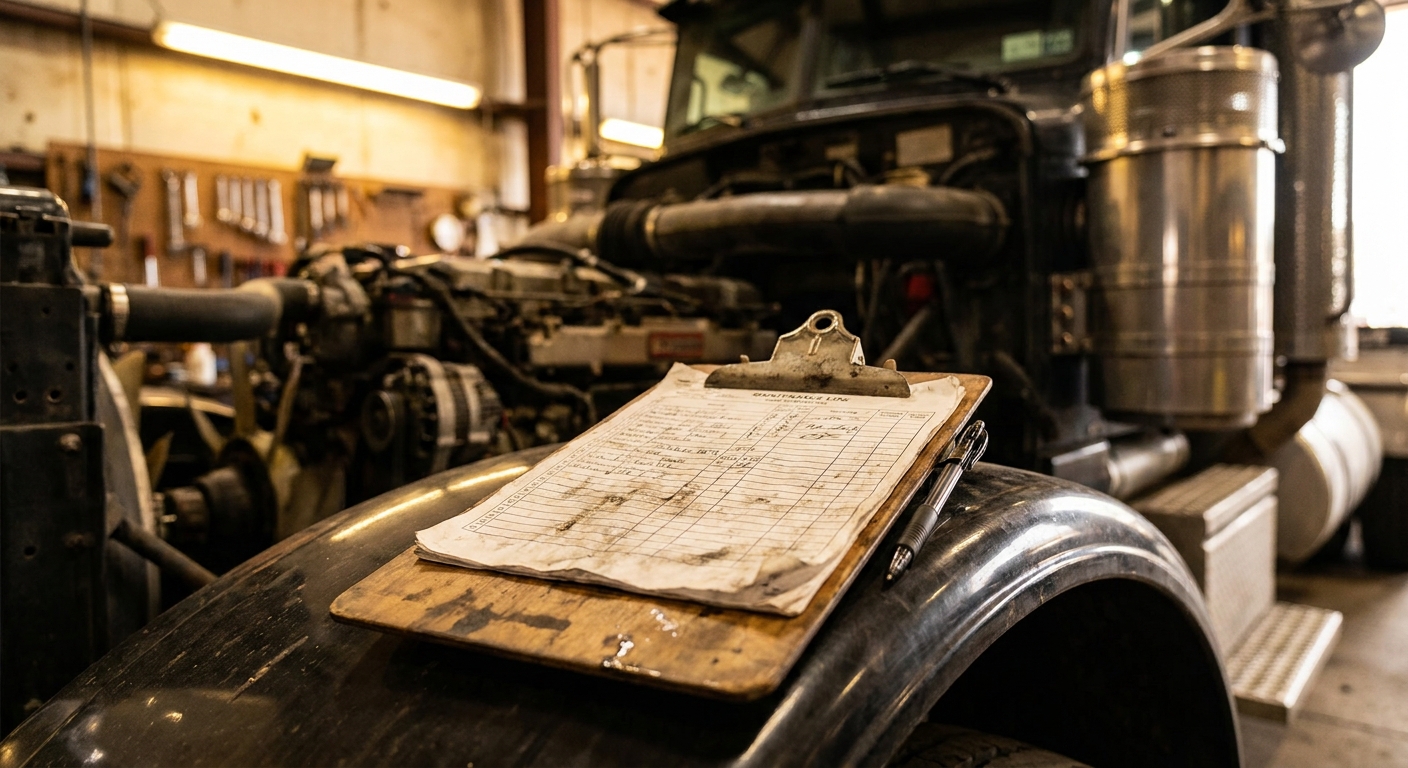
Control a truck for thirty consecutive days and you are required to keep a record on it.
Not encouraged. Required. That is 49 CFR 396.3(b), and it applies to every motor carrier, including the one-truck kind.
Most operators treat the maintenance log as good practice. It is a rule, and the rule is specific about what has to be in it.
The four things the record must contain
- Identification of the vehicle. Company number if it is marked, plus make, serial number and year. And if the truck is not yours, the name of the person furnishing it.
- A means to indicate the nature and the due date of the inspection and maintenance operations to be performed.
- A record of inspections, repairs and maintenance, showing their date and nature.
- Pushout window and emergency door tests — this one is for buses, not for you.
Read the second one again, because that is the one almost nobody has.
A due date is not a receipt
Most people who think they keep a maintenance log keep a folder of invoices. That satisfies the third item and misses the second entirely.
The rule asks for something that points forward: what is coming due, and when. An invoice tells you what already happened. A due date tells you what is about to.
That difference is not a technicality invented by an inspector. It is the whole reason the requirement exists. A pile of receipts proves you paid for repairs. A schedule proves you were managing the truck.
And the practical version is the same one an owner-operator would want anyway: the sheet that says when the next service is due is the sheet that keeps you out of a breakdown.
How long you have to keep it
Two numbers, and they are easy to get wrong:
- One year, kept where the vehicle is housed or maintained.
- Six months after the vehicle leaves your control.
That second one is the one people miss. Sell the truck, and the paperwork does not go with it. You keep it another six months.
Note also where the records have to live: where the vehicle is housed or maintained. Not in a box at the house across town.
What "systematically" is doing in part (a)
The section opens by requiring carriers to systematically inspect, repair and maintain every vehicle under their control, and it says parts must be in safe and proper operating condition at all times.
Then it names some of them outright: frame and frame assemblies, suspension systems, axles and attaching parts, wheels and rims, and steering systems.
That list is worth noticing. It is not the list of things that make a truck go. It is the list of things that hold it together and point it straight, which is exactly where a neglected truck shows its neglect first.
What to do with this today
- Start the sheet with the identity block. Make, serial number, year, and your unit number. Five minutes once, and item one is done forever.
- Add a due-date column. Next oil, next greasing, next alignment check, next brake inspection. That single column is what turns your invoices into a compliant record.
- Keep it where the truck is. The rule says housed or maintained. A copy in the cab and a copy in the shop beats a perfect file you cannot produce.
- Do not throw it out when you sell. Six more months, minimum.
- If someone else's trailer is under you for a month, it counts. Thirty consecutive days of control is the trigger, not ownership.
The part that pays for itself
Compliance is the reason the rule exists. It is not the reason to do it well.
A truck with a real service history sells for more, argues better with a warranty department, and gets diagnosed faster when something goes wrong, because the shop can see what has already been ruled out. The same sheet does all three.
The operators who get surprised by repairs are almost never the ones with a due-date column. They are the ones with a drawer.
We do inspections, alignment, suspension and brake work in Houston, Dallas and Monterrey, and everything we touch goes on paper you can keep: thetrucksavers.com.
Original source: 49 CFR 396.3, inspection, repair and maintenance (eCFR)