The Yellow Dot Never Replaced Balancing
The yellow dot marks the lightest point and the red dot the high point of radial force variation. Neither one replaces balancing: they only mean less lead.
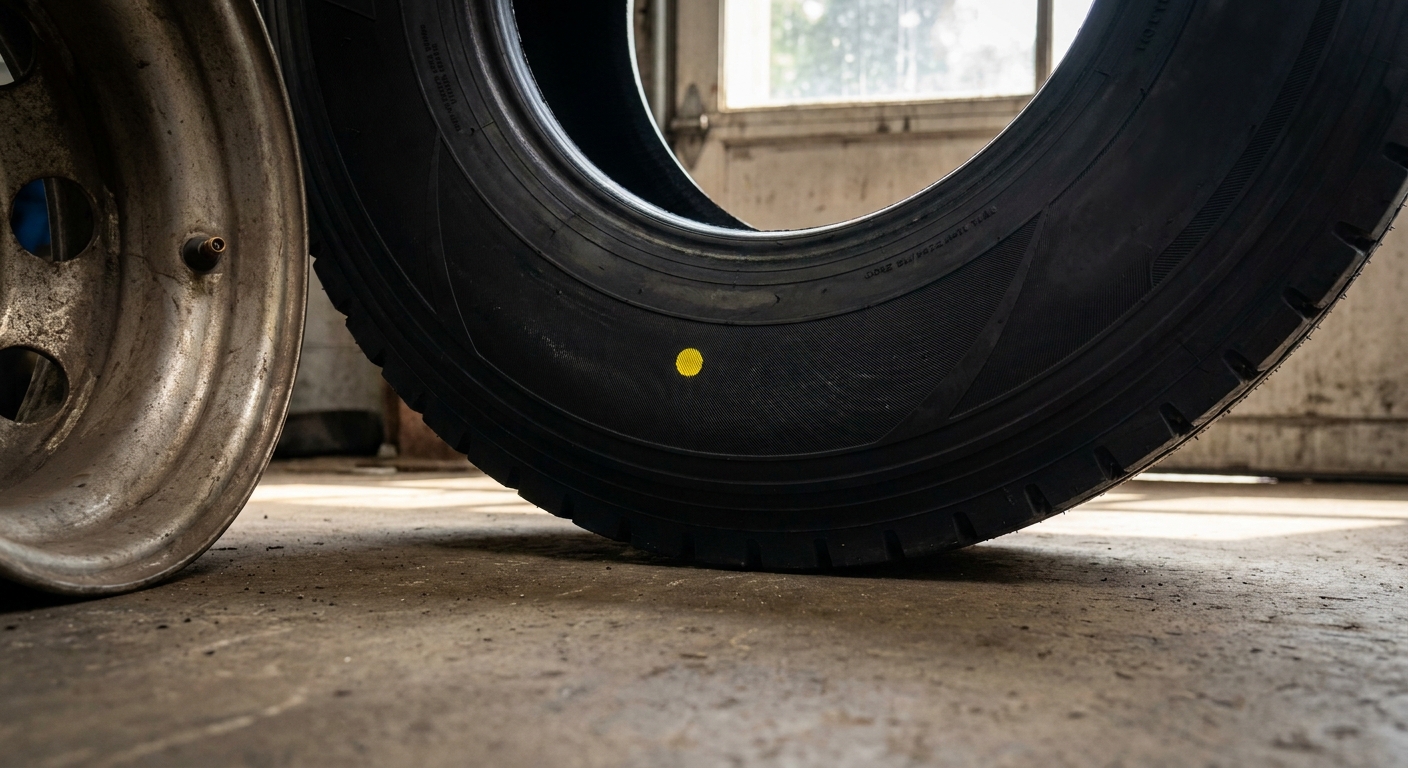
It is one of the arguments that never dies in the yard: a new tire shows up with a paint dot on the sidewall, somebody says to line it up with the valve stem, and somebody else answers that balancing already handles that. Both are partly right, and the confusion comes from one thing: not all the dots mean the same thing.
They are two different marks, not one
The yellow dot marks the lightest point of the tire. The idea at mounting is to place it next to the valve stem, because that area of the wheel tends to be the heaviest: you put the light part of the tire against the heavy part of the rim.
The red dot is something else. It marks the high point, the point of maximum radial force variation, which is the stiffest part of the tire. It is not about weight: it is about shape and stiffness.
And if a tire carries both, common practice is to give the red dot priority, though that depends on the tire design and on what the manufacturer specifies.
What the dot does NOT do
Here is the heart of the argument, and it deserves a straight answer: the paint dot does not replace balancing. Mounting the tire to the dot is a good starting position — it usually means less lead — but the tire still gets balanced.
Whoever says "that is what balancing is for" is right that balancing is what governs. Whoever says "line up the dot" is right that it helps. They are not contradicting each other: one is the starting point, the other is the work.
And if your tire has no dot
It happens, and it is not a defect. Not every manufacturer marks them, and the paint wears off on its own as the tire rolls, or gets washed off with soap and water after mounting. A tire that has already worked usually has no dot left to find.
Nothing important is lost in that case: you mount it and you balance it. The dot matters at initial mounting, not afterward.
What to check at mounting
- Look for the dot before mounting, not after. Once it is on the wheel you cannot see it.
- Yellow next to the valve stem. That is the common reference on a new tire with no red dot.
- If there is a red dot, that one governs, unless the manufacturer says otherwise.
- Ask for the balance anyway. The dot does not replace it, and no serious mounting skips it.
- If there is no dot, do not hunt for one. It does not mean the tire is bad.
The preventive close
The paint dot is a mounting aid, not a shortcut. It lets the balance start with an advantage and need less counterweight, and that is where its job ends. What actually takes the vibration out is the machine, not the color on the sidewall. Iron never lies: if it still shakes after mounting, something was left unresolved.
If you have a vibration and cannot tell where it comes from, The Truck Savers checks it in Houston, Dallas and Monterrey.
Original source: Tire Agent — Red and Yellow Dots on Tires Meaning