The Last Four Digits Are the Week and the Year
Your sidewall carries a build date. Two digits for the week, two for the year.
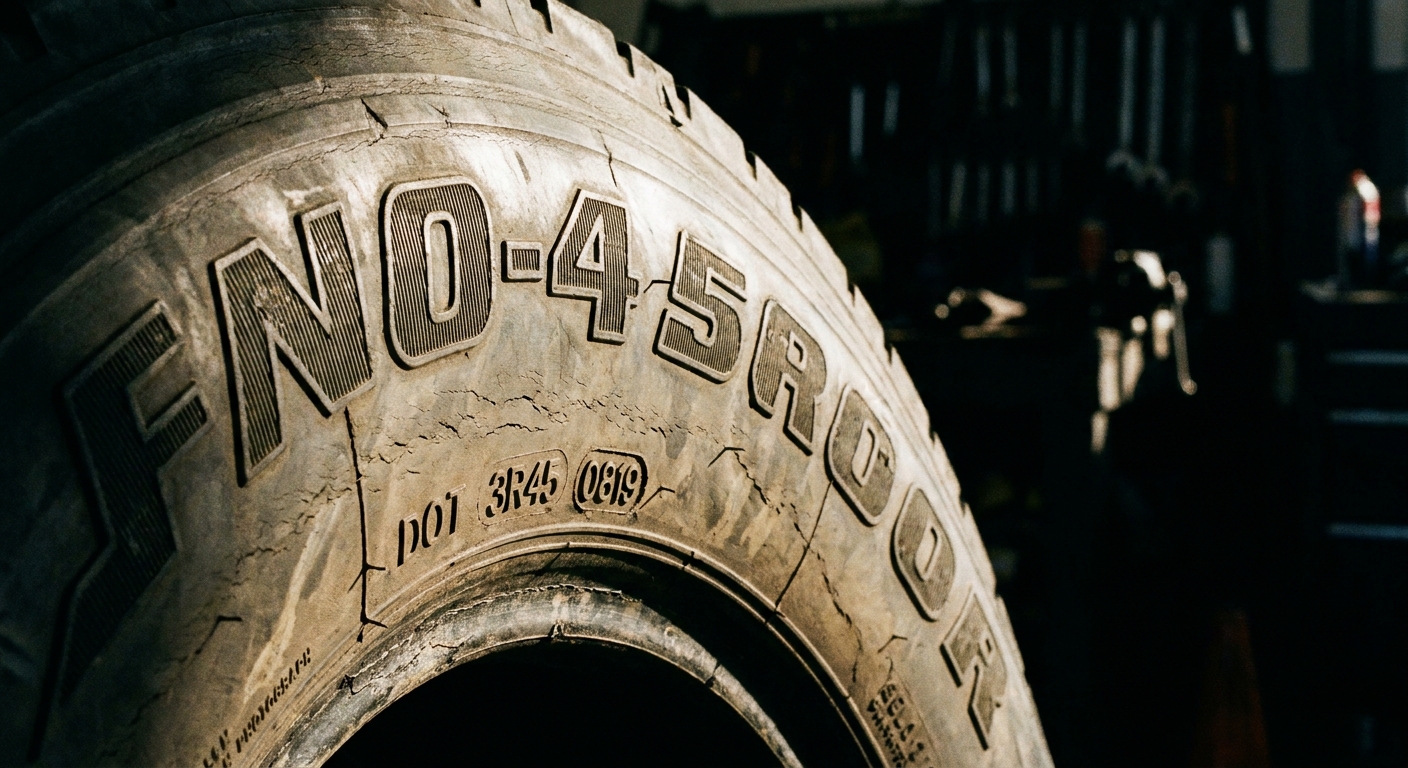
The last four digits on your sidewall are a date, and almost nobody reads them.
They are not a part number and not a batch code. Federal rule 49 CFR 574.5 says the date code is four numerical symbols and that it is the final group of the tire identification number. Two digits for the week, two for the year.
How to read it in ten seconds
Find DOT on the sidewall and read to the end of that string. The last four numbers are what you want.
- First two digits: the week. The rule uses 01 for the first full calendar week of the year, 02 for the second, and so on. The calendar week runs Sunday through Saturday.
- Last two digits: the year. The final two digits of the year of manufacture.
The regulation gives its own example: 0109 means the tire was built in the first full calendar week of 2009, the week beginning Sunday, January 4 and ending Saturday, January 10.
So a tire reading 2618 was built in the twenty-sixth week of 2018. That is late June of that year, and it tells you something no tread-depth gauge can.
The rest of the number, briefly
A new tire carries a full identification number of 13 symbols, molded into one sidewall.
- Plant code, three symbols. First group. It identifies the plant, assigned by NHTSA.
- Manufacturer's code, six symbols. Second group, and only on new tires.
- Date code, four numbers. Always last.
One detail worth knowing if you are looking at older stock: manufacturers were allowed to keep using an older two-symbol plant code only until April 13, 2025. After that, three symbols.
Retreads are marked differently, on purpose
This is the part that saves arguments on a purchase.
A retreaded tire carries a shorter identification number: seven symbols, not thirteen. It has the plant code and the date code, but not the manufacturer's code, because that group cannot be used on a retread.
And there is a separate mark: the symbol R, applied at the time the number is marked. The rule is explicit that the R is not part of the identification number. It is a flag.
So if you are told a casing is new and the sidewall shows seven symbols and an R, the sidewall is right and the seller is not. That check costs nothing and takes a few seconds per wheel.
What the date actually tells you
Be careful here, because this is where shop folklore takes over.
The date code is information, not a legal expiration. Part 574 requires the date to be there and readable. It does not set a maximum age at which a truck tire must come off. Anyone who quotes you a federal number of years for a commercial tire is quoting something that is not in this rule.
What the date does give you is context for everything else you are looking at. A tire with plenty of tread and a date from eight years ago is a different object than a tire with the same tread from last year. Rubber ages whether or not it rolls, and it ages faster sitting in sun and heat than it does under load.
Sidewall cracking, weather checking between the tread blocks, and a hard, glassy feel to the rubber all mean more once you know how old the tire is.
Where this costs you money
- Buying a used truck. Eight tires with old dates is a purchase you are about to make on top of the purchase you are making. Read all eight before you talk price, spare included.
- Buying tires that were "in stock." A tire can be new and still not be recent. It is a fair question to ask before it goes on the rim, not after.
- Matching duals. Two tires of very different ages on one wheel end age and wear differently even when the tread matches at the start.
- Trailers that sit. The trailer parked most of the year is where old rubber hides. Those tires accumulate calendar without accumulating miles, and calendar is the part that gets forgotten.
- Making a claim. The date is the first thing a manufacturer asks for. If you cannot read it, you cannot start.
Write it down once
The practical move is boring and it works. The next time the truck is on the lot, walk it and write down the four digits from every wheel position, spare included, on the same sheet as your empty weight.
It takes one pass. After that, you know which corner is oldest without crawling under anything, and you replace on a schedule instead of on a shoulder.
We look at tires, alignment and suspension in Houston, Dallas and Monterrey, and we read the dates while the truck is up: thetrucksavers.com.
Original source: 49 CFR 574.5, tire identification requirements (eCFR)