The DVIR Rule Has an Exception for One-Truck Carriers
Section 396.11 does not apply if you run only one commercial vehicle. The exception is real, and narrower than it sounds.
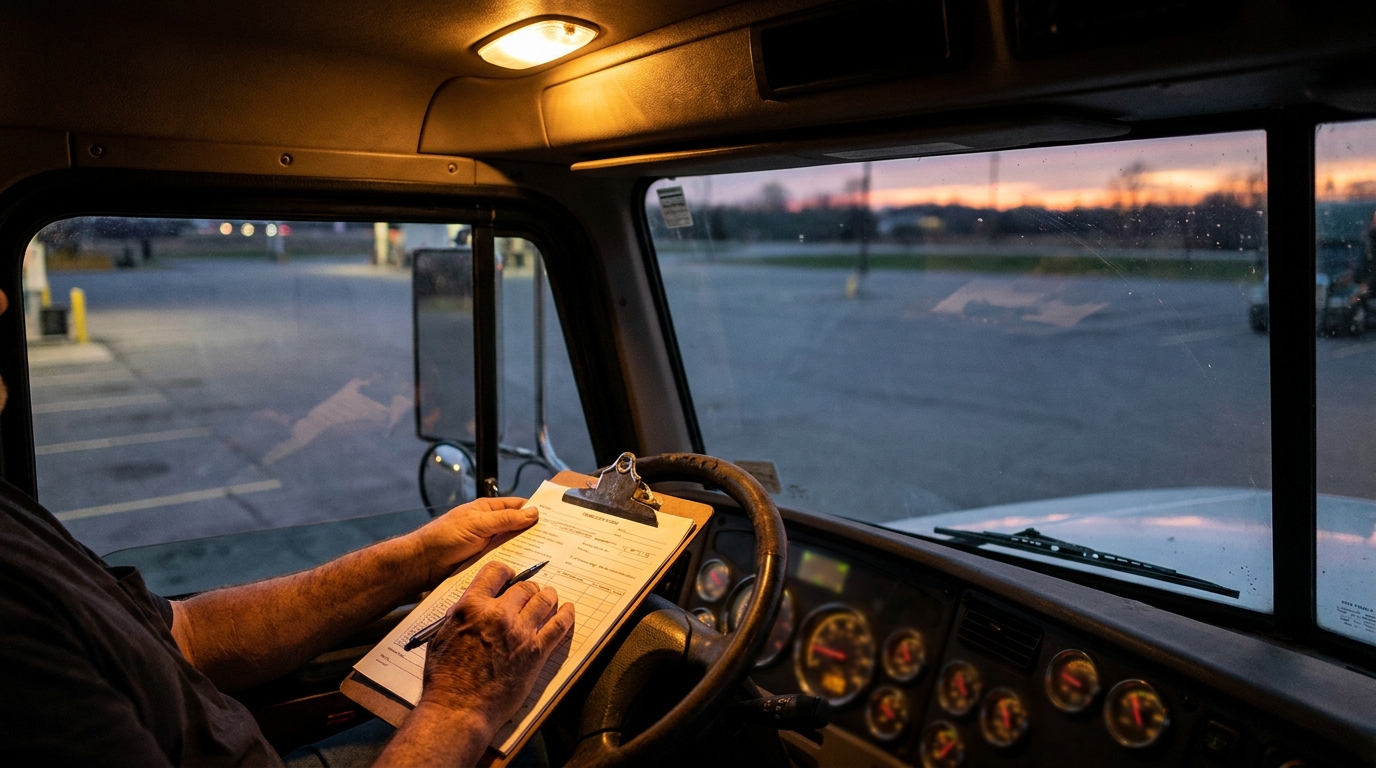
If you run one truck, the daily inspection report rule does not apply to you. That exemption is written into 396.11 and nowhere else in Part 396. Check your maintenance file before you stop filling out the nightly form. The exception covers one form, not the whole of Part 396.
That first sentence is in the regulation, in plain words, and most one-truck carriers have never been told. It is also the sentence most likely to be misread, so the rest of this covers what it does not change.
What the rule asks of everyone else
49 CFR 396.11 makes every motor carrier require its drivers to report, and every driver to prepare a written report, at the completion of each day's work, on each vehicle operated. If a driver ran three vehicles that day, that is three reports.
The report covers at least eleven items, and the list is worth knowing by heart: service brakes including trailer brake connections, parking brake, steering mechanism, lighting devices and reflectors, tires, horn, windshield wipers, rear vision mirrors, coupling devices, wheels and rims, and emergency equipment.
The part everybody repeats backwards
Here is the sentence that surprises people who have been filling out a form every night for years: drivers are not required to prepare a report if no defect or deficiency is discovered or reported. That is in paragraph (a)(2)(i).
The report exists to move a defect from the driver's head onto paper so the carrier has to deal with it. No defect, no report required by this section. A fleet may still want one for its own records, and that is a company policy, not this rule.
When there is a defect, the chain closes: the driver signs it, the carrier repairs anything likely to affect safe operation before the vehicle runs again, and the carrier certifies on that same report that it was repaired or that repair was unnecessary. All three pieces — report, repair certification, and the driver's review certification — are kept three months.
The exception, quoted exactly
Paragraph (a)(5) lists who is out. The rules of this section do not apply to a private motor carrier of passengers (nonbusiness), to a driveaway-towaway operation, or to any motor carrier operating only one commercial motor vehicle.
One truck. Not one driver, not one owner — one commercial motor vehicle in the operation. Add a second and the exception is gone.
What the exception does not touch
This is the part worth carrying, because being outside 396.11 is not being outside Part 396.
- Systematic maintenance still applies. Section 396.3 requires carriers to systematically inspect, repair and maintain the vehicles under their control. The one-truck exception is written into 396.11, and it stays there.
- The annual inspection still applies. Section 396.17 and its appendix A do not carve out the single-truck operator.
- A roadside inspection does not care. Nothing about the exception changes what an officer finds on the vehicle, or what puts it out of service.
- Your own records are still your defense. If something goes wrong and there is no paper anywhere showing the truck was looked after, the exception explains why one specific form is missing, not why nothing was documented.
Two practical notes
First, the report may be created and kept electronically, under 49 CFR 390.32. A phone app that produces a signed record is a report.
Second, on a two-driver operation only one driver has to sign, provided both agree on the defects listed. That is a small allowance and it is conditional on the agreement, not on convenience.
Why this one is worth five minutes
Most compliance surprises are people doing more than the rule asks, badly, and less than it asks where it counts. A one-truck carrier filling out a clean DVIR every night out of habit is spending time on a form this section does not require, while the maintenance file that is required may be empty.
Read your own operation against the two lists above. The paperwork you owe is smaller than you think and the maintenance you owe is not.
At The Truck Savers™ the shop and inspection resources sit in one place, and Truck Savers News keeps the compliance side of the trade documented here. Prevention before repair — the iron never lies.
Original source
Every requirement above was read in the regulation in force, edition of August 18, 2026: eCFR, 49 CFR 396.11, Driver vehicle inspection report(s).