The Brakes Need 200 Liters of Water
Race trucks are production tractors capped at 160 km/h. The brakes need water.
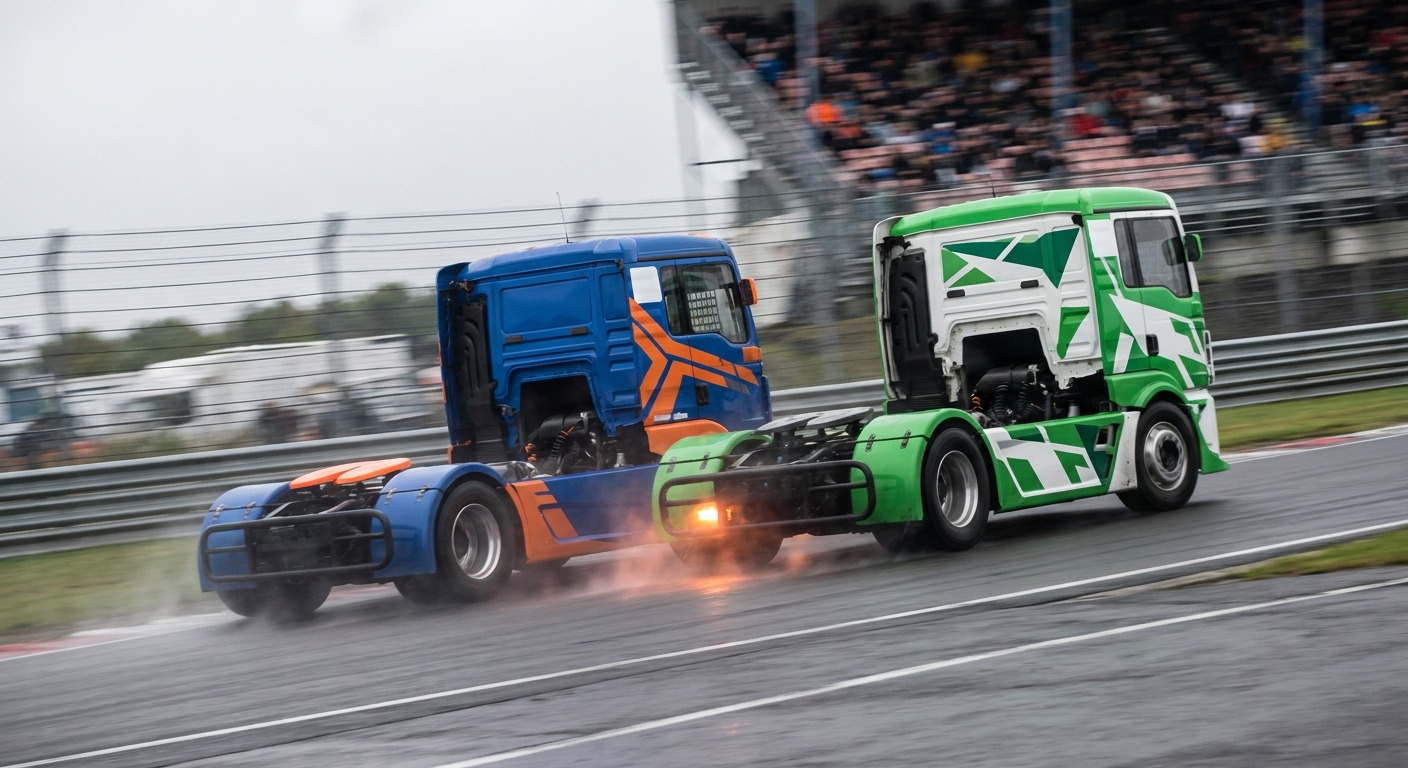
A European race truck carries 200 liters of water on board, and none of it is for the engine.
It is for the brakes. That single number tells you more about what these machines are doing than any lap time would.
The FIA European Truck Racing Championship runs tractor units around road circuits, and the first thing worth knowing is what they start life as: series production two-axle road tractors. Not purpose-built race chassis. The same basic article that pulls a trailer down a motorway.
The numbers, from the governing body
The FIA's own technical breakdown puts a race truck at around 5,300 kg, with a maximum engine capacity of 13,000 cc, one turbo, and averages of 1,200 hp and 5,500 Nm of torque.
Then comes the part that surprises people who assume racing means revving:
- Maximum 3,000 rpm.
- Top speed 160 km/h, imposed by regulation.
- 0 to 100 km/h in 5 seconds.
- 30 to 160 km/h in 7 seconds.
Three thousand rpm. That is a diesel truck engine operating in the same rev range yours does, making four figures of horsepower, and being asked to do it lap after lap.
Why the speed is capped
The 160 km/h ceiling is not a technical limit. The engines would pull past it comfortably. It is written into the rules.
The reason is mass. Five and a bit tonnes arriving at a corner carries an enormous amount of energy, and all of that energy has to be turned into heat by the brakes and then carried away. Raise the top speed and you raise the energy by the square of it. The regulation is an admission that the physics of stopping, not the physics of going, is what governs this category.
Which is the same reason a loaded rig on a grade is a braking problem before it is anything else.
What the 200 liters are doing
The trucks run ventilated disc brakes front and rear, actuated by compressed air at a pressure the rules cap at 12 bar. On top of that they carry water tanks that can hold 200 liters, sprayed onto the brakes to pull heat out of them during a race.
Two hundred liters is 200 kilograms of ballast a race team would love to delete and cannot. That is how hard the heat problem is.
Your truck has the same problem and no water tank. It has a different answer: engine brake, exhaust brake, gearing, and the discipline to descend in a gear low enough that the service brakes stay in reserve. Riding the brakes down a grade is trying to solve with friction what the racers cannot solve with friction plus 200 liters of water.
The consumption figure worth quoting
The FIA lists fuel use at 100 liters of diesel per 100 km. Roughly 2.4 miles per gallon, on biodiesel, on a truck pulling nothing at all.
It is a good reminder of where diesel actually goes. Not into the load. Into acceleration and into heat. A race truck is the extreme version of the same trade every operator makes: every time you accelerate hard and brake hard, you are buying speed with fuel and then throwing it away as heat in the discs.
What a race truck teaches a working one
- Heat is the enemy, not speed. A category built around 5-tonne vehicles caps the speed and adds water. Your grade descent deserves the same respect.
- Ventilated discs exist for a reason. If your truck runs discs, the cooling passages are part of the brake. Packed with road grime they are just heavy solid rotors.
- Air pressure has a ceiling for a reason too. The rules cap actuation at 12 bar. On your truck the governor cut-out and the pushrod stroke are the equivalent, and both drift out of spec quietly.
- Torque is what moves mass. 5,500 Nm at 3,000 rpm is the same lesson as your own torque curve: the engine works low, and hunting for revs costs fuel without adding pull.
- Production parts, pushed hard, still fail predictably. These are road tractor units underneath. What breaks them on a circuit is what wears yours on a route, only faster.
The part that translates directly
Racing series exist to compress time. A race weekend puts a decade of heat cycles through a brake package and shows you where it gives up.
What the ETRC keeps demonstrating is that on a heavy vehicle, the limiting component is almost never the engine. It is everything downstream that has to absorb what the engine produced: brakes, bearings, suspension, tires. Sound familiar? That is the whole preventive argument, run at 160 km/h with a crowd watching.
If your truck pulls to one side under braking, runs hot on one wheel end, or the pedal feels different loaded than empty, that is heat and geometry talking. We check brakes, bearings, suspension and alignment in Houston, Dallas and Monterrey: thetrucksavers.com.
Original source: FIA, ETRC — Time To Get Trucking Technical