The Axle Ratio Is Your Real Tow Limit
Two identical trucks can tow thousands of pounds apart. The axle is why, and that code is not on the door sticker.
Two pickups sitting side by side in the same lot. Same model, same engine, same cab, same year. One can pull thousands of pounds more than the other.
Nothing about that is visible from the outside. The difference is the gear set inside the rear axle, and it is the single spec that decides your number.
Why the manufacturer publishes it that way
Open any factory towing guide and the tables are not organized by model. They are organized by engine, cab, drive and axle ratio, and the capacity changes as you move across that last column.
That is not a footnote. It is the structure of the entire document. The manufacturer is telling you, page after page, that the axle is a variable and not a detail.
Where the code lives
There is a Service Parts Identification label on most trucks — usually inside the glove box, sometimes on the driver's door jamb. It lists the build codes for that specific unit, and one of them is the axle.
Here is the part where people get in trouble: they look the code up on a forum.
Those tables mix manufacturers. Search for a Ford axle code and you will get results that quote a GM code as if it were the same thing. A wrong ratio in your head is worse than no ratio at all, because you will plan a load around it.
The code gets decoded by the manufacturer, from your VIN. A dealer parts department will read it in a minute and it costs nothing.
When there is no label left
On a working truck, that sticker is often gone, painted over or unreadable. Two ways to get the number anyway:
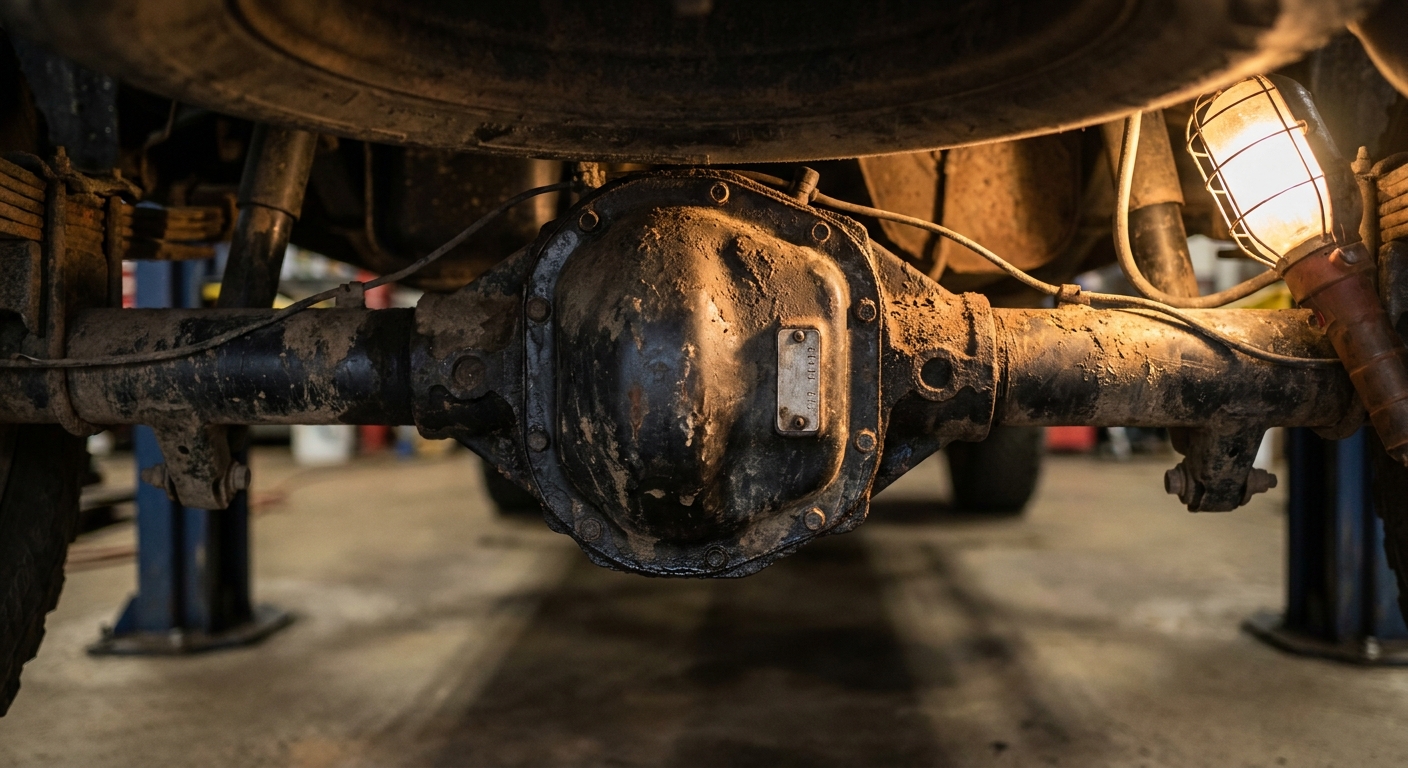
The tag on the differential. Many axles carry a metal tag under one of the cover bolts with the ratio stamped on it. It is filthy and easy to miss, but it is right there on the housing.
Count it. With the truck safely supported and both rear wheels off the ground, mark the driveshaft and mark one tire. Turn the tire exactly one full revolution and count how many turns the driveshaft makes. Between three and four turns means roughly a 3-point-something ratio; a bit over four means roughly 4.10. It is not laboratory precision, but it will tell you which family you are in, and that is usually the question.
Where it shows up on a used truck
This matters most on a unit you did not order yourself.
Fleets spec trucks for the work they had at the time, and that spec follows the truck forever. A pickup that spent its first life running light routes for a utility company was very likely ordered with a tall, fuel-friendly ratio. It looks identical to the one that was ordered to pull.
So when a used truck cannot do what you expected, the first suspicion is usually the engine or the transmission. Often it is neither: the truck is doing exactly what it was built to do, and it was built for a different job.
Check the ratio before you spend money chasing a performance problem that is not a fault.
What the number actually changes
A numerically higher ratio — 4.10 against 3.31 — multiplies torque more. The truck starts a heavy trailer more easily and holds a grade better.
The cost is that the engine turns faster at the same road speed. More rpm at cruise, more fuel burned empty, more noise on a long run.
A numerically lower ratio does the opposite: quieter and cheaper empty, and working harder every time you hook up.
Neither is better in the abstract. What matters is what the truck actually does. A unit that runs empty most of the week and tows twice a month is a different decision than one that never leaves the yard without a trailer.
One more number from the same guide
While you are in the manufacturer's towing guide, there is a figure worth writing down: the tongue load should be ten percent of the total loaded trailer weight.
That is not a suggestion from a forum, it is in the guide, and it is the number people get wrong in the direction that makes a trailer sway.
What to do with this
Find your axle ratio once, write it in the glove box next to your GCWR, and stop guessing. It takes a phone call and it settles every towing question you will have for as long as you own the truck.
And if the truck already pulls and it wanders, shudders or eats tires on one edge, that is not a ratio problem. We do suspension, alignment and driveline work in Houston, Dallas and Monterrey: thetrucksavers.com.
Reference: 2026 Ford RV & Trailer Towing Guide