The Annual Inspection Counts Four Units, Not One Truck
The annual inspection counts units, not trucks. The rule's own example inspects a tractor, a semitrailer, a full trailer and the converter dolly separately, and the paperwork for each one has to ride on that unit.
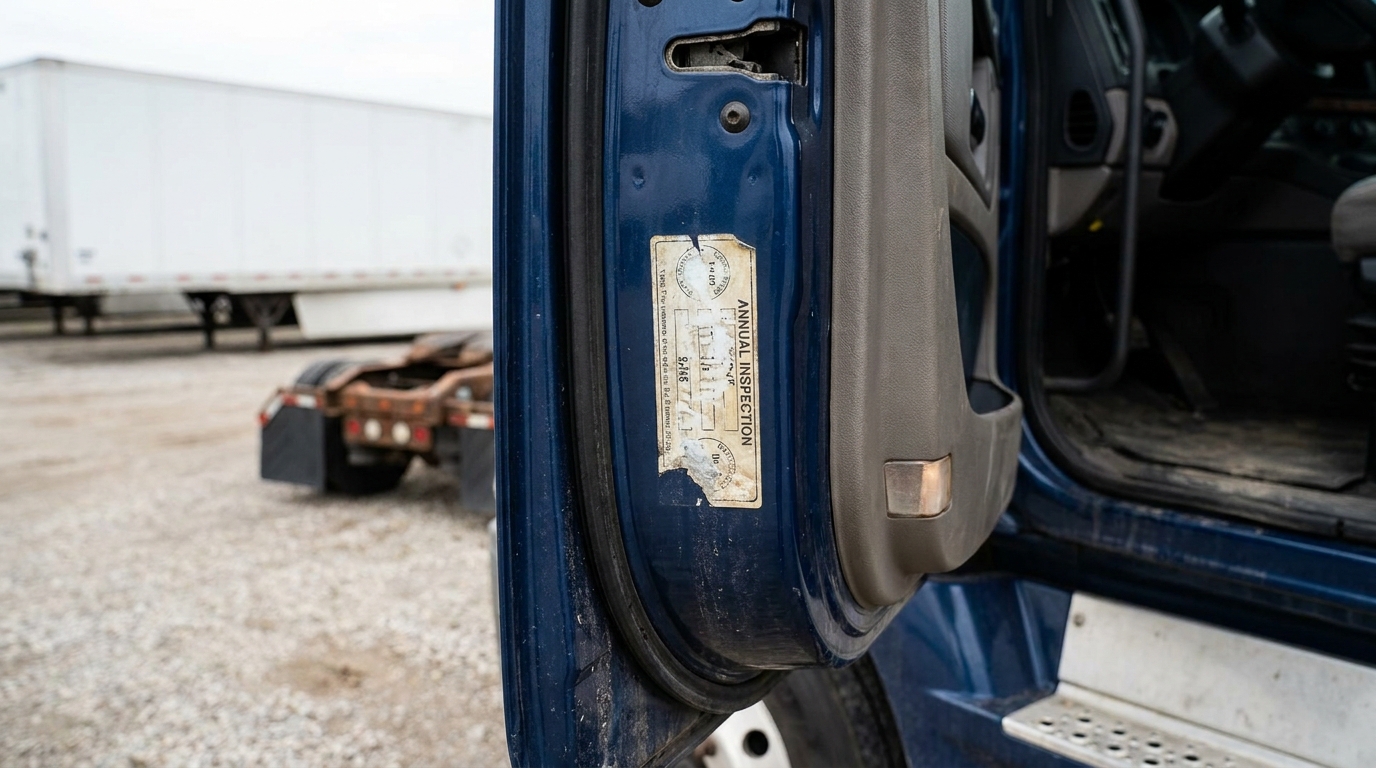
The decal on your door jamb covers one unit. The trailer behind it needs its own, and so does the dolly.
That is not a reading of the rule. It is the example the rule uses.
Count the units in your combination before someone else does it at a scale house.
Most owner-operators treat the annual inspection as one event: one truck, one shop visit, one sticker on the jamb, good for a year. Section 396.17 of the federal safety regulations does not work that way, and the gap between those two ideas is where a clean maintenance record turns into a roadside finding.
The rule counts units, not trucks
Paragraph (a) is short and it is blunt. Every commercial motor vehicle must be inspected covering, at a minimum, the parts and accessories in appendix A to part 396. Then it defines its own term: the term commercial motor vehicle includes each vehicle in a combination vehicle.
And it gives you the example itself. For a tractor, semitrailer and full trailer combination, the regulation says the tractor, the semitrailer and the full trailer including the converter dolly if so equipped must each be inspected. Four units in that example. Four inspections.
Pull a plain tractor and one van and you have two units, not one. That is still twice what a lot of operators have on file.
The paper has to ride with the unit
Paragraph (c) is the one that gets written up. A carrier must not use the vehicle unless each component in appendix A has passed an inspection at least once during the preceding 12 months, and the documentation of that inspection is on the vehicle.
You have two ways to carry it. The inspection report prepared under 396.21(a), or other documentation based on that report — a sticker or a decal — which has to contain four specific things:
- The date of the inspection.
- Name and address of the motor carrier, intermodal equipment provider or other entity where the inspection report is kept.
- Information uniquely identifying the vehicle, if that is not already clearly marked on it.
- A certification that the vehicle passed an inspection in accordance with 396.17.
A decal missing the address of where the report lives does not do what the rule asked. Look at yours.
Fifteen categories, and brakes are only the first
Appendix A is titled Minimum Periodic Inspection Standards, and it opens by saying a vehicle does not pass if it has one of the listed defects. The list runs through fifteen headings: brake system, coupling devices, exhaust system, fuel system, lighting devices, safe loading, steering mechanism, suspension, frame, tires, wheels and rims, windshield glazing, windshield wipers, motorcoach seats, and rear impact guard.
Notice what that means for a trailer. Coupling devices, suspension, frame, tires, wheels and rims, lighting and the rear impact guard are all trailer items. The trailer is not along for the ride here — it carries most of the list.
Who is allowed to sign it
Paragraph (d) lets a motor carrier perform its own annual inspection. Paragraph (e) lets it hand the job to a commercial garage, a fleet leasing company, a truck stop or a similar commercial business acting as its agent — provided that business operates and maintains facilities appropriate for commercial vehicle inspections and employs qualified inspectors.
Qualified is defined, in 396.19. The individual has to understand the inspection criteria in part 393 and appendix A and be able to identify defective components, has to have mastered the methods, procedures, tools and equipment, and has to be capable by experience, training or both — either a completed federal or state sponsored training program or a certificate from a state or Canadian province, or a combination of training and experience totaling at least one year.
Your cousin with a good set of wrenches is not automatically a qualified inspector. The rule wrote down the bar.
The state inspection clock starts at the end of the month
This one is quietly worth money. Under paragraph (f), a vehicle that passes a periodic inspection under a state government or an equivalent jurisdiction in the Canadian provinces, the Yukon Territory or Mexico — meeting the appendix A minimums — is considered to have met the annual requirement. For twelve months commencing from the last day of the month in which the inspection was performed.
Inspected on the third of the month, your clock still starts on the thirty-first. Read the expiration off the end of the month, not off the date stamped on the paper, and stop giving away weeks you already paid for.
What to do before your next load
- Count your units. Tractor, semitrailer, full trailer, converter dolly. Each one is a separate inspection with separate documentation.
- Read your own decal against the four items in paragraph (c). Date, name and address, unique vehicle identification, certification.
- Confirm the paper is on the unit, not in a folder at the house. The rule says on the vehicle.
- Ask the shop about 396.19 before the inspection, not after. Training program, state certificate, or a year of combined training and experience.
- Write the expiration as the last day of that month and put it on your calendar sixty days out.
Paragraph (g) puts the responsibility on the carrier to keep every appendix A component at the minimum or repaired promptly, and paragraph (h) sends failing to perform the annual properly to 49 U.S.C. 521(b).
At The Truck Savers™ the inspection is free and no appointment is needed, and Truck Savers News keeps documenting the regulatory side of this trade. Get the weekly TSN newsletter and see the rules before they see you.
Original source
Every requirement above is quoted from the regulation in force: 49 CFR 396.17, Periodic inspection, and the fifteen categories are from appendix A to part 396, Minimum Periodic Inspection Standards. Title 49 edition current as of August 19, 2026.