SR 167 Fife Tolls Begin December 14: Count Your Axles
The Fife expressway starts tolling December 14. Check the axle count and payment method before quoting a Port of Tacoma trip.
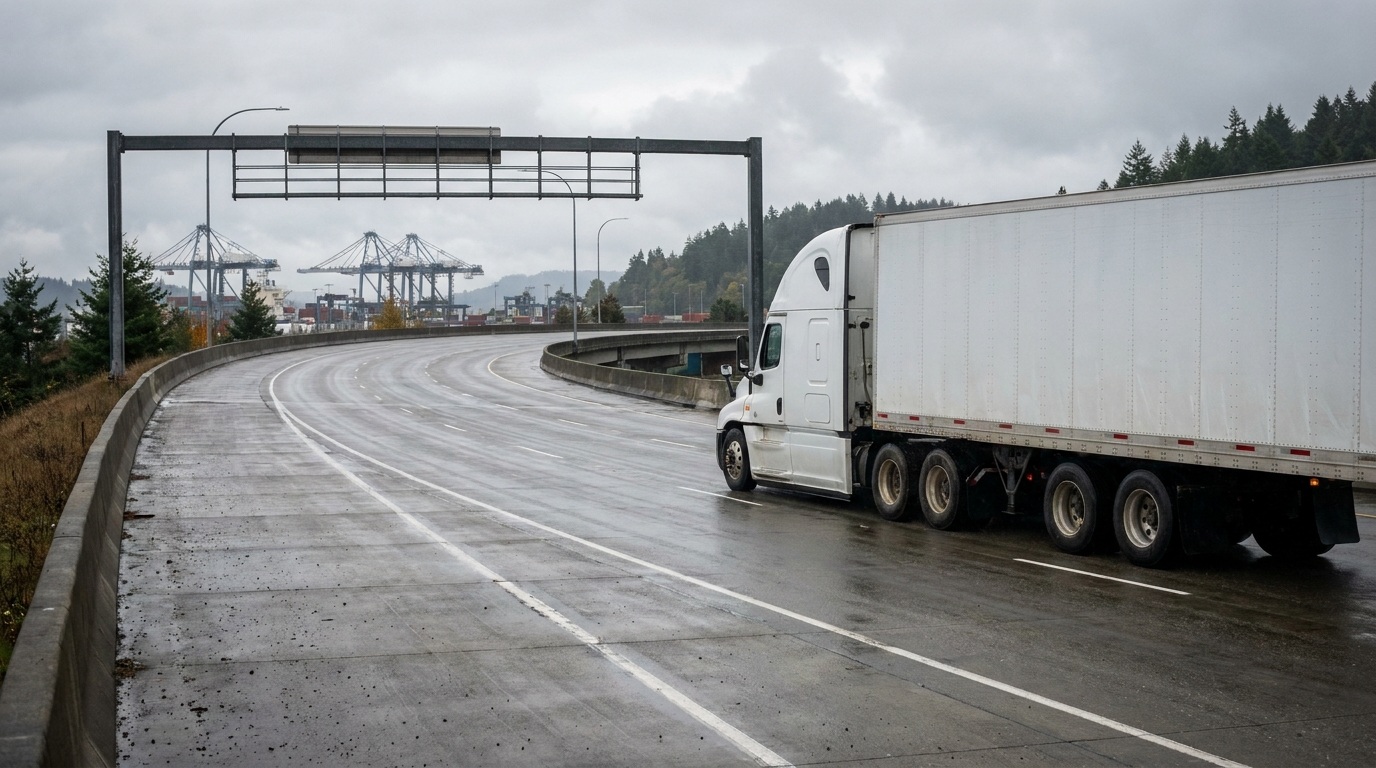
AI-generated editorial illustration; not a documentary photograph.
Washington has announced a date that belongs in a freight dispatch calendar: tolling on the SR 167 Expressway in Fife begins at 5 a.m. Monday, December 14, 2026, local time. The affected section connects Interstate 5 with SR 509 near the Port of Tacoma. For an owner-operator, the immediate job is to identify whether a planned movement actually uses that section, then put the correct payment arrangement into the trip estimate.
The WSDOT announcement describes a $1 base toll with a valid Good To Go! pass, with another 50 cents for each axle beyond two. Collection applies in both directions at all hours. Without a Good To Go! account, a mailed bill carries a higher rate, at least $2 more per trip depending on axle count. Nearby untolled alternatives remain free. These are conditions of this expressway announcement, not a price list for every Washington toll road.
Identify the section before changing a quote
Write the actual origin, terminal or warehouse, and destination beside the proposed route. A reference to Tacoma in a load description does not establish that the truck will enter the new expressway. Equally, seeing SR 167 on a navigation screen does not identify every segment or its charging rules. Ask the route planner to mark the specific I-5–SR 509 connection and the direction of travel. That gives dispatch and the driver a shared reference instead of two different ideas of the same road.
This distinction matters when a customer gives only a terminal name. The gate used for a container move, an off-site storage yard, and a warehouse receiving entrance may produce different approach routes. Confirm the entrance with the facility rather than inferring it from an area name. The purpose is a reliable route estimate; this article does not recommend an unverified truck detour, promise a shorter trip, or establish access permission at a port facility.
Put the complete combination on the worksheet
The announced structure makes axle count relevant. Record the combination expected for that movement, not merely the tractor number or the equipment type carried in the dispatch system. A planning example using the stated valid-pass structure is a five-axle combination: $1 plus three additions of $0.50 equals $2.50 for one use. That calculation assumes the announced terms apply; it is an illustration, not a toll bill or a quote for an unidentified vehicle.
A useful estimate names its assumptions. Put the road section, intended travel date, expected number of uses, axle count, and account or pass arrangement in separate fields. If equipment changes between quoting and dispatch, recheck the relevant fields. Do not multiply an old passenger-vehicle amount across all truck moves. Nor should a dispatcher treat an example calculation as evidence of a discount, an exemption, or an account configuration already in place.
Assign the payment check to a person
Before the first affected dispatch, decide who verifies the company's payment setup and who handles a mismatch. A driver may be using a company tractor, a leased unit, or equipment assigned temporarily. Keep the operational question specific: which vehicle and pass will be used for this trip, who controls the applicable account, and where will the resulting charge be reconciled? Those questions can be answered before a load is accepted.
The announcement says account options include a card on file or an automatically replenished prepaid balance. The fleet should review the provider's actual terms and its own controls rather than assuming that opening an account settles every administrative detail. Do not put payment credentials in a driver handoff, group message, or public post. A dispatch record needs the responsible person's name and confirmation status, not secret account access.
Separate the road charge from the freight agreement
A toll estimate and a customer reimbursement agreement are different records. The road operator's charge does not establish what a broker or shipper will pay the carrier. Before accepting a movement, identify how the written freight agreement handles route costs, what supporting documentation it requests, and which person can clarify an unresolved term. This is an operational review step, not a statement that a particular customer owes reimbursement.
For a recurring lane, compare the estimate with the actual matched charge after the trip. Record the date, unit, trailer if relevant, route section, and load reference in a private business file. Investigate a discrepancy before using it as the new standard for future quotes. A difference could reflect a changed assumption; this article does not diagnose the account or assert that any charge is incorrect.
A short handoff before December 14
- Confirm that the planned approach uses the Fife expressway section covered by the announcement.
- Record the trip date, direction, equipment combination, and axle count.
- Have the responsible employee verify the applicable pass and account arrangement.
- State the expected number of expressway uses and the assumptions behind the estimate.
- Keep the customer agreement and the eventual road charge as separate, traceable records.
- Leave any unresolved access or billing question visibly open for follow-up.
Use the announcement as a dated planning input and recheck the official terms before travel. The value is knowing which cost belongs to which route and vehicle, not assuming the new road produces a guaranteed saving. For other route services, start with the Truck Saver Finder directory and verify the facility's current entrance and services directly. A listing is a starting point, not a truck-access clearance.
Original source: WSDOT.