Retreads Are Legal Up Front. Regrooves Are Not
Almost everybody thinks retreads are banned on a truck's steer axle. That rule is about buses. What 49 CFR 393.75 actually restricts on trucks is regrooved tires, and only above a load rating.
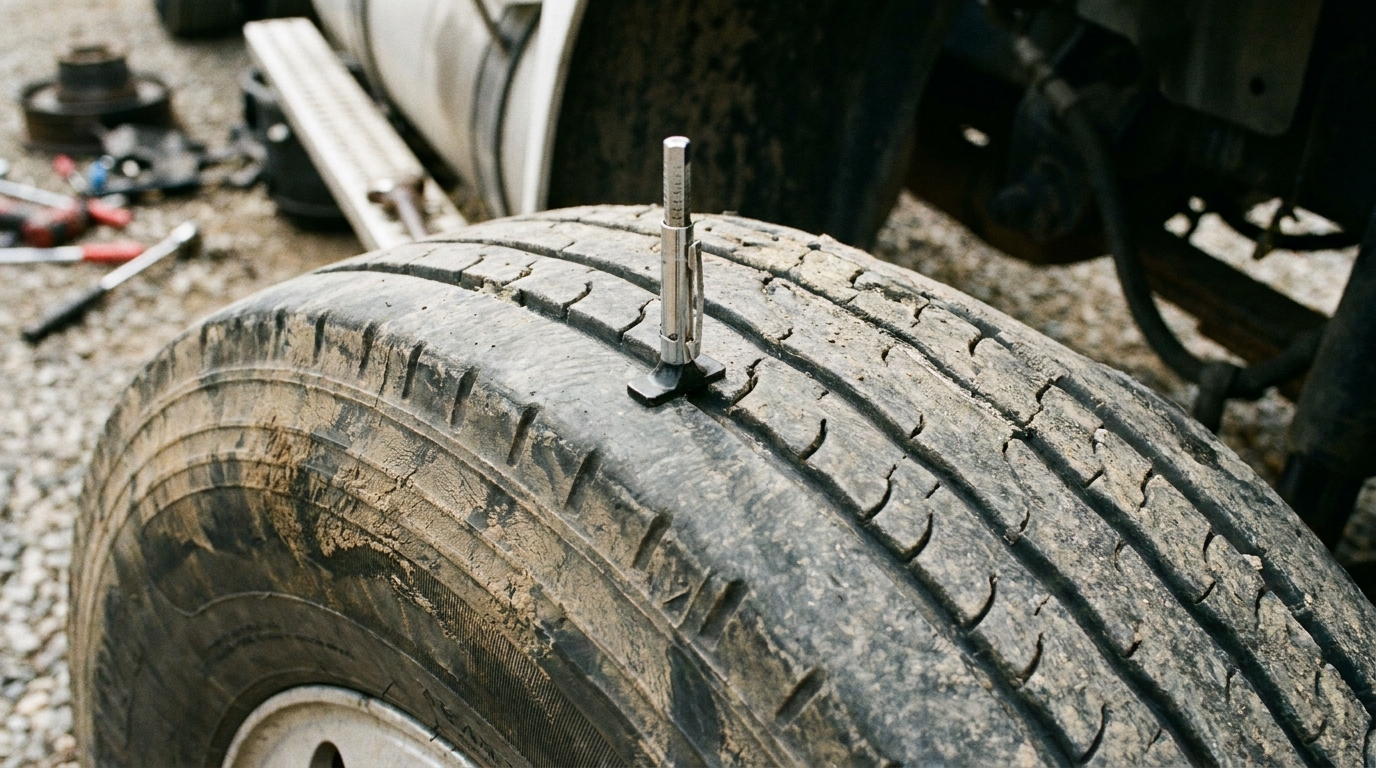
Ask around a truck stop and most people will tell you that retreads are illegal on the steer axle. They are not — not on a truck. The rule that everybody half-remembers is about buses, and the one that actually restricts trucks is about a different thing entirely.
What 49 CFR 393.75 actually says
Four separate paragraphs, and they do not say the same thing:
- (d) Buses: no regrooved, recapped or retreaded tires on the front wheels. Flat prohibition.
- (e) Trucks and truck tractors: a regrooved tire rated at 2,232 kg (4,920 pounds) or more may not be used on the front wheels. That is it — the paragraph says nothing about retreads.
So on a truck steer axle, a retread is not prohibited by this section. A regrooved tire above that load rating is.
Regrooved is not retreaded, and the difference is the whole point
Regrooving cuts new grooves into the remaining rubber of a worn tire. Retreading bonds a new tread onto an inspected casing in a plant. One removes material from a tire that is already worn; the other adds material to a casing that passed inspection.
The regulation treats them differently because they are different operations, and confusing them is how a driver ends up arguing the wrong point at a roadside inspection.
The depths, which are not the same front and back
- Front wheels of a bus, truck or truck tractor: 4/32 of an inch minimum, measured in a major tread groove.
- Everything else: 2/32 of an inch minimum.
And a detail that costs people points: the measurement may not be taken where the tie bars, humps or fillets are. Those are the raised sections inside the groove. Measure there and you get a shallower reading than the tire actually has — or a deeper one, depending on where you land. Either way it is not the legal measurement.
The four conditions that put a tire out of service regardless of depth
Paragraph (a) does not care how much tread is left. A vehicle may not be operated on a tire that:
- has body ply or belt material exposed through the tread or sidewall;
- has any tread or sidewall separation;
- is flat or has an audible leak;
- has a cut deep enough to expose ply or belt material.
"Audible leak" is worth reading twice. If you can hear it, the tire is already out of service — there is no threshold to argue about.
One more that almost nobody checks
Paragraph (f): a tire labeled with a maximum speed of 55 mph or less may not be operated above that rating. Speed-restricted tires exist on plenty of specialty and heavy-haul equipment, and the label is on the sidewall.
What to do with this
- Know which tire you have. "Retread" and "regroove" get used interchangeably in conversation and they are not the same thing to an inspector.
- Measure in a major groove, away from the tie bars. Same gauge, different spot, different number.
- Check the steer axle at 4/32, not 2/32. A tire that is legal on the drives is not automatically legal up front.
- Do not treat "legal" as "recommended." The rule sets a floor. Your customer, your insurer or your own margin for error may sit higher, and that is a business decision, not a compliance one.
If you would rather have somebody else measure it before an inspector does, the +100 point inspection covers it: The Truck Savers, free and no appointment.