Record Crude Output, Record Prices at the Pump
The EIA forecasts 13.8 million barrels a day in 2026, a new record. The pump did not get the memo.
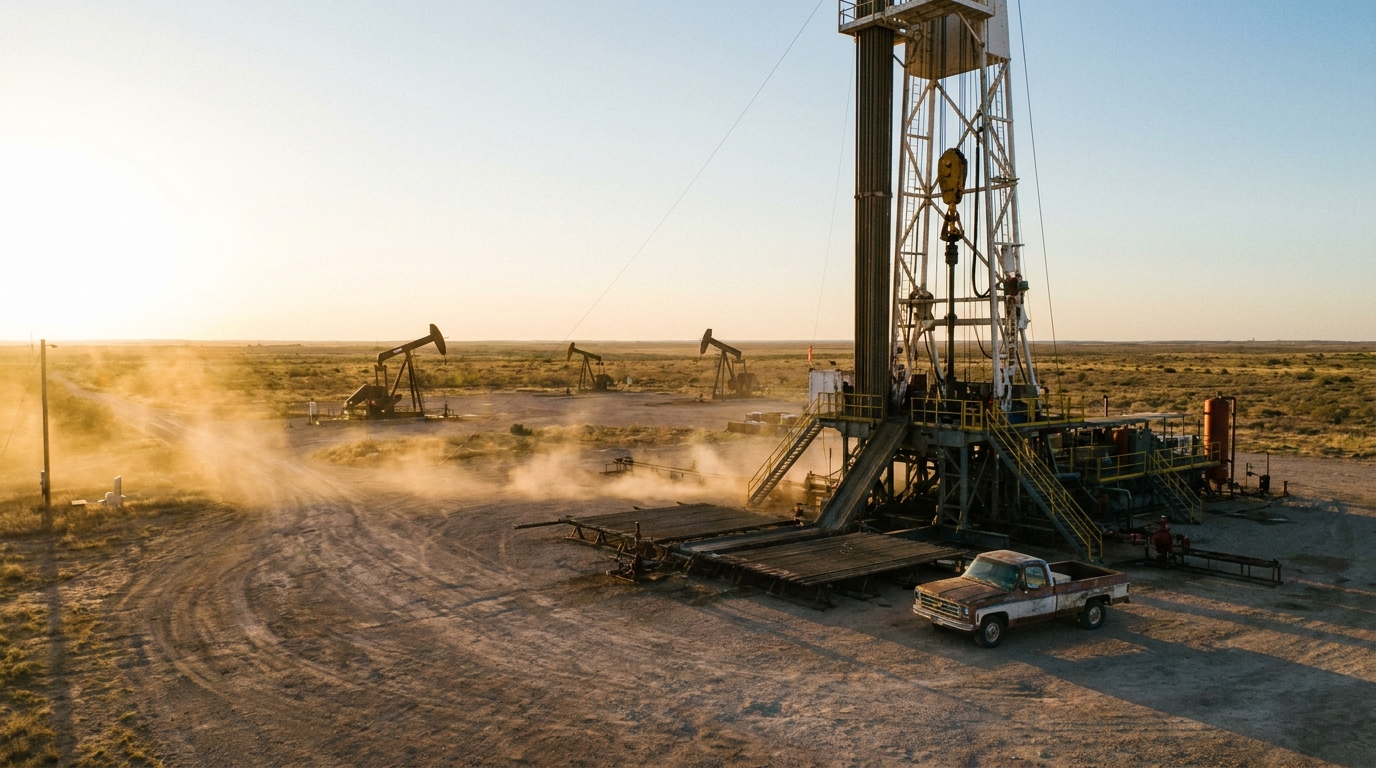
The same week diesel hit a record at the pump, the country is on track to pump more crude oil than it ever has.
Both things are true. Neither one cancels the other, and the gap between them is where a lot of money gets lost in arguments at the fuel desk.
The number
The Energy Information Administration forecasts United States crude oil production will average 13.8 million barrels per day in 2026, passing the previous record of 13.7 million set in 2025.
That is not a projection built on hope. Production in the first half of 2026 already averaged 13.7 million b/d, which is 2% more — 0.3 million barrels a day — than the same stretch of 2025.
Notice how small the increment is. A record by one tenth of a million barrels is a record, but it is not a flood.
Where the barrels come from
Two places account for most of the growth.
The Permian, in Texas and New Mexico, is forecast at 6.8 million b/d in 2026, 3% above last year. Roughly half the country's output, out of one region.
The Federal Gulf of America added 0.2 million b/d in the first half, a 10% jump, and is forecast up 3% for the year. That came from four projects that came online in the last year or so: Shenandoah at about 70,000 b/d since July 2025, Ballymore at 58,000 since April 2025, Whale at 38,000 since January 2025, and Salamanca at 25,000 since late 2025. Four smaller ones are expected before the end of the year.
The number that says whether it keeps going
Here is the part worth understanding, because it tells you something about next year and not just this one.
Drilling happens when the price beats the cost. West Texas Intermediate went from an average of $65 a barrel in 2025 to $84 through August 2026.
Against that, operators told the Dallas Fed's energy survey in March what it costs them to break even: $69 a barrel in the Midland Basin and $63 in the Delaware Basin, the Permian's two biggest.
Eighty-four against sixty-nine. That is a working margin, and it is the reason the rigs are running. It also tells you what would slow them down — not a policy announcement, a price that falls back toward the sixties.
So why is diesel at a record too
Because the barrel is not what you buy.
Crude comes out of the ground. Diesel comes out of a refinery. What you pay at the pump is the crude plus what it costs to turn it into fuel, and that second piece has been unusually expensive. We laid that out separately in the piece on the crack spread, and it is the actual answer to "how can production be at a record and my fill-up cost more than ever."
The short version for the fuel desk: more crude does not mean cheaper diesel when the bottleneck is refining, not drilling.
What this changes for you
Not much this week, and that is worth saying plainly instead of dressing it up.
Do not budget on a coming drop. A production record is not a forecast of pump prices, and the EIA is not saying it is. If you are building a rate around fuel getting cheaper, you are guessing.
Watch the price of crude, not the volume. Volume tells you what is being produced. Price is what decides whether it keeps being produced. Eighty-four dollars with breakevens in the sixties is a comfortable gap; if that gap closes, the next year looks different.
Keep an eye on the Gulf in hurricane season. A tenth of the growth is offshore, and offshore stops when weather says so. This year's forecast from Colorado State University calls for a below-normal Atlantic season because of El Niño, which is good news, but a season being mild on average has never protected a single platform.
The part you actually control
None of the above is a lever you own. These are: tire pressure, alignment, brakes that release all the way, and hours spent idling. Each one of them turns diesel into nothing, and every one of them costs more to ignore at six dollars than it did at four.
We do alignment, suspension and tires in Houston, Dallas and Monterrey: thetrucksavers.com.
Original source: U.S. Energy Information Administration, United States on track for record crude oil production in 2026