Ram 1500 Recall: 1.27M Trucks Over Rear Belt Anchors
The second-row buckle anchors may have left the factory improperly installed, so the odometer tells you nothing. The VIN lookup opened August 6; letters mail August 18.
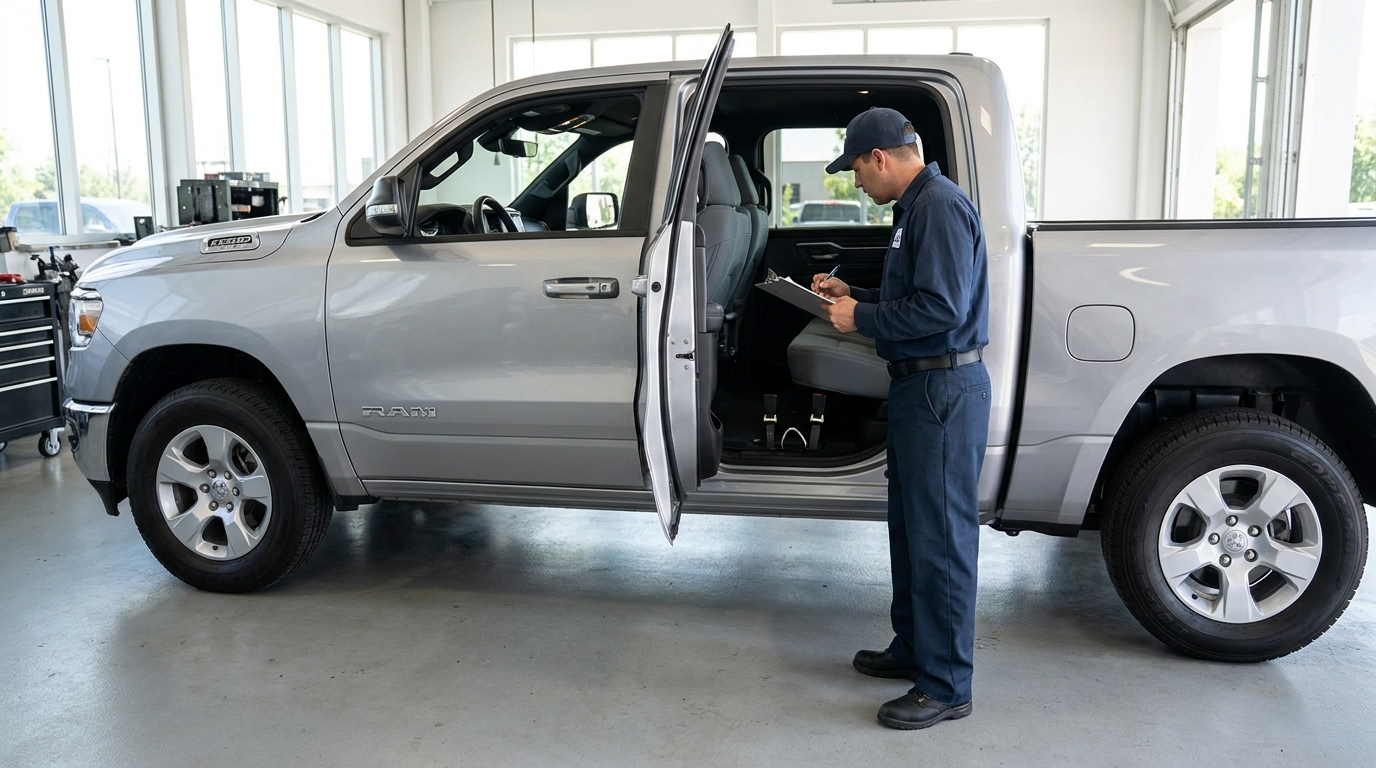
A seat belt anchor is not a wear part. Pads glaze, bushings sag, tires tell you they are done. An anchor that was bolted wrong at the factory gives you nothing to read — it looks identical on a truck with 900 miles and one with 190,000. That is what makes this campaign different from most: your odometer cannot answer it.
What the filing says
The campaign is numbered 26V495000 and reached federal regulators on July 30, 2026. Chrysler (FCA US, LLC) is recalling certain 2019-2026 Ram 1500 pickups — 1,271,294 units, one of the largest single campaigns of the year. The listed component is SEAT BELTS: REAR/OTHER: ANCHORAGE.
The stated defect is that the second-row seat belt buckle anchors may have been improperly installed. The anchor is the fastening point that ties the buckle stalk to the body structure of the truck, underneath and behind the rear bench. Because of that installation, the vehicles do not comply with Federal Motor Vehicle Safety Standard 210, "Seat Belt Assembly Anchorages" — the rule that sets how much load an anchorage has to hold and where it has to be.
That word, noncompliance, is the part worth reading twice. This is not a component that degraded in service. It is a truck that left the plant outside the standard, which is why the affected range runs across eight model years instead of one bad production month.
Why the second row is the row that matters here
For a work pickup, the second row is not where the family rides on weekends. It is where the helper rides to the job, where a crew of three rides to a yard, where a driver's relief sits on a long transfer. A half-ton crew cab earns its keep precisely by carrying people in those seats.
So the exposure is not theoretical for an operator running Ram 1500s as service or support trucks: the seats under the recall are the seats being used, every day, by someone on your payroll. The filed consequence is straightforward — an improperly installed anchor may fail to properly restrain occupants.
What the record does not say
Three absences in the record are worth as much as the defect. Owners were not told to stop driving, and there is no park-outside instruction. There is no fire risk attached to this campaign. And the remedy is not a parts replacement queue: dealers will inspect and attach the seat belt buckle anchor to the body structure as necessary, free of charge.
That last detail changes the math for anyone who avoids recall work because of downtime. "As necessary" means a large share of these 1.27 million trucks will be inspected, found correct, and handed back. The visit is an inspection first and a repair only if yours is one of the wrong ones.
The dates, and the one that already passed
Owner notification letters are expected to be mailed August 18, 2026. But the useful date is the one already behind us: VINs involved in this recall became searchable on NHTSA.gov on August 6, 2026. The lookup is open now. Waiting for the envelope adds nothing except the time the mail takes.
Practical checklist
- Run the VIN, not the model year. "2019-2026 Ram 1500" is the outer boundary of the campaign, not a list of affected trucks. Only the VIN lookup tells you about your truck.
- Check every Ram 1500 in the operation, including the ones that never leave the yard and the one somebody drives home. Eight model years means mixed-age fleets are likely to have several.
- Quote the numbers when you call. Chrysler's internal number for this recall is 67D; the federal campaign is 26V495000. Customer service is 1-800-853-1403. A service writer finds it faster with the campaign number than with a description.
- Ask for the inspection result in writing, not just "we looked at it." A documented free repair, or a documented pass, is worth having.
- Do not try to torque it yourself. An anchorage is a certified structural attachment under FMVSS 210. A shop-tightened bolt does not restore compliance, and it does not close the recall in the manufacturer's record.
The preventive read
The habit this rewards is boring and cheap: when a truck joins the operation, run its VIN once, and run it again at every ownership or assignment change. Recalls do not follow the truck to the new owner by themselves — the letter goes to the address on the registration, which is frequently not where the truck sleeps. Fleets that lose recall notices almost never lose them to carelessness; they lose them to paperwork that moved.
Preventive maintenance coverage, shop guidance and operator resources are collected at thetrucksavers.com, and the practical maintenance and compliance reporting continues here at Truck Savers News.
Original source
Recall data verified directly against the federal recall record for campaign 26V495000: NHTSA, Chrysler (FCA US, LLC) recall 26V495000.