One Mirror Is Legal Only If You Can See Back Inside
Two outside mirrors are the rule. One is legal only when the driver can already see to the rear from inside the cab.
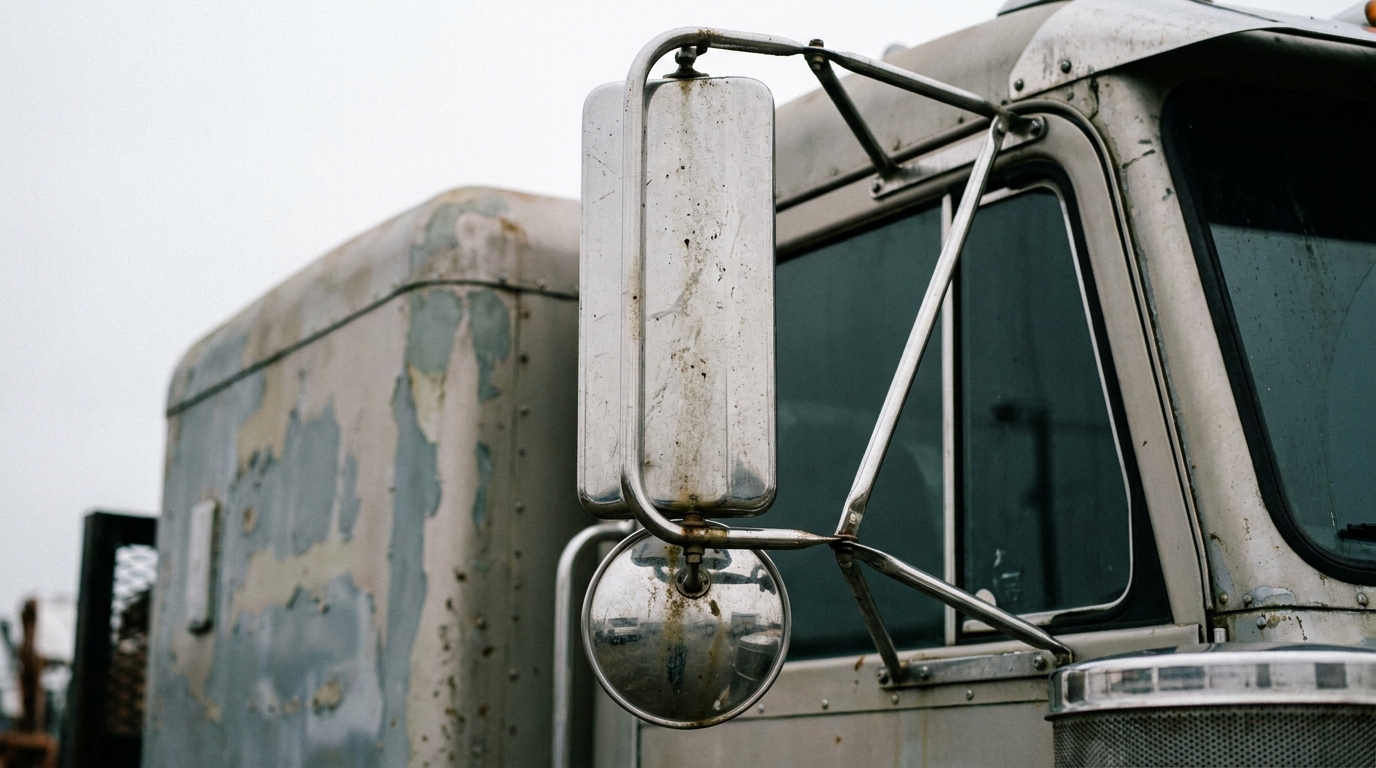
Two mirrors. That is the whole rule, and almost every truck on the road satisfies it without anyone thinking about it. The interesting part of 49 CFR 393.80 is the exception, because it describes a truck most drivers have never operated.
What the section actually requires
Every bus, truck and truck tractor has to carry two rear-vision mirrors, one on each side, firmly attached to the outside of the vehicle. They have to be located so they reflect to the driver a view of the highway to the rear, along both sides of the vehicle.
Two words in there do more work than they look. Firmly attached means a mirror that shakes itself useless at highway speed is not doing what the rule asks, even if it is physically bolted on. And along both sides means the requirement is about coverage, not about counting hardware: two mirrors aimed at the same lane satisfy the count and fail the purpose.
The standard is frozen to the build date
The mirrors, and any replacement for them, have to meet at least the requirements of Federal Motor Vehicle Safety Standard No. 111 — 49 CFR 571.111 — as that standard was in force at the time the vehicle was manufactured.
That phrasing shows up again and again in Part 393, and it is worth internalizing: the calendar that governs your equipment is the one on the data plate, not the one on the wall. It is the same logic that decides which trailers need antilock brakes and which sleeper berth dimensions apply to your bunk.
The practical consequence is about replacements. When a mirror gets taken off by a gate post, the part that goes back on is measured against the standard from the year the truck was built. Not the year of the accident, and not the newest catalog page.
The exception nobody uses
Paragraph (b)(2) is the one worth reading slowly. Only one outside mirror is required — on the driver's side — on trucks that are so constructed that the driver has a view to the rear by means of an interior mirror.
Read that against a tractor pulling a van trailer and it collapses immediately: there is no view to the rear through the cab, because there is a box in the way. The exception is written for straight trucks with an open or glazed back, the kind where a center mirror actually shows the road behind.
So the rule is not really "two mirrors." It is "cover both sides, and if your truck can already see straight back from inside, we will accept one outside mirror on your side." Almost no combination vehicle qualifies, which is why almost nobody has heard of it.
The other two exceptions
Mirrors installed on a vehicle manufactured before January 1, 1981 may stay in service. That is a grandfather clause, not an exemption: the moment they are replaced, the replacement has to meet FMVSS 111 as it stood when the vehicle was built.
And in driveaway-towaway operations — moving vehicles by driving them, one towing another — the driven vehicle needs at least one mirror giving a clear view to the rear.
Why this ends up in a violation column
Mirrors are the cheapest thing on a commercial vehicle that can put it out of service, and they fail for reasons that have nothing to do with the glass.
A loose bracket lets the head drift through the day, so the mirror that was aimed correctly at seven in the morning is showing the shoulder by noon. A cracked mounting arm passes a glance and fails a push. A convex spot mirror installed to fill a blind spot ends up angled so far down that the flat mirror above it is the only one doing work.
None of that is exotic. All of it is visible in the thirty seconds it takes to walk both sides of the unit before rolling.
What to check before you leave
Sit in the seat and confirm each mirror shows the side of the trailer and the lane beside it, not the sky and not your own tank.
Push each mirror head with one hand. If it moves and stays moved, the bracket is the problem, not the aim.
Look at the mounting arms where they meet the door or the cowl, because that is where cracks start and where vibration shows up first.
If a mirror was replaced recently, know what it was replaced with. The rule points at the standard from your truck's build year, and a bargain mirror that meets nothing in particular is a finding waiting to happen.
And if you run a straight truck and somebody told you one mirror is enough, check whether you actually have a rear view through the cab. That is the condition the exception rests on.
It takes half a minute and it is the kind of thing a shop should be looking at without being asked. At The Truck Savers the mirrors and their brackets go into the inspection with everything else, because a part that costs almost nothing can park a truck for the afternoon.