No Grease Fitting Means Do Not Grease It
Rubber bushings get no grease: petroleum breaks the rubber down. The fitting is the instruction, and play is how you find them.
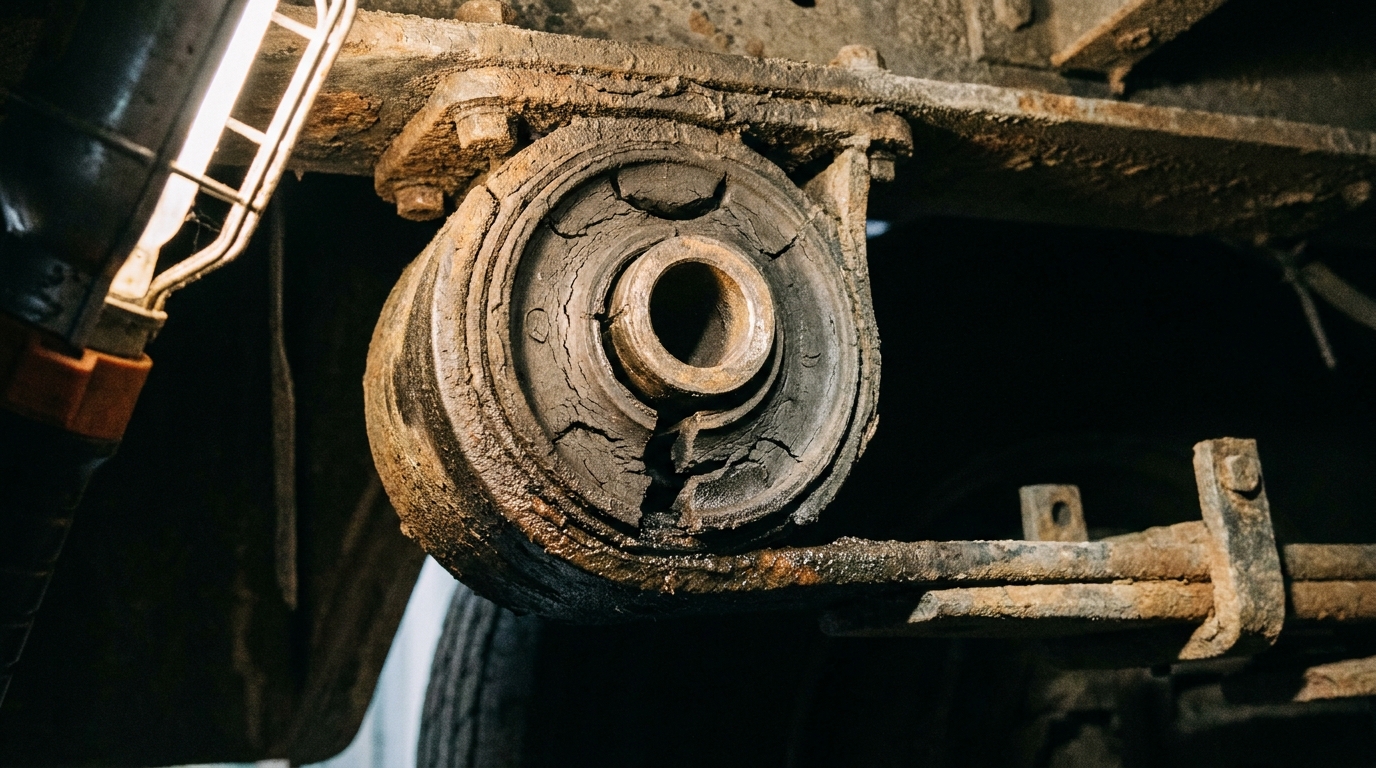
Two different drivers asked us about bushings today. One had a problem with his. The other wanted to know whether he should be greasing them.
The second question has a short answer that costs people money when they get it backwards: it depends on what the bushing is made of, and the truck already tells you.
If it has no grease fitting, it was not built to be greased
Rubber bushings do not get grease. Petroleum products swell rubber and break it down, so greasing a rubber bushing does not protect it — it shortens its life. That is the opposite of what the person with the grease gun is trying to do.
Bronze and metallic bushings that come with a zerk fitting do get grease, on the interval the component maker specifies.
So the fitting is the instruction. If the part has a zerk, somebody designed it to be greased. If it does not, nobody did, and adding grease anyway is not a favor.
What a worn bushing actually feels like
Most people go looking for a noise. Noise comes late and it lies about where it is coming from — sound travels through the frame and a clunk at the back can be born up front.
What a worn bushing really produces is play. Movement where there should be none, in a joint that is supposed to flex a controlled amount and no more.
You find play with a pry bar and the weight off the component, not by listening. Somebody works the bar while somebody else watches the joint. What you are looking for is the metal sleeve moving inside the bushing, or the bushing moving inside its housing. Either one means it is done.
And check the rubber itself while you are under there. Cracking, chunks missing, or the sleeve visibly off-center in the bore all say the same thing.
Why it matters before it fails
A bushing does not usually strand you by itself. What it does is let a component move in a way it was never supposed to move, and everything downstream pays for that.
That is why worn bushings and uneven tire wear show up together so often. If the axle can shift under load, the alignment you paid for is only correct while the truck is parked. You can align that truck perfectly and it will eat the tires the same way, because the geometry moves as soon as it goes to work.
The same logic covers the other things bolted through bushings: shock mounts, torque rods, spring hangers, cab mounts. Play in any of them means the part is not being held where the engineer put it.
It also explains a repair that keeps coming back. Replace a part but leave the worn bushing it mounts through, and the new part starts working itself loose from day one. The bill says the component was replaced; the truck says nothing changed.
The order to check them in
Start where the load is highest and the failures are most common: spring hangers and torque rod ends. Then shock mounts, then cab mounts.
Do it with the truck supported and the weight off the suspension. A bushing under full load is being squeezed into position and will hide its own play.
Do all the positions in one session, not the one you suspect. Bushings on a truck are the same age and have taken the same road; if one is finished, the others are on the same schedule. Finding out one at a time means paying labor four times to get under the same truck.
What to tell the shop
Say how the truck behaves, not what you think is broken. Wandering, a shimmy that comes with load, tires wearing on one edge after an alignment, a clunk over expansion joints — those give a mechanic somewhere to look.
And if you have had an alignment recently and the tires are still wearing wrong, say that too. It is one of the strongest hints there is that something is moving that should not be.
We do suspension and alignment work in Houston, Dallas and Monterrey: thetrucksavers.com.
Reference: 49 CFR 393.207, suspension systems (FMCSA)