Mud Flap Rules for Trucks: Texas vs. California
Texas measures mud flap clearance in inches. California measures whether the flap actually stops the spray and covers the tread. Here is what each state requires.
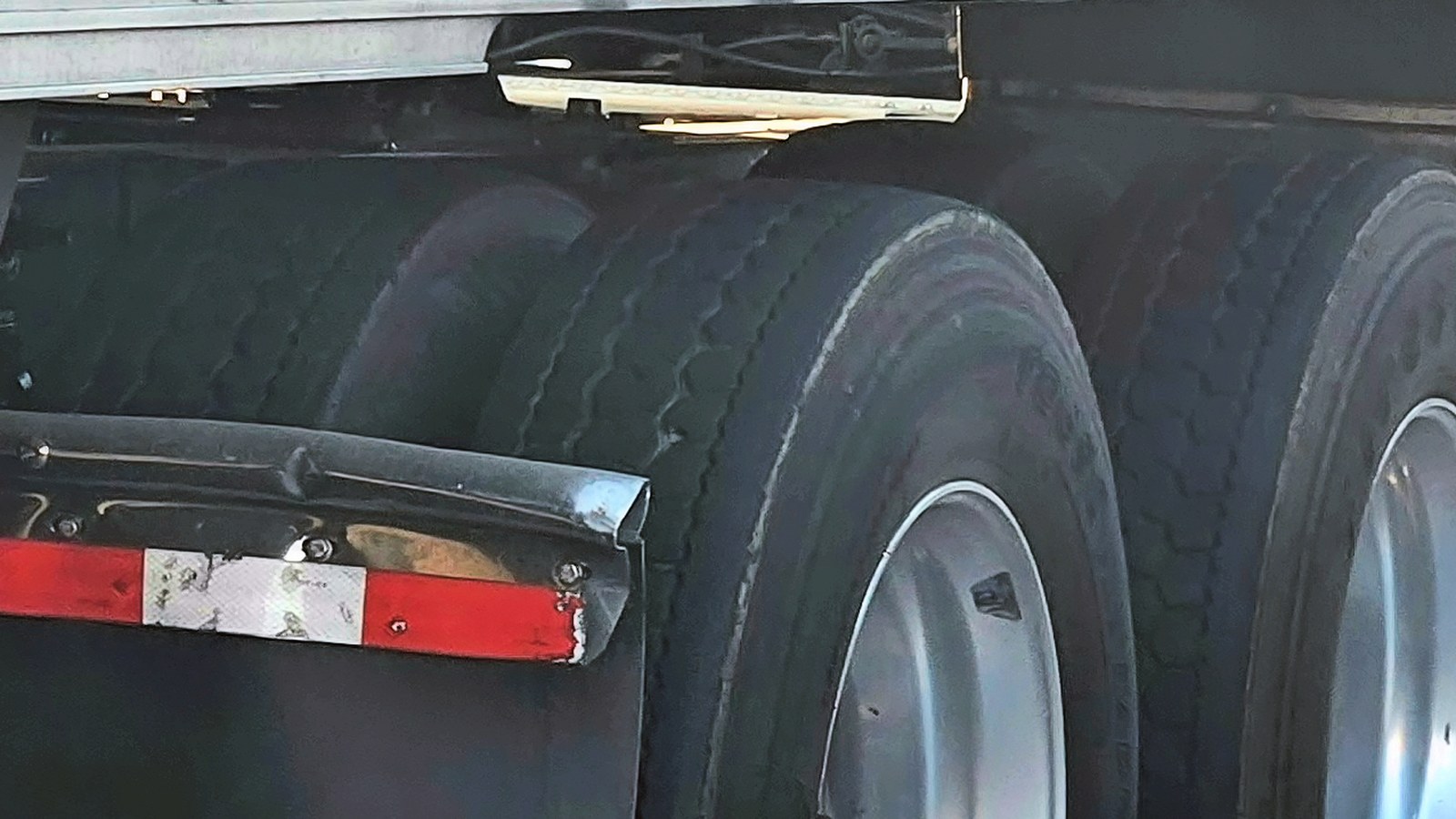
Two states, two completely different tests for the same piece of rubber. Texas tells you where the flap has to end. California tells you what the flap has to accomplish. A unit that clears one standard can still be written up under the other, and drivers running Interstate 10 end to end pass under both in the same week.
Texas gives you a number you can measure
The Texas rule lives in Section 547.606 of the state Transportation Code, and it is written for equipment inspectors rather than for lawyers. It applies to a road tractor, a truck, a trailer, a truck-tractor pulling a semitrailer, or a semitrailer behind a towing vehicle, whenever that unit carries at least four tires, or at least two super single tires, on its rearmost axle. The statute defines a super single as a wide-base single tire used in place of two standard tires on the same axle, which means the wide-base conversion many fleets ran for weight savings does not put a trailer outside the rule.
Where the rule gets concrete is the clearance. The guards or flaps have to be of a type prescribed by the department, and they must hang behind the rearmost wheels within eight inches of the road surface. Eight inches is a tape-measure standard. An inspector does not have to argue about how much water your trailer throws, and neither do you.
Two carve-outs matter for day-to-day planning. The section does not apply to a truck-tractor operated alone, so a bobtail move is outside it, and it does not apply to a pole trailer. The current wording of the clearance and tire language dates to a 2011 amendment, so a shop manual printed before that is not a safe reference.
California asks what the equipment actually does
California takes the opposite approach in Section 27600 of its Vehicle Code, and the scope is far wider. It reaches any motor vehicle with three or more wheels, plus any trailer or semitrailer. There is no bobtail carve-out written the way Texas wrote one.
The requirement is a result rather than a dimension. The vehicle needs fenders, covers or devices, including flaps or splash aprons, or a body and attachments that afford adequate protection to effectively minimize spray or splash of water or mud to the rear. Nowhere does the section name a distance from the pavement. What it does add is a width rule that catches a lot of aftermarket parts: whatever you mount has to be at least as wide as the tire tread.
The exemptions are narrow and mostly historical. Vehicles exempt from registration are out, as are trailers and semitrailers with an unladen weight under 1,500 pounds, and certain pre-1971 vehicles under that same weight. None of that helps a loaded commercial unit.
Where operators get caught in between
Put the two rules side by side and the gap shows up immediately. A narrow flap trimmed to hang exactly eight inches off the deck can satisfy the Texas measurement and still be narrower than the tread it sits behind, which is a California problem. A generous flap that stops spray beautifully can satisfy California and still hang ten or twelve inches high after a suspension change or a worn bracket, which is a Texas problem.
The trap is treating any single number as a national rule. There is no federal ground-clearance figure that settles this for you, and the two states reviewed here do not agree on the question. If your lanes touch both, build to the stricter reading of each requirement at once: wide enough to cover the tread, low enough to sit inside the Texas limit.
What to look at before you roll
- Measure, do not eyeball. Take the tape to the bottom edge of the flap with the trailer at normal ride height, not empty in the yard.
- Compare width to tread, not to the bracket. The California test is the tire tread behind it, and a replacement flap is often narrower than the original.
- Check the hardware, not just the rubber. A bent hanger or a stretched bracket raises the bottom edge without anything looking obviously broken.
- Re-measure after suspension or tire work. A ride-height change or a switch to wide-base tires moves the flap relative to the road.
- Know which units are actually covered. Running bobtail through Texas is not the same exposure as pulling a loaded trailer through it.
Mud flaps are one of the cheapest items on the whole unit and one of the easiest to fail on. A flap replaced in the yard costs a few minutes. The same flap found at a scale house costs the clock, and it puts an equipment note on a record that follows the truck. If you are pricing replacements, the parts and accessories catalog at The Truck Savers store is a practical starting point, and there is more operator-side maintenance coverage at thetrucksavers.com.
Finally, treat this as a two-state comparison and nothing more. Every state writes its own splash and spray language, and the only version that protects you on a given lane is the one on that state's books.
Original source
Statutory text reviewed directly: Texas Transportation Code, Chapter 547 and California Vehicle Code, Section 27600.