Monza Opened September 3, 1922, After 110 Days of Work
Monza opened on September 3, 1922. It went up in 110 days and never stopped being the fastest.
Monza opened on September 3, 1922. The Automobile Club of Milan had decided to build it that January, to mark the club's twenty-fifth anniversary, and the work took one hundred and ten days. Next weekend, September 4 to 6, grand prix cars come back to it for the one hundred and fourth year.
One hundred and ten days. Design by an architect named Alfredo Rosselli, ground broken in the middle of May, cars on track by the first week of September. There is no modern circuit anywhere that gets built on that schedule, and very few things of any kind.
Third in the world, and the only one still doing the job
Monza was the third purpose-built race track on earth, after Brooklands in England and Indianapolis in the United States. Not third in Italy. Third anywhere.
Brooklands is gone as a racing venue. Indianapolis is still running. Monza is still running too, and it is the only one of the three that has held a round of the top international championship almost without interruption since that championship existed. It was on the original calendar in 1950 and has hosted the Italian round every year but one since.
What they actually built in 1922
The original site was two circuits sharing the same piece of park, which is a strange idea today and was a normal one then.
- A road course of 5.5 kilometers, winding through the trees.
- A high-speed loop of 4.5 kilometers, with two banked curves joined by two straights of 1,070 meters each.
- The banking was calculated for something in the range of 180 to 190 kilometers per hour — theoretical, in 1922, on the tires of 1922.
You could run either one, or you could join them and run both. The combined layout is where the circuit's reputation for speed started, and it never really left.
The banking that is still standing in the woods
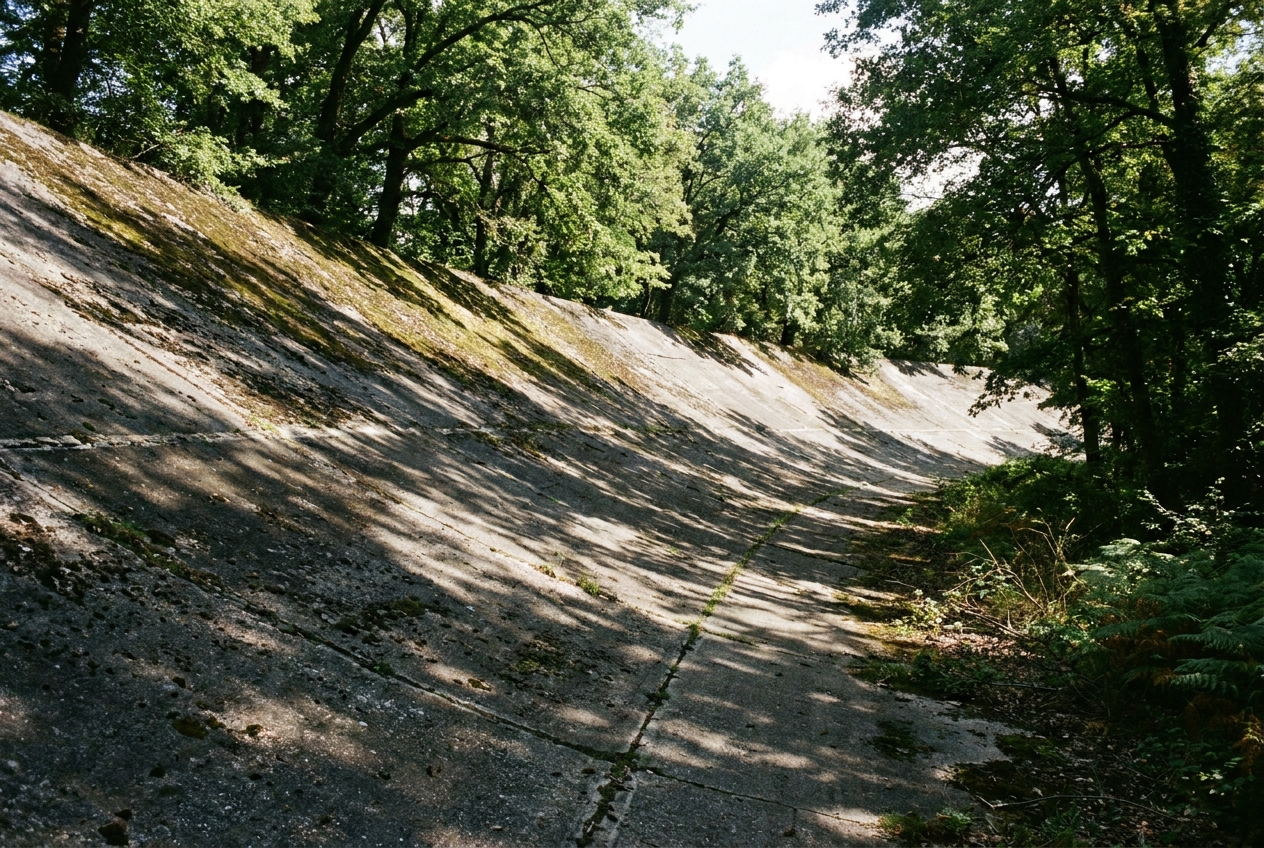
The high-speed loop was rebuilt in the 1950s, longer and steeper: 4,250 meters, curves with a 320-meter radius, geometry calculated for roughly 285 kilometers per hour.
It was used heavily through the 1960s and then it stopped being used by the top category. It was never demolished. The concrete is still out there in the park, weathered and streaked and slowly going green at the edges, and you can walk up to it. Photographers have been going there for sixty years for the same reason: it is a piece of engineering that stopped being needed and refused to disappear.
The modern circuit is short on corners and long on nerve
Today's layout runs 5,793 meters. The chicanes that break up the straights were added over decades, one safety review at a time, and every one of them was an argument.
What survived all of it is the character. Monza is still the fastest circuit the championship visits. Cars run the least downforce of the year here, which makes them quick in a straight line and nervous everywhere else. The Parabolica — a long, single-pitch, opening-radius right-hander onto the main straight — is still the corner everyone talks about, because it is the one where getting greedy early costs you the entire straight afterward.
Why a truck publication cares about an Italian park
Because Monza is the clearest example in motorsport of a simple idea: speed does not create problems, it reveals them.
A circuit with low downforce and enormous braking zones does not politely hide a weak component. Brakes that are merely acceptable become the limiting factor within a few laps. A cooling system with no margin finds its margin. Everything marginal gets named, quickly and publicly, because the track asks the same question at the same three places every single lap.
That is exactly the relationship a working truck has with a long grade, a heavy load and a schedule. The difference is only that the truck asks the question once every few thousand miles instead of once every eighty seconds, so the answer arrives later and in a worse place.
The dates, for anyone planning around them
Grand prix racing returns to Monza on September 4 to 6, 2026, the fifteenth round of the season, over 53 laps of the 5.793-kilometer circuit. Practice on Friday, qualifying Saturday, race Sunday. No sprint on this weekend's format.
The preventive read
The old banking is still standing because of how it was built, and it is honest about its age in a way nothing else on the property is. You can see every year of it in the concrete.
Trucks are the same, and less forgiving, because nobody keeps them as a monument. What tells you the real condition of a unit is not how it feels on a good road — it is a measurement, taken deliberately, before the grade asks for it. At The Truck Savers the inspection is free and that is exactly what it produces: a number, not an impression. Los fierros nunca mienten.
Original source: Autodromo Nazionale Monza — History.