Mismatched Duals: One Tire Drags the Other
Michelin puts the limit at a quarter inch of height between duals. Past that, the tall one drags the short one and both build heat.
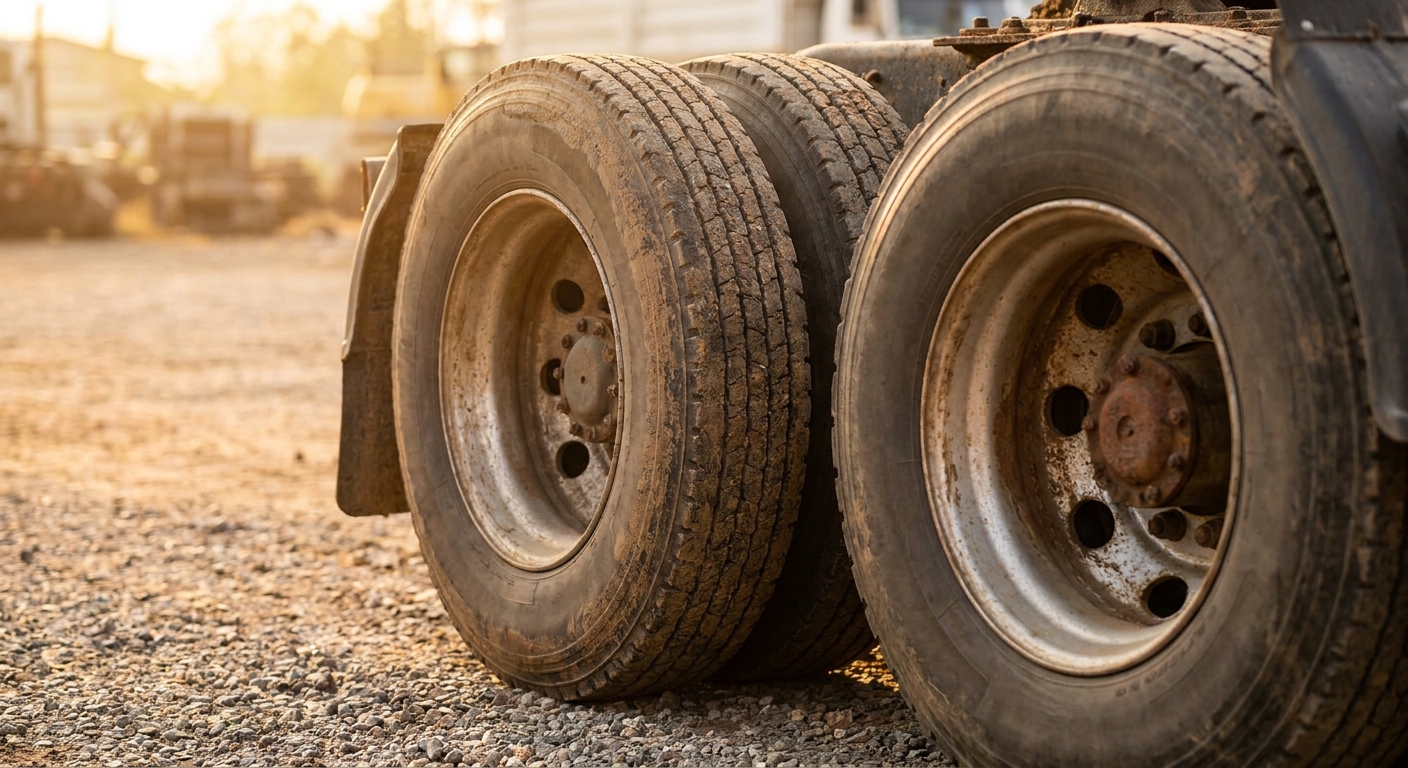
Two tires in a dual set do not share the load the way people picture it. They are bolted together and forced to travel the same distance, whether or not they are the same size.
That is the whole problem. If one is taller than the other, the tall one is dragging the short one down the road all day.
The number the tire makers use
Michelin puts the limit at a quarter inch of height difference between the two tires in a dual, measured at the center of the tread with the tire at its working pressure.
On a tandem, the same idea goes one level up: the average tire diameter on one drive axle should not be more than a quarter inch away from the average on the other axle.
That is a manufacturer and fleet-program recommendation, not a line in the federal regulations. Nobody is going to write you up for a mismatched dual. The tires collect the fine instead.
What actually happens out there
The taller tire has a larger rolling circumference, so in one revolution it wants to cover more ground. Its partner will not let it, because they are locked together on the same hub.
So the tall one scrubs. It is being held back and it fights that the entire trip. The short one gets pushed along faster than it wants to go.
Both of them build heat doing it, and heat is what kills a truck tire. The wear shows up on both, and it is the kind of irregular wear people blame on alignment when the alignment was never the problem.
It also means the taller tire is carrying more than its half of the load, on a hub designed for the two of them to split it.
How to measure it without guessing
A pi tape reads diameter directly and that is the clean way to do it.
If all you have is a regular tape measure, run it around the tire to get the circumference and divide by 3.1416. That is your diameter, and it is accurate enough to catch a quarter inch.
Do it with the tires inflated to working pressure. A tire that is thirty pounds low reads short, and you will "match" two tires that are not matched at all — you will have matched an air problem.
Where mismatches come from
Almost never from buying wrong. They come from repairs.
One tire gets replaced and its partner stays. The new one is full depth, the old one has forty thousand miles on it, and now the set is out of spec on the day it leaves the shop.
They also come from mixing casings that were retreaded at different times, and from swapping a tire in on the road because that was what the service truck had at two in the morning. That is a legitimate call to make at two in the morning. It just should not survive to the next PM.
Pressure creates the same problem
A dual that is running low is a shorter tire, and a shorter tire in a set behaves exactly like a mismatched one. The difference is that this version is free to fix and it comes back every month if nobody checks it.
Both tires in a dual carry the same pressure. Not close to the same — the same. Ten pounds apart is enough to put the set outside the quarter inch you just measured for.
The inside tire is the one that gets skipped, because the valve is awkward to reach and the person with the gauge is in a hurry. That is why it is also the one that fails first. Valve extensions exist for exactly this reason, and a set of them costs less than one casing.
What to tell the shop
Say what the tires are doing, not what you think is wrong. One tire on a set wearing faster than its partner, a dual that keeps running hot, a set that needs air more often on one side — each of those points somewhere specific.
And say when the tires were replaced and whether they were replaced in pairs. That single answer explains most mismatched sets before anybody measures anything.
What to do with the ones you already have
Measure the sets you have before you buy anything. You may be able to fix most of it by moving tires around rather than purchasing.
Pair the closest diameters together, put the taller of each pair on the outside where it can be measured and inspected without pulling anything, and keep the odd tires for positions where they run alone.
And when you replace one of a dual, decide right there what happens to its partner. That decision is cheaper standing in the shop than it is three months later with two tires worn wrong.
We do tire and alignment work in Houston, Dallas and Monterrey, and we measure the sets before we sell anything: thetrucksavers.com.
Reference: Mismatched Duals, Heavy Duty Trucking