Maverick Tows 4,000 Pounds, Twice Its Standard Rating
The Maverick tows 2,000 pounds standard and 4,000 with the tow package. For 2027 that package stops requiring a second bundle.
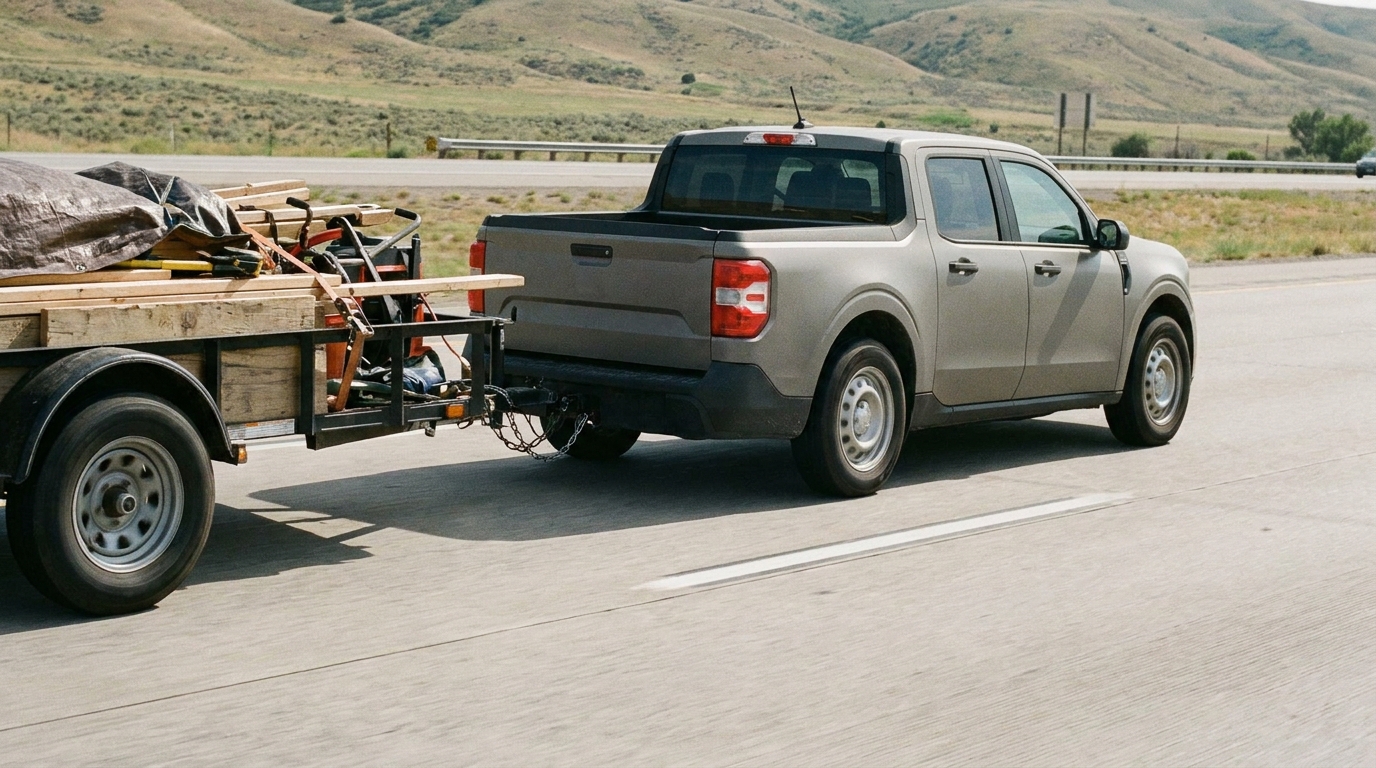
A compact pickup that tows 2,000 pounds is a different tool than one that tows 4,000. On the Ford Maverick, the difference between those two numbers is one option box, and for 2027 that box gets easier to check.
The 4K Tow Package now stands on its own across every trim: XL, XLT, Lariat, Lobo and Tremor. Previously it could not be ordered by itself — buyers had to add the Ford Co-Pilot360 package first.
What doubles the rating
The package is not a sticker. It adds a trailer brake controller, a Class III hitch with a two-inch receiver and both 4-pin and 7-pin connectors, a transmission oil cooler, an upgraded cooling fan, a higher-capacity radiator that comes only with the EcoBoost engine, and a 17-inch conventional spare tire.
Read that list again as a mechanic would. Three of those items are about heat. That is the honest reason the tow rating doubles: pulling weight is mostly a thermal problem, and the factory raises the number when it has added the hardware to carry the heat away.
Why the standard number is 2,000
Without the package, the Maverick tows 2,000 pounds — the same figure for both powertrains and both drive configurations. That is a small trailer: a single-axle utility, a couple of ATVs, a load of yard debris.
Four thousand is a different category. It reaches most single-axle enclosed trailers, a small skid steer on a light trailer, or a car hauler with nothing on it.
The change that actually matters
The 2027 move is a pricing and ordering change, not an engineering one. The truck tows what it towed. What changed is that the tow package no longer drags a second package along with it.
For a buyer who wanted towing and did not care about the driver-assistance bundle, that was money spent on something they did not ask for. Now the box stands alone.
What this means if you already own one
This is the part worth being direct about: a 2,000-pound Maverick does not become a 4,000-pound Maverick because the option got cheaper on a newer truck. The rating belongs to the hardware, and the hardware includes cooling that was installed at the factory.
Adding a hitch to a truck that was built without the package gives you a hitch. It does not give you the transmission cooler, the fan, the radiator or the brake controller, and it does not raise a single number on the door jamb or in the owner's manual.
Checks that apply to any light-duty tow setup
Find your truck's actual rating rather than the brochure's maximum. Configuration changes it, and the number that matters is the one for the truck you own.
Weigh the trailer loaded, not empty. Trailer weight ratings describe the trailer, not what you put in it, and the gap is where people get in trouble.
Check tongue weight, not just total weight. A trailer that is within the rating but loaded tail-heavy will sway, and sway is a handling failure, not a capacity failure.
Look at the brake controller question honestly. Many trailers over a certain weight require brakes by state law, and a controller is what operates them from the cab.
Watch transmission temperature on grades if your truck has a gauge for it. Towing damage in light-duty trucks is usually heat over time, not a single dramatic failure — which is the same reason the factory ties the higher rating to cooling hardware.
And inspect the hitch, wiring and safety chains before a long pull rather than at the ramp. A trailer connection is one of the few things on a truck where a five-minute check has a consequence measured in lives, not dollars.
The connector tells you what the trailer expects
The package includes both a 4-pin and a 7-pin connector, and that detail is more useful than it sounds. A 4-pin carries lights only: running lights, brakes, turn signals. A 7-pin adds the circuits for electric trailer brakes, reverse, and a charge line.
So the connector on the trailer tongue is a fast way to read what the trailer was built to need. If it ends in seven pins, somebody expected that trailer to have brakes and expected the tow vehicle to operate them. Pulling it with an adapter that drops those circuits does not make the requirement go away; it just means nothing is answering it.
The same logic runs through the whole package. Every piece in it exists because a heavier trailer asks something of the truck that a 2,000-pound trailer does not: more heat out of the transmission, more air through the radiator, and a way to slow the load that is not the truck's own brakes.
That kind of check is what The Truck Savers does for a living on the heavy side, and the logic does not change because the truck is smaller.