LRR Tires: Compare Cost per Mile Before Buying
A low tire price does not establish a low operating cost. Compare service, usable miles and casing value before choosing the next set.
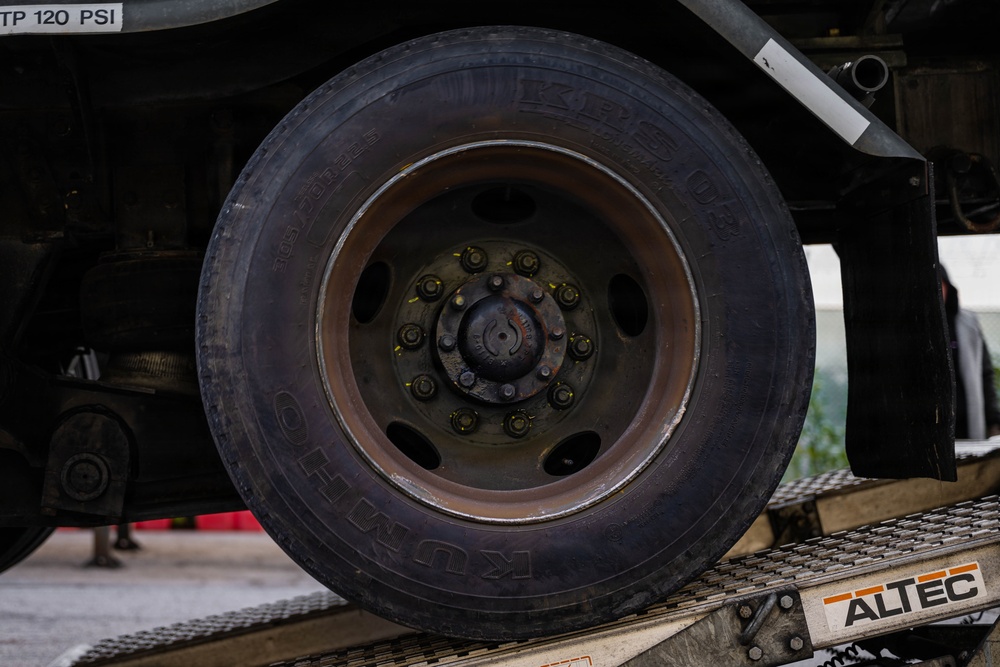
Illustrative archive: military fuel-truck tire, Senior Airman Zachary Jakel / U.S. Air Force, DVIDS 9515336. Public domain. Neither this tire nor its pressure marking is a product recommendation. Photo and reuse information.
Compare service life, not just the invoice
A cheaper tire can cost more per mile if it leaves service earlier. That is the practical question when evaluating low rolling resistance, or LRR, tires: what does the tire program cost on your own equipment and routes?
Michelin's fleet-cost guidance considers service life, fuel efficiency, maintenance, downtime and retreadability beyond purchase price. This is a manufacturer's framework, not an independent product ranking or a guaranteed result for your fleet.
A calculation with invented inputs
For a limited tire-only comparison, add purchase cost and recorded tire services, subtract any realized casing credit, and divide by miles before removal. Use the same tire and service period throughout.
For illustration only, option A costs $600, adds $100 in services, returns a $50 casing credit and runs 100,000 miles. Its $650 net cost divided by 100,000 is $0.0065 per mile: 0.65 cents. Option B costs $500, adds $100 in services, returns no credit and runs 80,000 miles. Its $600 divided by 80,000 is $0.0075 per mile: 0.75 cents.
These are invented numbers, not current prices, expected life or promised savings. Fuel, downtime and other operating costs are excluded. Unknown future mileage belongs in a labeled estimate, not an achieved-results column. A more expensive purchase does not automatically win either; change the assumptions and the comparison can change.
Keep application and evidence together
- Record complete model, size and intended axle position.
- Separate supplier projections from your own mileage records.
- Keep actual service charges, removal reasons and casing credits.
- Evaluate fuel claims separately without inserting a generic saving percentage.
- Confirm application with the appropriate tire professional before ordering.
EPA's SmartWay verification applies to the listed model and Class 8 tractor-trailer axle application. It does not calculate your operating cost, and the photograph does not establish verification for the tire shown.
Revisit the estimate after removal
Compare offers using matching cost categories, then replace estimates with recorded results. Do not prolong service to improve a spreadsheet; condition and application remain technical decisions. Review the references below before committing to the next order.
Original sources: MICHELIN cost-per-mile guidance. EPA SmartWay verification list.