Idling Costs $44.79 a Night, $8,400 a Year
Idling burns 0.8 gallon an hour. That is Argonne's number, not a guess.
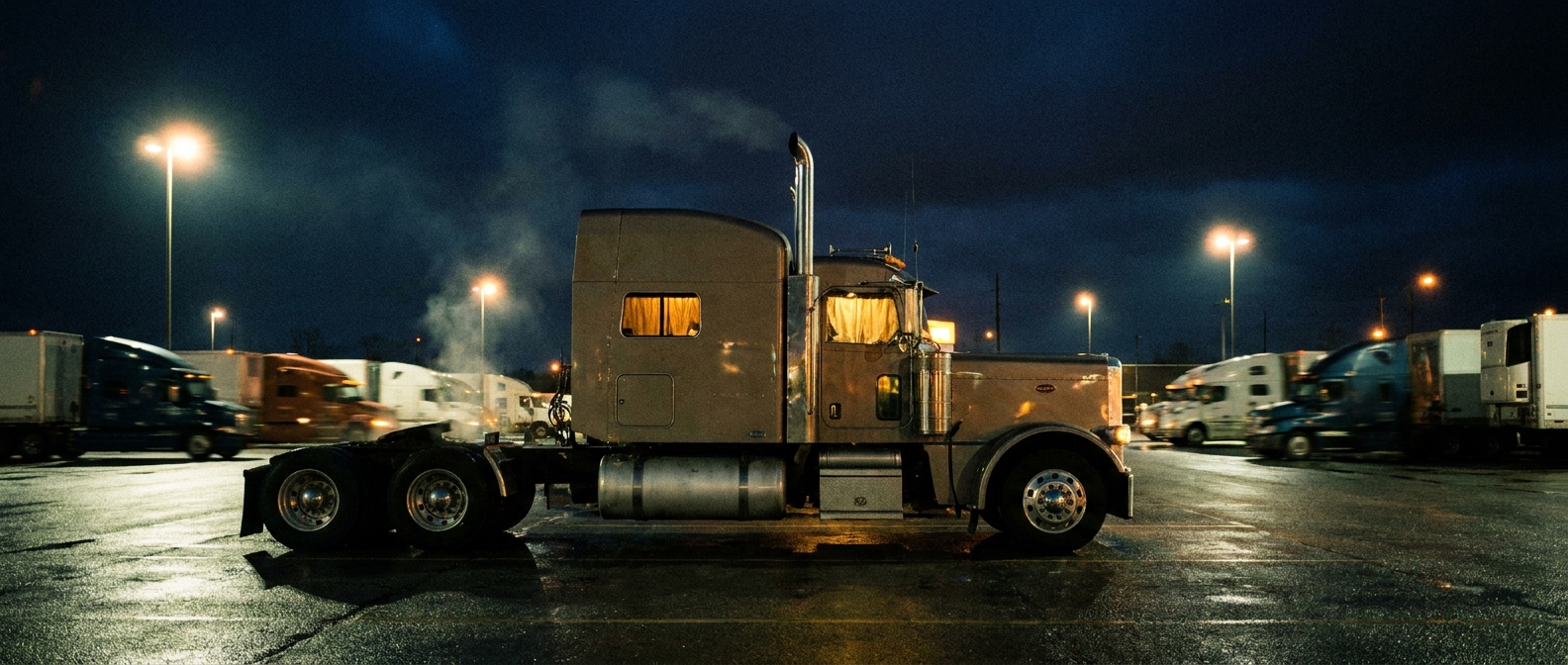
Your engine burns eight tenths of a gallon every hour it sits there doing nothing.
That number comes from Argonne National Laboratory, and it has been the working figure in Department of Energy analysis for years. Not an estimate somebody made up on a forum. Eight tenths of a gallon per hour, main engine, no load, nobody moving anywhere.
On its own that sounds small. Put a price on it and it stops sounding small.
What one night actually costs
The Energy Information Administration put national on-highway diesel at $5.599 a gallon for the week ending August 31, 2026. Down about a penny from the week before, and still the number on the pump.
Run the arithmetic and it goes like this:
- One hour of idling: $4.48.
- A ten-hour break: $44.79.
- A full year: about $8,400.
That last one needs the second half of the Argonne figure. A long-haul truck idles roughly 1,800 hours a year, which works out to about 1,500 gallons. At today's price that is $8,398 and change, burned while parked.
Eight thousand four hundred dollars is not a rounding error on an owner-operator's year. It is a set of steer tires, a rebuilt turbo and an alignment, with money left over.
The number nobody puts on the invoice
Here is the part that makes idling worse than the fuel line suggests: none of those hours show up as miles.
Your cost per mile is built by dividing what you spent by how far you went. Idle fuel goes into the numerator and contributes nothing to the denominator. Every hour parked with the engine running quietly makes your cost per mile look worse without you hauling a single extra pound.
Meanwhile the engine is accumulating hours. Oil change intervals, warranty terms and resale conversations all read engine hours, and an hour at idle counts the same as an hour at seventy. Some fleets use the rough conversion of one idle hour to roughly thirty-three miles of engine wear. Whether or not you accept that exact ratio, the direction is not in dispute: you are spending engine life to run a heater.
Why the engine hates it more than you do
An engine at idle runs cool and lightly loaded, which is exactly the condition it was not designed for.
Combustion is less complete. Unburned fuel washes past the rings and dilutes the oil. Soot loads the aftertreatment faster than a working duty cycle would, so regeneration events come more often, and a regeneration burns fuel too. On the emissions side the exhaust never gets hot enough to keep the catalyst happy, which is how a truck that mostly idles ends up with dashboard lights a truck that mostly runs never sees.
So the fuel bill is the visible cost. Wet stacking, diluted oil, extra regens and a full aftertreatment are the invisible ones, and they arrive as a shop ticket months later.
The scale of it, nationally
Argonne's estimate for rest-period idling across the US fleet is up to one billion gallons a year, at a cost near three billion dollars. The same work puts the emissions at about 11 million tons of carbon dioxide, 55,000 tons of nitrogen oxides and 400 tons of particulate matter.
You cannot do anything about the national number. You can do something about your 1,800 hours.
What to actually check this week
- Pull your idle percentage. Almost every modern ECM reports it. If you have never looked, look — the number is usually higher than the guess.
- Multiply it by your own diesel price, not the national average. If you fuel in California, the same 1,500 gallons cost far more than $8,400.
- Separate the idling you need from the idling you drifted into. Warm-up in real cold, aftertreatment cycles and safety in extreme heat are legitimate. Forty minutes at a shipper because nobody shut it off is not.
- Price the alternative against your real number. An auxiliary power unit, a bunk heater or shore power each has a payback, and the payback depends entirely on how many hours you actually idle. Do the division before anybody quotes you.
- Check the idle shutdown timer. Most trucks have one. On plenty of them it was switched off years ago and never switched back.
When the idling is telling you something else
If your idle hours climbed and your routes did not change, something else changed.
A cab that will not hold temperature makes a driver run the engine longer. Weak batteries push people to idle rather than risk a no-start. A charging system that is not keeping up turns every break into engine time. Those are all fixable, and fixing them is cheaper than the fuel.
We look at charging systems, batteries and APU installs in Houston, Dallas and Monterrey: thetrucksavers.com. If the math above says an APU pays for itself on your hours, that is what Go Green APU is for.
Original source: Argonne National Laboratory, Long-Haul Truck Idling Burns Up Profits (US Department of Energy)