How to Test a 7-Way Trailer Connector Without a Tractor
A powered test box energizes one circuit at a time so three dark lamps stop looking like three problems. Ground first, and never trust the pin colors from memory.
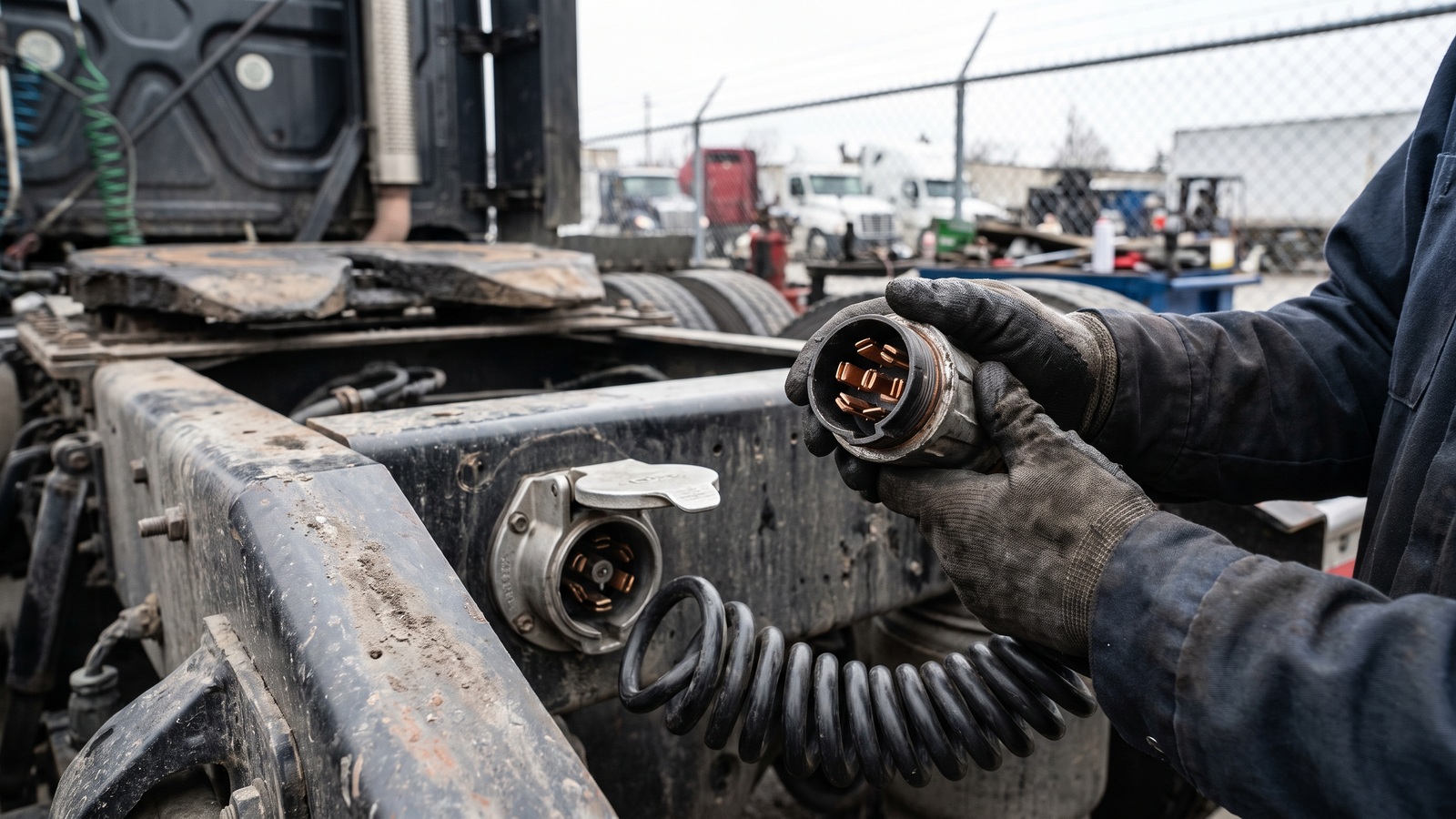
A dead trailer lamp is cheap in the yard and expensive at the scale. The difference is whether anybody looked before the tractor was coupled — and you do not need a tractor to look.
Why the yard is the right place
The federal standard is blunt: all lamps required by the lighting rules have to be capable of being operated at all times, and they cannot be obscured by dirt, by the load or by added equipment. There is no allowance for a lamp that works once the connection warms up, and none for a circuit that only fails in the rain.
The same defect also lands on paper. The daily driver vehicle inspection report has to cover lighting devices and reflectors among its listed items, and anything on that report that affects safe operation has to be repaired before the unit runs again. A lighting fault found in the yard is a work order. The same fault found at a roadside inspection is a violation with your carrier's name on it.
What a powered tester actually does
A trailer test box — the tool most shops still call a MUTT — supplies its own 12-volt power to the seven-pin plug and lets you switch each circuit on by itself. That is the whole trick. Instead of guessing from the cab with a helper shouting, you energize one circuit, walk the trailer, and see exactly which lamps answer.
Working one circuit at a time is what separates a diagnosis from a guess. When you flip everything on at once, three dark lamps look like three problems. Energized one by one, the same three usually turn out to be one bad ground.
Before you plug anything in
- Secure the trailer first. Chock the wheels. A test box supplies electricity, not air — you have no service brakes and no way to move the unit safely.
- Look at both halves of the connection. Bent or burned pins, green corrosion, a cracked housing, a spring cover that no longer closes, or standing water in the receptacle explain more faults than any bulb.
- Use a fused supply. Twelve volts is not a shock hazard, but a shorted circuit moves enough current to melt insulation and start a fire.
- Nobody under the trailer. Not while circuits are live, not for a quick look.
Do not trust the color code from memory
Here is the detail almost nobody knows. Vehicle wiring has to be installed and maintained to the industry wiring standard, but the rule specifically states that the jumper cable plug and receptacle need not conform to the seven-conductor connector standard everyone quotes.
In other words, the familiar pin assignment is a widely followed convention, not a federal requirement. On a mixed fleet, on rebuilt harnesses, and on anything that has been repaired in a hurry, the wire that should be one circuit may not be. Confirm against the trailer's own wiring diagram before you conclude that a circuit is dead, because a miswired repair reads exactly like a failure.
What the walkaround should confirm
- Ground first, always. Multiple lamps dim or dead at once is a ground problem until proven otherwise, and it is the one fault that makes every other reading lie.
- Each circuit alone. Clearance and marker, tail, left turn, right turn, stop, and the auxiliary circuit — one at a time, with a full walk each time.
- Dim is a finding, not a pass. A lamp that glows weakly is resistance in the ground path or a corroded socket. It will be the first one to die on a wet night.
- Check the ABS lamp on the side of the trailer. Trailers built on or after March 1, 1998 are required to carry an exterior ABS malfunction indicator lamp. If it stays lit with the trailer powered, the problem is in the antilock system, not in your lighting circuit.
- Measure voltage drop, not just continuity. A corroded pin passes a continuity test and still starves the lamp under load. Drop testing under load is what finds it.
- Write down what you found and what you fixed. A dated record is the difference between a clean file and an argument.
What this test cannot tell you
Be honest about the boundary. A test box confirms the trailer side. It says nothing about the tractor's circuits, and nothing about a jumper cable that only fails when it flexes over the fifth wheel. If the trailer passes on the box and still misbehaves coupled, the fault moved upstream — into the cable or the tractor — and that is a different afternoon.
Trailers built on or after March 1, 2001 also have to be able to send an ABS malfunction signal forward to the towing vehicle, so a cab warning lamp that will not go out is not automatically a trailer problem either. It can be the path between the two.
Ten minutes with a test box is the cheapest inspection on the property. Practical maintenance guidance and the tools for this kind of work are collected at thetrucksavers.com, and if you would rather have the compliance dates arrive on their own, the Truck Savers News weekly newsletter is free.
Original source
Requirements quoted from the current edition of title 49: 49 CFR 393.9, lamps operable, 49 CFR 393.28, wiring systems, 49 CFR 393.55, antilock brake systems and 49 CFR 396.11, driver vehicle inspection reports.