How Much Play in the Wheel Is Legal: The 393.209 Table
Steering play creeps in slowly and nobody gives you a reference point. 49 CFR 393.209 publishes a table with a hard number for your exact wheel diameter, and it flatly forbids repairing a steering joint by welding.
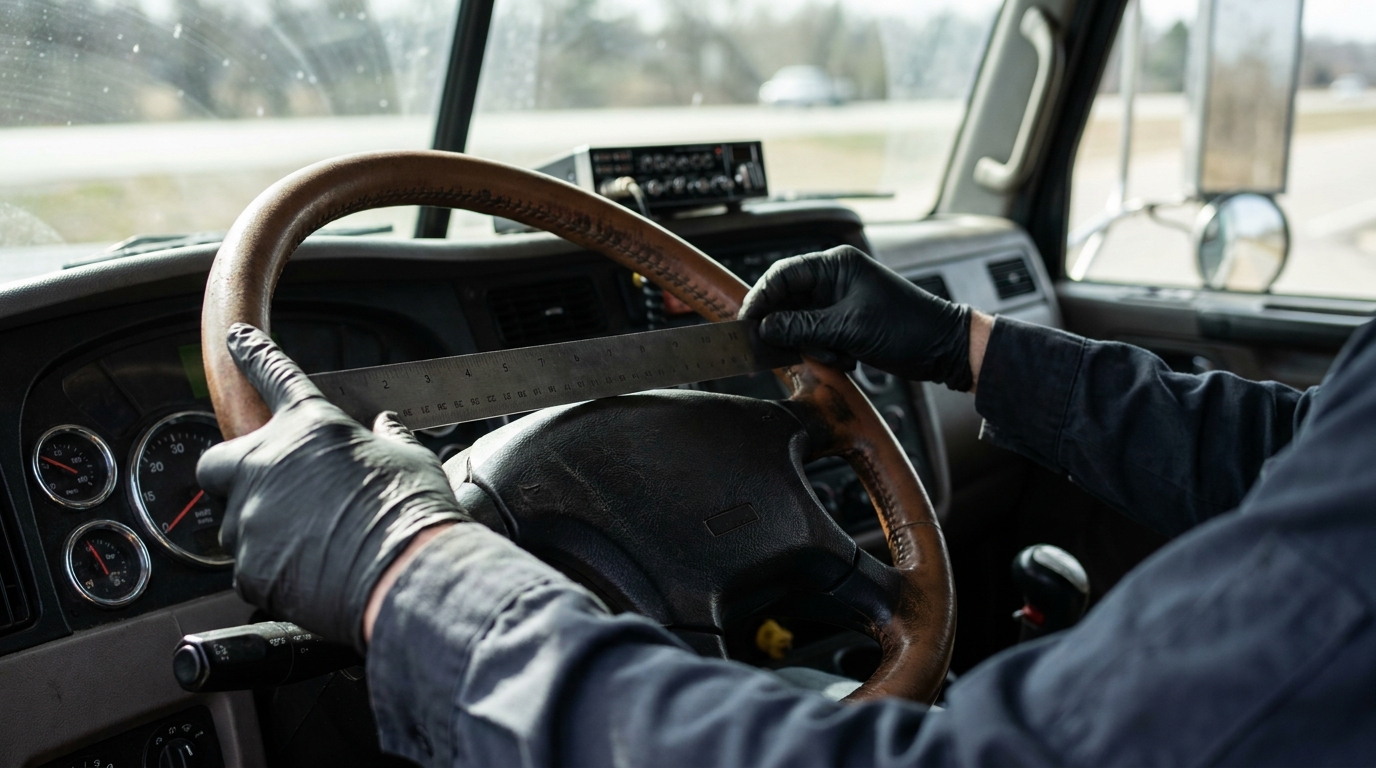
Every driver knows the wheel on his truck has some slack in it. You turn an inch or two before the front end answers. It creeps in so slowly that the number you got used to five years ago feels normal today, and nobody hands you a reference point.
The reference point exists. 49 CFR 393.209 is a page long, it is the section an inspector opens when the steering comes up, and it does something unusual for a regulation: it publishes a table with a hard number for your exact wheel.
The table, by wheel diameter
Paragraph (b)(1) sets maximum steering wheel lash — the free play at the rim before the wheels start to move. It changes with the diameter of the wheel and with whether the system is manual or power assisted:
- 16 inches or less — manual 2 in, power 4 1/4 in
- 18 inches — manual 2 1/4 in, power 4 3/4 in
- 19 inches — manual 2 3/8 in, power 5 in
- 20 inches — manual 2 1/2 in, power 5 1/4 in
- 21 inches — manual 2 5/8 in, power 5 1/2 in
- 22 inches — manual 2 3/4 in, power 5 3/4 in
If your wheel is not one of those six diameters, paragraph (b)(2) gives you the fallback in degrees instead of inches: 14 degrees of angular rotation for manual steering, 30 degrees for power steering.
Two things worth noticing before you go measure. First, the allowance is by diameter, so a bigger wheel legally gets more play at the rim — the same angle at the column travels farther out at the edge. Second, a power steering system is allowed roughly twice the lash of a manual one. That is not the rule being generous; it is the rule accounting for the assist in the box.
How you actually check it
You do not need a scan tool. You need a straight ruler and a second pair of hands, and it takes about two minutes:
- Engine running, so the power steering is doing what it does on the road.
- Wheels straight ahead, truck stopped, parking brake set.
- Turn the wheel gently in one direction until you feel the front tires just begin to move, and mark that spot on the rim.
- Turn gently back the other way until they begin to move again, and mark that spot.
- Measure the distance between the two marks along the rim. That distance is your lash.
Compare it against your diameter in the table. Measure the wheel, do not guess it — the difference between an 18-inch and a 20-inch wheel is half an inch of legal play, and that half inch is exactly the range where trucks sit when they start failing.
The rest of the section is where the real defects hide
Lash is the number people quote, but the paragraphs around it name the parts that actually cause it. Paragraph (a) requires the wheel to be secured, with no spokes cracked through or missing. Paragraph (c) requires the steering column to be securely fastened.
Paragraph (d) is the one that separates a real shop from the other kind. Universal joints and ball-and-socket joints must not be worn, must not be faulty, and must not be repaired by welding. That is not a preference and it is not a shop's house rule — the prohibition is written into the regulation. The same paragraph says the steering gear box must not have loose or missing mounting bolts, and no cracks in the box or in the mounting brackets; the pitman arm on the output shaft must not be loose; and the wheel has to turn freely through the limit of travel in both directions.
Paragraph (e) covers power steering: every component in operating condition, nothing loose or broken, belts not frayed, cracked or slipping, no leaks, and enough fluid in the reservoir.
What to do with this before your next inspection
- Measure once and write it down. A number you recorded in March is what tells you in August whether the play is growing.
- Measure the wheel too. The limit is useless without the diameter it belongs to.
- Look for the cause, not the symptom. Lash over the limit comes from somewhere: joints, box mounting, pitman arm, or the drag link.
- Never accept a welded steering joint. If someone offers to weld one, the regulation already answered.
- Check the belt and the fluid while you are there. They are in the same section for a reason.
Loose steering rarely announces itself. It arrives as a truck that wanders a little on the interstate, as front tires wearing in a pattern nobody can explain, as a driver who is more tired than the miles justify. Front-end inspection, steering and alignment work, and the shop guides for operators are at thetrucksavers.com, and compliance coverage continues here at Truck Savers News. Want the rules before they meet you on the roadside? Get the weekly TSN newsletter.
Original source
Requirements verified directly against the regulation in force: eCFR, 49 CFR 393.209, Steering wheel systems.