Hand-Adjusting Brakes Hides the Real Fault
Automatic adjusters have been required since 1994. If someone adjusts yours by hand, the adjuster is the messenger, not the fault.
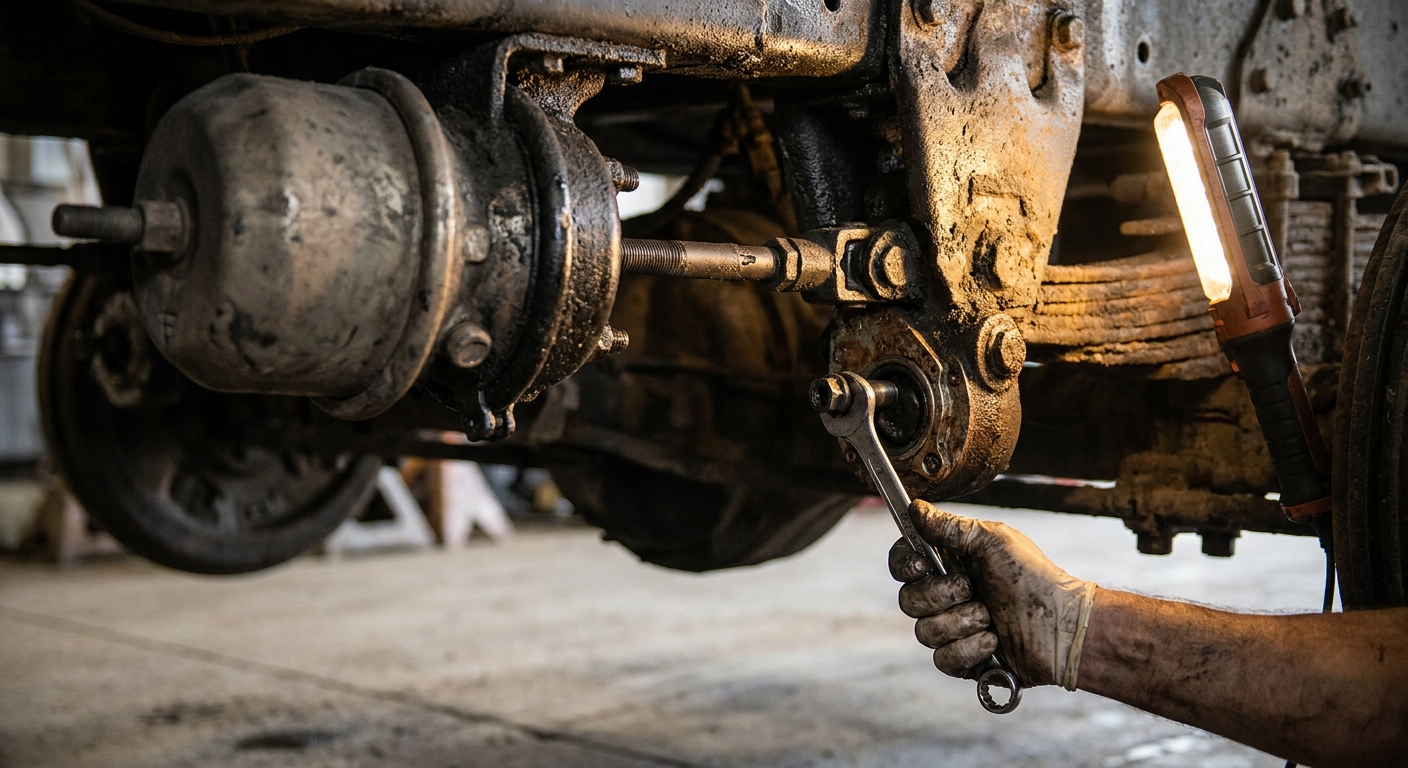
If somebody is putting a wrench on your slack adjusters every few weeks, that is not maintenance. That is a symptom.
Since October 20, 1994, commercial vehicles with air brakes have had to meet the automatic brake adjustment requirements of FMVSS 121. Hydraulic systems got the same treatment a year earlier, from October 20, 1993, under FMVSS 105.
Manual adjustment stopped being the normal state of things three decades ago.
What the rule actually requires
- Air brakes, built on or after October 20, 1994. The vehicle has to meet the automatic brake adjustment system requirements of Federal Motor Vehicle Safety Standard 121, in the version in effect when it was built.
- Hydraulic brakes, built on or after October 20, 1993. Same idea, under FMVSS 105.
- An indicator, on air systems. If the vehicle was built on or after October 20, 1994 and has an external automatic adjustment mechanism with an exposed pushrod, the under-adjustment condition has to be displayed by a brake adjustment indicator.
That third one is the part most operators have never had pointed out to them. The rule does not just want the adjuster to work. It wants the truck to be able to tell you when it is not working.
Why adjusting it by hand hides the problem
An automatic slack adjuster is supposed to take up the slack as the lining wears. When it stops doing that, the pushrod stroke grows.
Put a wrench on it and the stroke goes back where it belongs. The truck measures fine that afternoon. And nothing that caused the drift got touched.
The usual suspects are not the adjuster itself: a seized camshaft, dry or worn bushings, a clevis pin wearing oval, a chamber that is not returning fully. All of those make the adjuster look lazy while the actual fault sits somewhere else in the foundation brake.
So the manual adjustment buys a few weeks and moves the failure further down the road, usually to a worse place to find it.
Where the wear shows up first
Before a brake goes out of adjustment badly enough to be written up, it usually leaves a trail on the lining.
A wheel whose adjuster is falling behind stops carrying its share, and the linings on that wheel wear slower than the rest. Pull the drums on a truck that has been adjusted by hand for a few months and the set often does not match: two wheels close to the wear line and one with visible material left.
That mismatch is the same fault seen from the other end, and it is visible during a service you were already paying for.
What to look at instead
- Ask how often it is being adjusted. Not whether it is in adjustment today. Frequency is the diagnostic; a single measurement is not.
- Look for the indicator before you look for the stroke. If the truck has an exposed pushrod and an external adjuster, there should be something telling you the condition. Find out if yours has it and whether anyone reads it.
- Check the whole foundation, not the adjuster. Camshaft rotation, bushings, clevis pin, chamber return. The adjuster is often the messenger.
- Write down the date each time. Two adjustments in a month on the same wheel is a pattern, and a pattern is what a shop can actually chase.
What we are not telling you
We are not telling you that adjusting by hand is illegal. This section does not say that, and we did not verify it anywhere else. What we are telling you is that it is a sign of a fault, and that is shop judgment, not regulation.
We are also not printing stroke limits by chamber size. Those live in FMVSS 121 and in the out-of-service criteria, and we have not opened either, so we are not going to hand you a number that decides whether a truck rolls.
And we are not quoting a fine, because this section does not set one.
The part that costs money
A brake that is out of adjustment is not just an inspection problem. It is a brake doing less of the work while the others do more, and the ones doing more wear faster and run hotter.
By the time it shows up as a violation, it has usually been showing up as uneven lining wear for a while. That is the cheaper place to catch it.
We do brake work in Houston, Dallas and Monterrey: thetrucksavers.com.
Original source: 49 CFR 393.53, automatic brake adjusters and brake adjustment indicators (eCFR)