Georgia Tax Pause: Compare Pump Receipts
Georgia’s fuel tax pause is temporary. Compare actual offers, dates and route costs before changing your fuel plan.
Georgia has temporarily suspended collection of its motor-fuel and diesel-fuel taxes under a September 28 executive order. The measure took effect September 29, 2026, and the order states that it expires October 29 at 11:59 p.m., unless renewed. For an owner-operator, the useful task is to compare the actual fuel purchase available on the route, rather than treating the announcement as a guaranteed reduction on every receipt.
Read the dates before changing the fuel plan
Executive Order 09.28.26.01 addresses petroleum supply disruptions and volatile prices. Its tax provision suspends the collection specified in Georgia Code Section 48-9-3 for the effective period, unless otherwise terminated. That identifies a particular state measure. It does not promise a nationwide fuel discount, set a retail pump price or establish the price a particular truck stop must quote to your account.
A fuel budget prepared before September 29 should therefore be checked against current offers. A budget for travel after October 29 needs another review of the official position. Treat the end date as a planning checkpoint, not an assumption that the same conditions will continue through the rest of the year. Save the order with the date on which your fleet reviewed it.
Compare what you would actually pay
The following comparison is an editorial purchasing method, not a government savings estimate. Start with the exact fuel grade, station, payment method and account price you can use. Compare two offers for the same planned purchase. A cash sign, a credit-card price and a fleet-card quote can represent different transactions; recording them as if they were interchangeable makes the comparison unreliable.
For a hypothetical example, a difference of ten cents per gallon on a purchase of 150 gallons equals fifteen dollars before considering any other cost. Those numbers are illustrative, not observed Georgia prices. The calculation puts the possible purchase difference into dollars. It does not tell you whether a detour, extra waiting or a change in delivery timing makes sense for the trip.
Write the two offered prices beside the expected gallons and the time at which you checked them. Then separately list the additional distance or time required to reach the alternative stop. This keeps the purchase comparison visible without pretending that a cheaper displayed gallon automatically makes the entire trip cheaper. Use your own truck's records for the extra-distance calculation instead of a universal fuel-economy assumption.
The weight provision is a separate decision
The same order also addresses certain vehicle movements connected to the emergency. Do not read its higher weight figure as permission for every truck on every Georgia road. The provision concerns state-maintained roadways and explicitly excludes interstates. It includes vehicle and dimensional conditions, requires permits for covered movements outside normal restrictions, and preserves posted bridge limits. Review the full order and the applicable permit with the responsible authority before planning such a movement.
This matters even if the immediate reason you opened the document was fuel cost. A dispatcher could correctly identify the tax suspension but incorrectly carry the separate weight statement into an ordinary load plan. Keep the fuel-purchase decision and the route-permission decision on different lines. Neither the pump receipt nor a social-media summary establishes that a heavier load is authorized.
A checklist for the next fuel purchase
- Confirm the timing. Check that the planned purchase falls within the current effective period and look for later official changes.
- Confirm the offer. Record the station, fuel grade, payment method and actual account price rather than relying only on a regional average.
- Compare the trip. Put the potential purchase difference beside the extra miles, available driving time and delivery commitments.
- Keep the receipt. Retain the purchase record and give the current state guidance to whoever handles your fuel-tax reporting. Do not improvise reporting treatment from this article.
- Review permissions separately. If a load depends on emergency size or weight relief, confirm the qualifying movement, route and permit before dispatch.
After the purchase, compare the actual receipt with the quote used in planning. If they differ, ask the seller or account provider to explain the transaction. Keep that explanation with the record so the next comparison uses the correct payment terms. A single receipt establishes what that purchase cost; it does not prove statewide savings or a trend across all stations.
The preventive approach is to make the next decision from a verified price and a verified route. Explore maintenance resources at The Truck Savers™. Keep the official order available for its complete conditions.
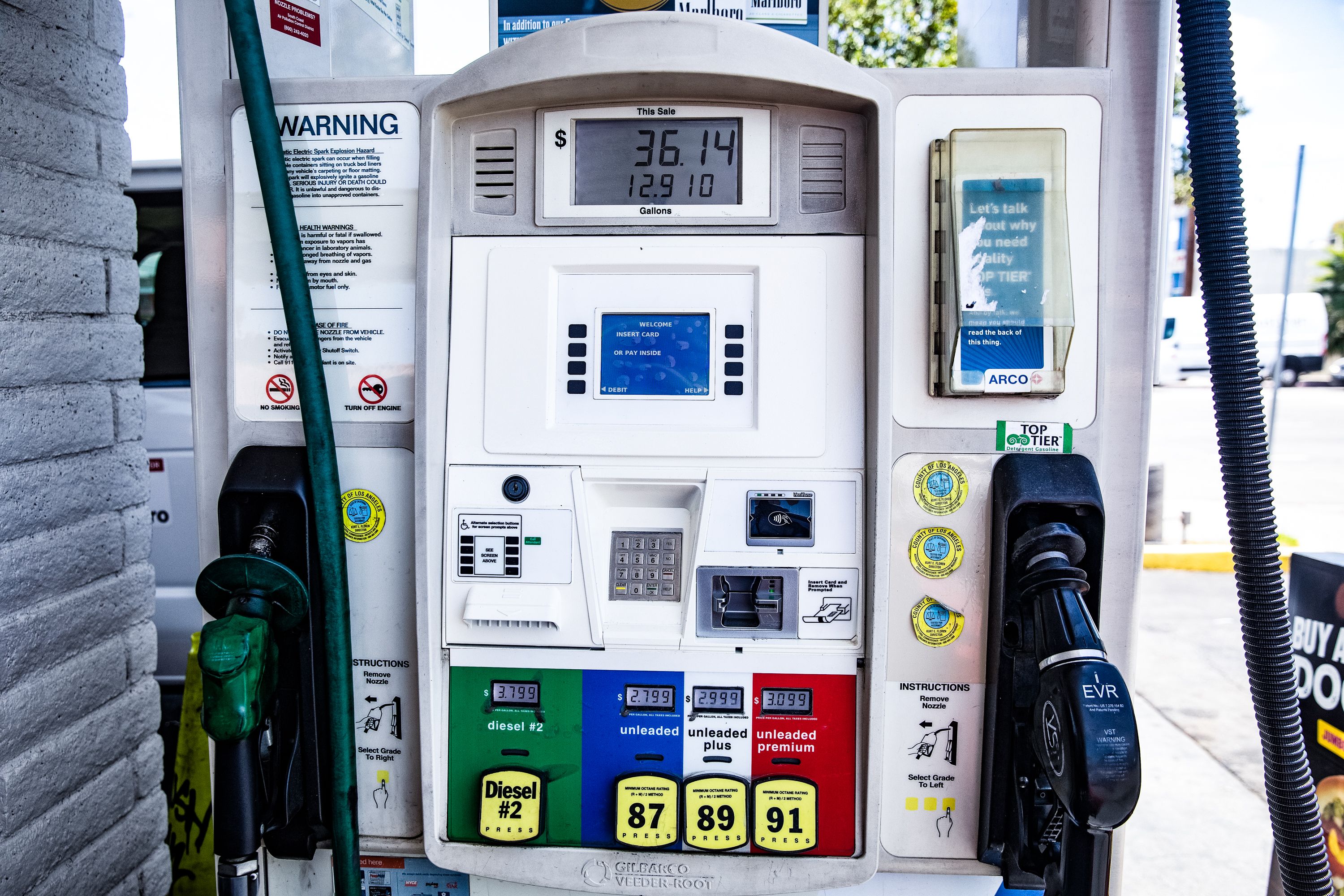
Illustrative archival photograph: Ekaterina Belinskaya / Pexels, Los Angeles, 2020. The pump and displayed prices are not a Georgia location or current price quote.