Gasoline Has a 10% Release Valve. Diesel Has None
Up to 10% of a gallon of gasoline can be ethanol, and that share does not come from a crude refinery. Highway diesel has no equivalent, and that is why the two never fall together.
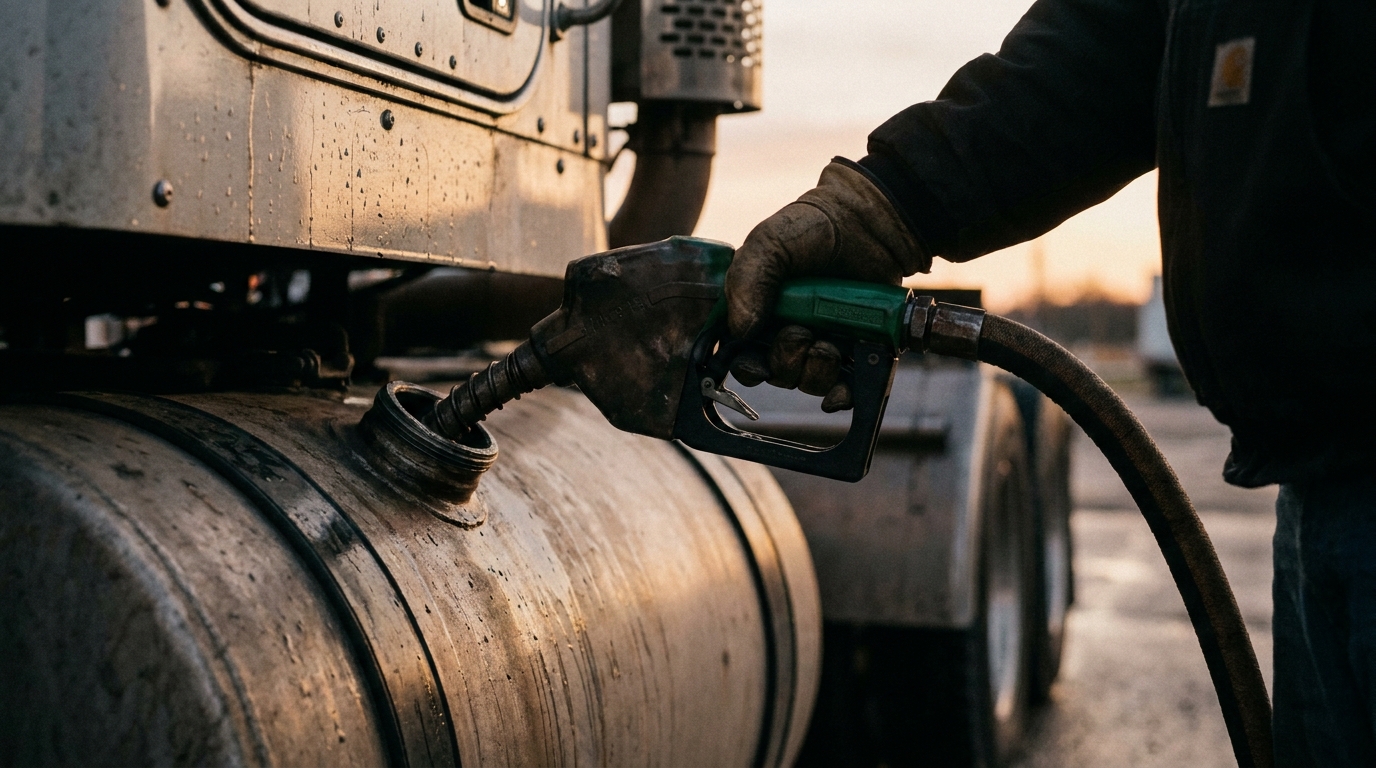
Diesel closed August at $5.599 a gallon nationally. Every time it climbs, somebody asks why nothing gets done about it — and the honest answer is structural: gasoline has a release valve that highway diesel does not have.
The valve gasoline has
Federal fuel rules give gasoline blended with ethanol its own regulatory lane. Under 40 CFR 1090.215, gasoline containing at least 9 and no more than 10 volume percent ethanol qualifies for special treatment on vapor pressure — the well-known 1.0 psi allowance.
Set aside the chemistry for a second and look at what that means in a tank: up to a tenth of what you pump is a component that did not come out of a crude refinery. When crude gets expensive, that tenth is a tenth that did not get more expensive at the same rate.
What highway diesel has instead
Ultra-low sulfur diesel is defined by numbers, not by flexibility. Under 40 CFR 1090.305:
- Sulfur: 15 ppm maximum.
- Cetane index of at least 40, or aromatic content of no more than 35 percent by volume — one or the other.
There is no paragraph that says "and you may extend it by ten percent with something cheaper." The spec is the spec, and every gallon has to meet it per gallon — not on average across a batch.
Why that difference lands on your fuel card
A fuel with a built-in blending component has a cushion when the underlying barrel moves. A fuel defined by a hard per-gallon spec does not. That is the whole asymmetry, and it explains something operators notice every year: gasoline and diesel do not move together, and diesel usually comes down slower.
It also explains why the policy conversation about gasoline prices has tools in it and the one about diesel mostly does not. There is no lever of the same kind to pull.
What that means for how you plan
- Stop reading gasoline headlines as diesel news. They are two different products under two different rules, and the reasons one falls do not apply to the other.
- Do not wait for a policy fix to price your loads. There is no equivalent of the ethanol lane sitting on a shelf for diesel.
- Treat the spread between the two as information, not as unfairness. When the gap widens, it is usually the gasoline side moving.
- Control what is actually in your hands: idle time, tire pressure, alignment and the routes you take. That list is short, and it is the whole list.
What we are not telling you
We are not giving you a year-over-year comparison or a record figure today. The EIA API returned rate-limit errors this afternoon and we could only confirm the most recent week. A number we cannot verify does not go in, even when it is being quoted everywhere.
The part you can control still gets you more than the part you cannot: The Truck Savers runs a free +100 point inspection, and alignment and tire wear are fuel economy whether the pump moves or not.