Frames: What 393.201 Forbids Welding and Drilling
Welding to a frame is not banned outright. Section 393.201 hands the criterion to the manufacturer, and forbids drilling the rail flanges outright unless the maker specifies it.
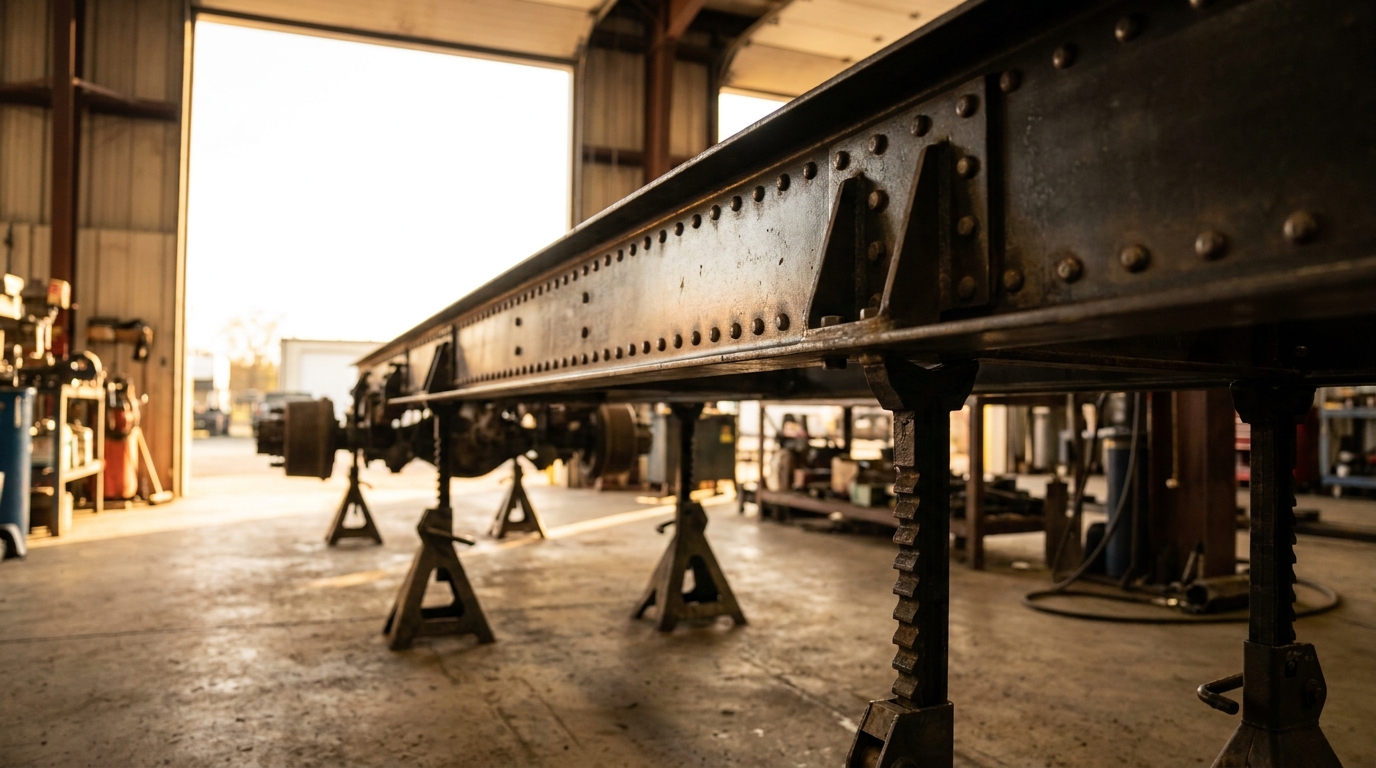
The frame rail is the one part of your truck nobody quotes a rule about. Welding a bracket to it is allowed only as the manufacturer recommends it. Check the rail flanges between the axles before you mount anything there. 49 CFR 393.201 is five short paragraphs, and almost nobody has read them.
They are worth reading, because two of them describe things that happen in ordinary shops on ordinary Tuesdays — welding a bracket on, drilling a hole for a mount — and the rule does not treat either one as routine.
What the section actually says
Paragraph (a) sets the condition: the frame or chassis of each commercial motor vehicle shall not be cracked, loose, sagging or broken. Paragraph (b) moves to what hangs on it — the bolts or brackets securing the cab or the body to the frame must not be loose, broken, or missing.
Then it gets specific in a way that catches people out. Paragraph (c): the frame rail flanges between the axles shall not be bent, cut or notched, except as specified by the manufacturer. Note the location. The rule draws a box around the span between the axles, which is where the rail carries the most bending load, and says do not modify the flanges there.
Welding is not forbidden. Freelancing is
Paragraph (d) is the one that gets repeated wrong in both directions. It does not ban welding to a frame outright. It says parts and accessories shall not be welded to the frame or chassis except in accordance with the vehicle manufacturer's recommendations — and then adds that any welded repair of the frame must also follow those recommendations.
So the question a roadside inspector or a shop is really asking is not was this welded? It is does the manufacturer allow this weld, here, this way? That is a documentable answer. Every major chassis builder publishes body-builder and frame-modification guidance saying where you may weld, where you may not, what preheat and filler to use, and what has to be reinforced afterward.
The practical consequence is that the person who decides is the manufacturer, not the welder. A good welder can lay a perfect bead in a place the book forbids, and the bead being perfect changes nothing about the paragraph.
The drill is the quieter half
Paragraph (e) is one sentence: no holes shall be drilled in the top or bottom rail flanges, except as specified by the manufacturer. Not the web — the flanges.
That distinction is the whole engineering story compressed into eight words. A frame rail is a C-channel, and in bending it is the top and bottom flanges that carry the tension and compression. The vertical web in the middle carries shear and is where manufacturers generally do allow fastener holes. Drilling the flange removes material from exactly the place the rail depends on, and a hole there becomes the point a crack starts from later.
This is why yard-built solutions go wrong without anyone acting carelessly: mounting a toolbox, an auxiliary tank, a headache rack or an APU bracket is a five-minute job with a mag drill, and the easiest place to put the bolt is straight through the flange because that is the flat surface facing you.
What to do with this before you buy or modify
- Before any add-on gets mounted, ask for the chassis maker's body-builder or frame-modification document, not an opinion. It exists for every major brand.
- Look at the rail between the axles specifically. Bends, cuts and notches in the flanges there are what paragraph (c) names.
- On a used unit, walk the rail from bumper to tandems with a light and look for old holes in the flanges, added brackets, and weld beads that do not look factory.
- Loose, broken or missing cab and body mounting bolts are their own paragraph. They are also the cheapest thing on this list to fix.
- Anything already welded or drilled outside the manufacturer's guidance is a conversation with a shop, not a decision to make in the yard.
Why the rule reads this way
Notice what 393.201 does not do. It does not give you a maximum crack length, an allowable hole diameter or a table of acceptable repairs. It hands the criterion to the manufacturer in three of its five paragraphs. That is unusual for Part 393, and it is deliberate: rail sections, steel grades and load paths differ enough between chassis that a single federal number would be wrong on most trucks.
For an owner-operator, that is actually good news. The standard you have to meet is written down by the company that built your frame, and it is available before you make the modification rather than after someone finds it.
At The Truck Savers™ the shop and inspection resources sit in one place, and Truck Savers News keeps the compliance side of the trade documented here. Prevention before repair — the iron never lies.
Original source
Every requirement above was verified against the regulation in force, edition of August 18, 2026: eCFR, 49 CFR 393.201, Frames.