Fog: Use Low Beams, Then Review the Route
Fog calls for low beams and a route review. Check visibility, official updates and a suitable stopping option before departure.
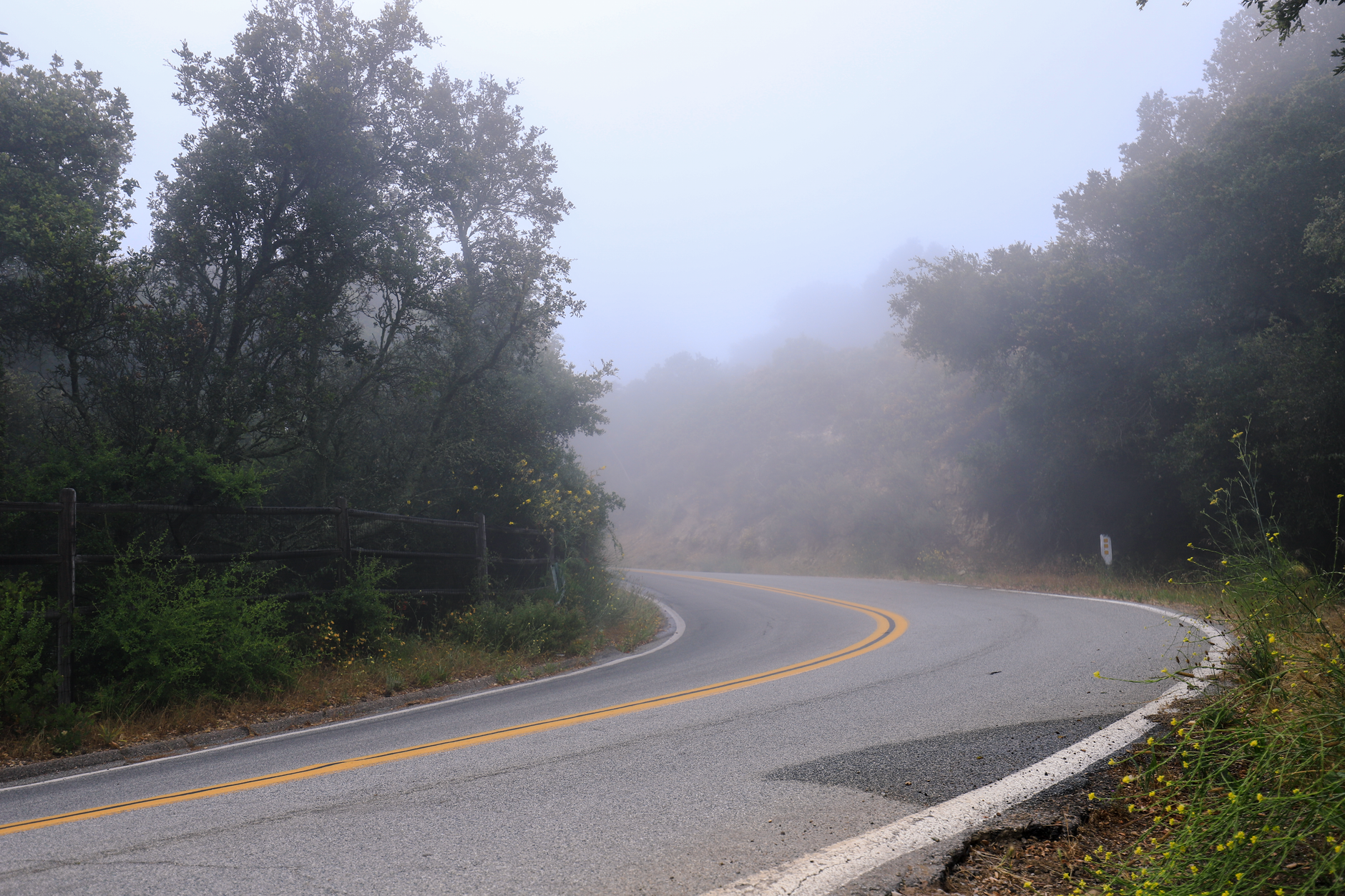
In fog, brighter headlights are not necessarily more useful. The National Weather Service advises using low beams and warns that high beams create glare that makes the road ahead harder to see. For an owner-operator, the lighting choice is one part of a larger decision: review the actual visibility, the route and a suitable place to stop before treating the delivery schedule as permission to continue.
Separate a lighting adjustment from a route decision
NWS guidance also calls for slowing down, allowing extra travel time and leaving ample distance from the vehicle ahead. It recommends using road markings to help follow the lane. Those points do not establish one speed or following-distance number that is safe for every truck. The guidance is general; the driver must still assess the actual conditions, the vehicle and any applicable restrictions.
This article is a planning guide, not an active warning for a named highway. Its photograph shows an illustrative California road, rather than conditions verified today. A forecast, a road photograph and a driver's current observation are different kinds of information. Keep their locations and times separate when deciding what they tell you about the next segment of a trip.
Review the segment you will actually travel
Before departure, identify the route and the period in which the truck would reach each area of concern. Check current official weather information for that location and road information from the responsible transportation agency. Record the source and when it was checked. A general forecast for a large region should not be rewritten as a finding that every road in the region has the same visibility.
A useful dispatch note can distinguish an observation from a prediction. For example, a hypothetical driver reports limited visibility near the planned departure point, while an office employee sees a forecast for improving conditions later. Both belong in the review, but neither alone establishes the state of another road farther along the route. Keep the unresolved segment visible rather than choosing the more convenient interpretation.
Plan a stopping option for the actual truck
The NWS advises stopping in a safe location when fog becomes extremely dense and visibility is near zero. Its examples include a parking lot. That general example does not certify a particular property for a tractor and trailer. Before depending on a planned stop, confirm access, space and permission through the information available for that location and the operator's established process.
An unfamiliar entrance or an unverified parking listing is not a complete stopping plan. Note which option has been checked and which still needs confirmation. If conditions deteriorate while driving, follow current official directions and the applicable operating procedures. A planning article cannot evaluate the available maneuver or determine whether a roadside location is appropriate for the vehicle at that moment.
Give the schedule an honest status
Extra time belongs in the operational conversation. Tell the person coordinating the load what is known, where the truck is and which review remains open. Avoid converting a tentative departure or arrival into a promise. For a small fleet, this distinction lets the office communicate with the customer while the driver concentrates on the conditions actually being encountered.
Suppose a hypothetical delivery appointment was planned before fog developed. The useful update is not simply that the lights have been changed. It identifies the route segment under review, the latest information checked and the next communication point. No universal delay estimate follows from the word fog. Revise the working schedule from the real situation instead of adding a guessed number of minutes.
Keep equipment and information checks distinct
Use the normal pretrip process to establish the condition of the lighting and visibility equipment. A selected switch position is not proof that every lamp works. Likewise, a completed equipment check does not answer whether the route can be traveled under the conditions ahead. Keeping these tasks separate prevents one successful check from closing a different question that still needs attention.
- Use the NWS low-beam guidance; avoid high-beam glare.
- Allow additional time and ample separation from traffic.
- Check current weather and road information for the route.
- Identify a stopping option suitable for the actual vehicle.
- Communicate observations, forecasts and unresolved questions separately.
- Review the plan again when the conditions change.
Find more practical operator guides at Truck Savers News.
Illustrative Santa Barbara, California road archive; not current weather or route clearance. Marina M / Pexels; Pexels License.
Original source: National Weather Service. Reviewed October 13, 2026.