Envoy AI Launches Ellie Workforce for Freight Brokers
Envoy AI's new Ellie Workforce can execute carrier sourcing, rate negotiation, compliance checks and shipment follow-up while people retain oversight.
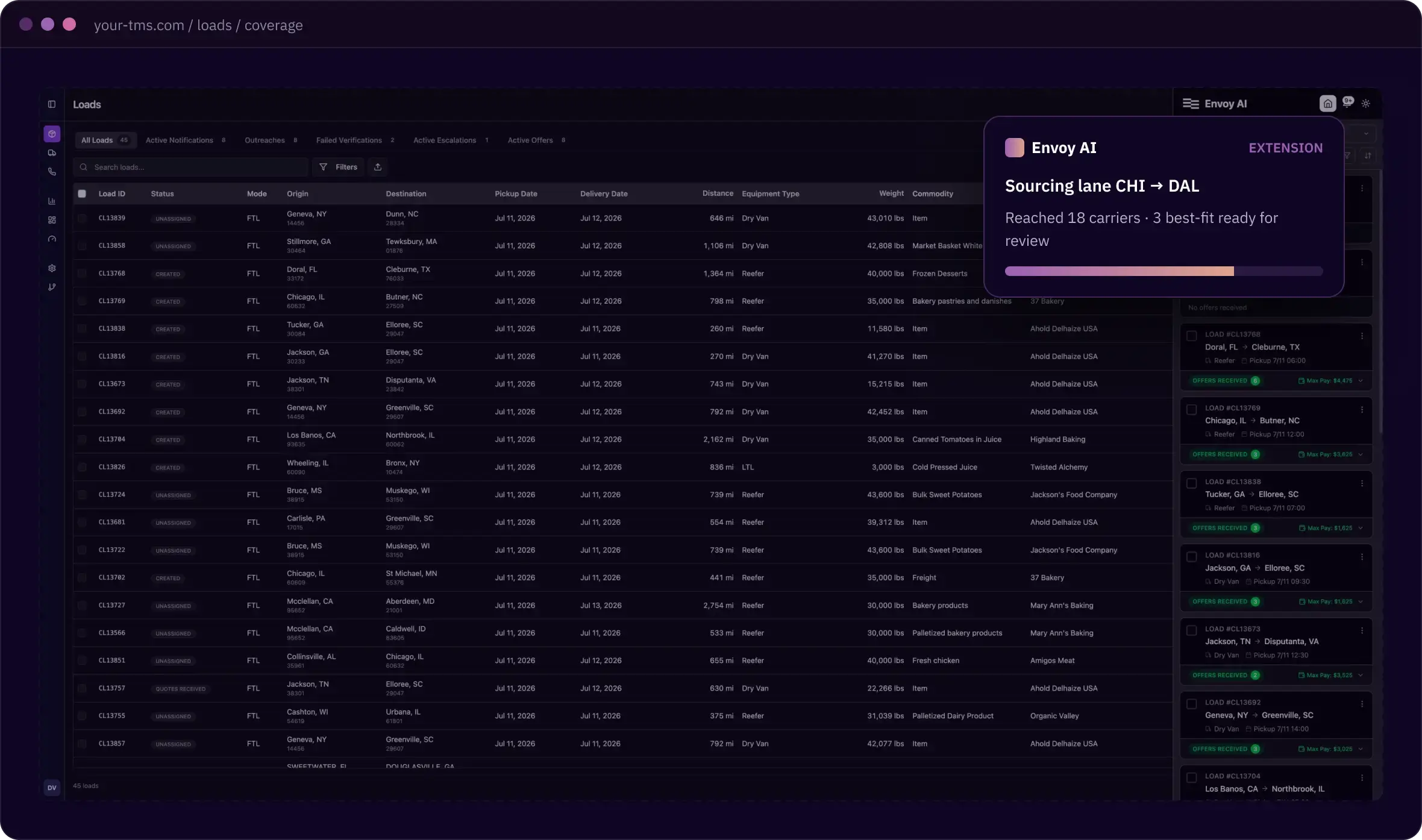
Envoy AI has launched Ellie Workforce, a browser-based platform designed to carry out routine freight-brokerage work instead of only recommending a next step. The system is aimed at logistics teams that source carriers, negotiate rates, check compliance, collect documents and monitor loads throughout the day.
The important change is the level of responsibility the software is being asked to assume. Ellie Workforce can act across connected freight systems and escalate an exception when a person needs to make the call. For brokers, dispatch teams and carriers, that could shorten repetitive exchanges, but it also makes operating limits, data quality and human review more important.
From AI assistant to freight execution
Many transportation tools summarize emails, suggest a carrier or flag a late load. Envoy AI is positioning Ellie Workforce as a group of digital workers that can complete a sequence of tasks. Its announced functions include carrier outreach and scoring, rate negotiation within configured parameters, carrier verification, document collection, communications coordination and shipment-progress monitoring.
The platform works inside a web browser and is designed to connect with transportation management systems, email, load boards, carrier networks and compliance platforms. Envoy AI says its Transportation Observability and Action System, known as TOAS, builds the context used to coordinate those actions. That matters because a freight decision rarely lives in one screen: a dispatcher may need the rate history, lane requirements, equipment type, carrier status and customer instructions before moving a load.
Ellie Workforce also combines capabilities that the company introduced earlier, including carrier matching, fraud-prevention checks, negotiation controls, shipment tracking and rules governing how the software contacts carriers. The launch is therefore less about a single chatbot and more about connecting several freight tasks into one controlled operating flow.
Where the operational value may appear
The most immediate opportunity is time. Reps often spend a large part of a shift repeating calls, requesting the same paperwork, checking status messages and moving information between systems. If automation handles those steps reliably, a team could spend more time on difficult lanes, service failures, customer relationships and exceptions that affect margin.
Envoy AI cited an early customer that reported booking loads faster and expanding activity without adding headcount. That is a company-reported experience, not an industrywide performance guarantee. Results will depend on the quality of each brokerage's data, integrations, business rules and supervision. A bad rule executed quickly can create more damage than a slow manual process.
For an owner-operator or small carrier, the change may be visible through faster digital outreach, automated document requests and more structured rate conversations. It may also mean that current insurance, authority, equipment and contact records become even more important. A system that cannot confirm a carrier's information may move to the next option before a human rep investigates the discrepancy.
What operators should check
- Authority and limits: Define which loads, lanes, rate bands and carrier profiles the system may handle without approval.
- Carrier identity: Require independent verification before changing payment details, contact information or dispatch instructions.
- Rate control: Set floors, ceilings and escalation rules so an automated negotiation cannot accept a load that loses money or violates a customer commitment.
- Document accuracy: Confirm that rate confirmations, insurance files, bills of lading and delivery records reach the correct load and party.
- Exception ownership: Assign a person to delayed pickups, rejected tenders, cargo claims, temperature problems and conflicting instructions.
- Audit trail: Keep a record of messages, decisions, data sources and overrides so the team can reconstruct what happened.
A brokerage evaluating autonomous execution should begin with a narrow set of repeatable lanes and measure more than booking speed. Useful indicators include falloffs, service failures, margin changes, carrier complaints, document errors and the percentage of cases escalated to a person. A manual fallback is essential when an integration is unavailable or the system encounters incomplete information.
Human judgment remains part of the load
Freight operations are full of details that do not fit neatly into a standard workflow: a receiver changes an appointment, a driver reports a mechanical issue, a commodity requires special handling or a familiar carrier calls from an unfamiliar number. Automation can gather facts and execute approved steps, but responsibility for safety, contracts, customer promises and fraud prevention still belongs to people and companies.
Teams should also decide how clearly an automated agent identifies itself when contacting carriers. Transparent communications can reduce confusion and make it easier for a driver or dispatcher to request a human. No carrier should rely on an unexpected message alone when bank information, load control or identity credentials are involved.
Technology does not replace the physical discipline that keeps a truck earning. Operators can use resources from The Truck Savers to support maintenance and uptime while freight teams improve the digital side of execution. The best result is not automation for its own sake; it is fewer preventable delays without surrendering control of the decisions that affect service, safety and margin.
Ellie Workforce shows how quickly freight AI is moving from advice toward action. Brokerages that test it should treat every permission as an operating policy, verify the results against real loads and expand only after the controls prove dependable. In freight, speed helps only when the information and the handoff are right.