DPF Service: 250,000 Miles or 800,000, It Depends on MPG
Cummins publishes three DPF intervals for one engine. Your fuel economy picks which one is yours, and the spread is 250,000 to 800,000 miles.
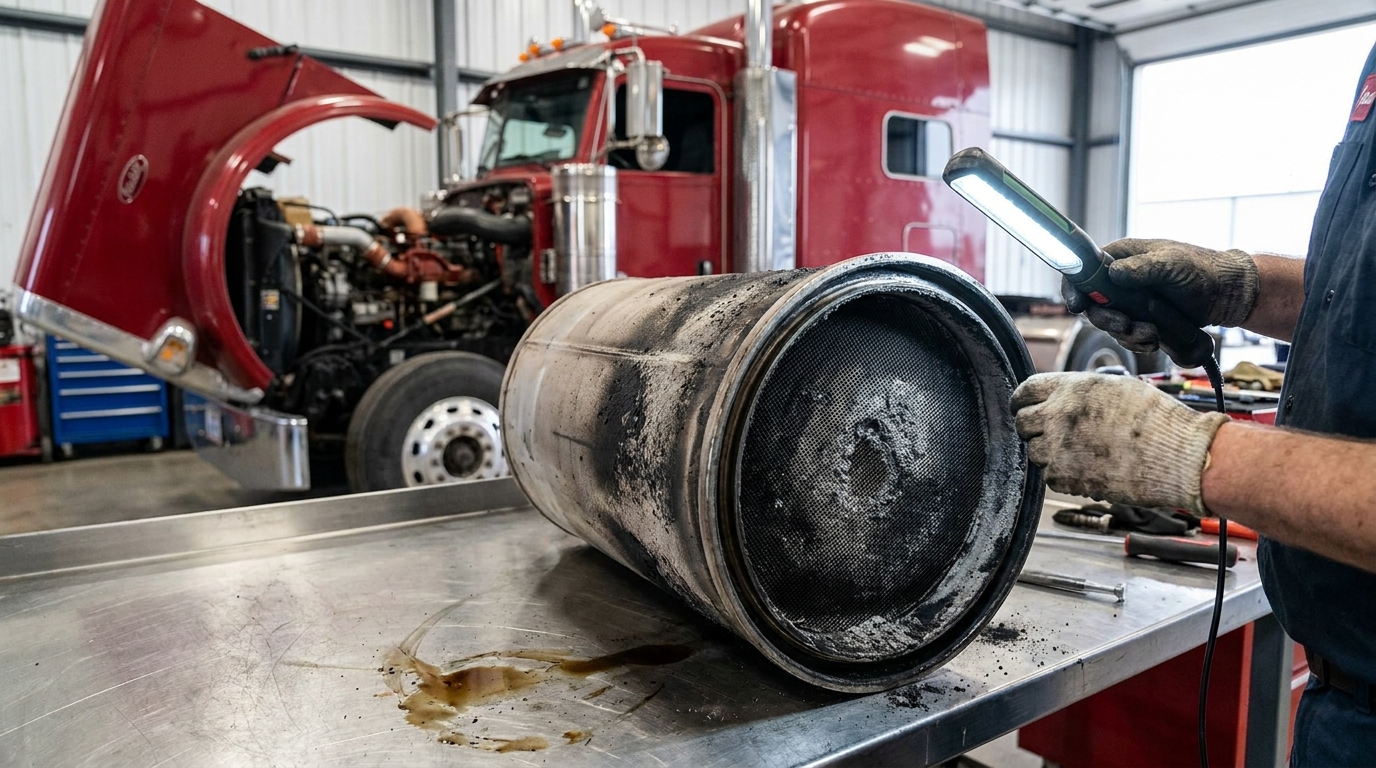
The interval on your DPF is not a mileage. It is your fuel economy.
Cummins publishes three different service intervals for the same filter on the same engine, and the only thing that decides which one is yours is how many miles you get out of a gallon.
Between the shortest and the longest there is a factor of more than three.
The three numbers
In the Quick Reference Guide for the X15 (EPA 2017), Cummins splits maintenance into three duty cycles, and it defines them by fuel economy — not by freight, not by state, not by how the owner describes the work. For the particulate filter:
- Severe duty, under 5.5 mpg: 250,000 to 400,000 miles.
- Normal duty, 5.5 to 6.5 mpg: 400,000 to 600,000 miles.
- Light duty, above 6.5 mpg: 600,000 to 800,000 miles.
Read the bottom of that range against the top: 250,000 against 800,000. Same engine, same filter, same part number. The truck that runs heavy and slow reaches the shop three times before the highway truck gets there once.
Why the city truck loses this one
Ash is what ends a filter's life. Soot burns off in regeneration; ash does not. It comes mostly from the oil the engine consumes, it stays in the honeycomb, and it accumulates until the filter has to come off the truck and be serviced.
So the question is not how many miles you drove. It is how many hours the engine ran and how much fuel it burned to produce those miles. A truck working stop and go, loaded, in heat, with long waits at the dock, burns a lot of fuel for very few miles. That is exactly what "under 5.5 mpg" describes, and it is the ordinary week of a truck working metro Houston, the Katy corridor and the port runs.
The same guide puts the recommended low idle at 600 RPM, and the reason is the same one: everything the engine burns while the truck is not moving lands on the wrong side of that mpg number, and eventually inside the filter.
The one number that does not move
Look at the DEF filter in that same table: 300,000 miles in all three columns. Severe, normal or light, it does not change.
That contrast is the point. When a maintenance item is on a fixed schedule, the manufacturer prints one number. When it depends on how the truck is worked, it prints a range and ties it to mpg. The particulate filter is in the second group. Anybody who quotes you a single mileage for a DPF service, with no question about your fuel economy, is quoting from somewhere other than the manual.
The rest of that table moves the same way: oil drain at 25,000, 35,000 or 50,000 miles by the same three cycles, fuel filter on the same steps, and overhead adjustment at 500,000 miles or 10,000 hours or 60 months, whichever comes first.
The truck tells you, and it flashes for 30 seconds
Here is the part most owners never use. The X15 carries an ash load monitor, and Cummins states plainly that the customer can rely on it to determine when DPF service is due. It is not an estimate you have to keep on paper.
When service is due, the driver is notified by the Check Engine Lamp or the Amber Warning Lamp, which flashes for 30 seconds after the key switch is turned ON. Not while driving — at key on, before the truck moves.
Thirty seconds at key on is a very easy thing to miss when you are already thinking about the load. It is also the cheapest warning on the truck.
For engines running normal and light cycles, above 5.5 mpg, that monitor is what lets Cummins offer either a variable interval or a fixed one of 400,000 to 800,000 miles, helped by the greater ash capacity of the Single Module aftertreatment system on the Efficiency and Performance series.
What to do with this before your next service
- Get your real mpg from the last full year, not from a good week. That number, and only that number, picks your column.
- Watch the dash at key on for a lamp that flashes about half a minute. That is the ash monitor talking.
- Put the ash cleaning on the same page as the oil drain, because they move together across the three cycles.
- Ask the shop which column they are quoting. If nobody asked your fuel economy, nobody knows your interval.
- Attack the idle hours, not just the miles. Time with the engine running and the truck parked is fuel burned for zero miles, and it is the fastest way into the severe column. That is the whole argument for an auxiliary power unit.
And one honest limit: these figures are Cummins' table for the X15 with EPA 2017 hardware. Every manufacturer publishes its own, and the engine in your truck has its own guide. What carries across all of them is the logic — the filter fills with ash on the engine's schedule, not on the odometer's.
The Truck Savers™ does not clean diesel particulate filters. What it works on is the number that picks your column: the road simulator inspection and the alignment in Houston and Dallas, because the fuel economy a truck loses out of line is the same mpg that moves the ash interval.
Original source: Cummins Inc., Truck Maintenance and Operation X15 (EPA 2017) Quick Reference Guide.