Uneven Semi-Truck Tire Wear: Causes by Pattern
Learn what shoulder wear, center wear, cupping and diagonal patterns can signal—and what owner-operators should inspect before the next load.
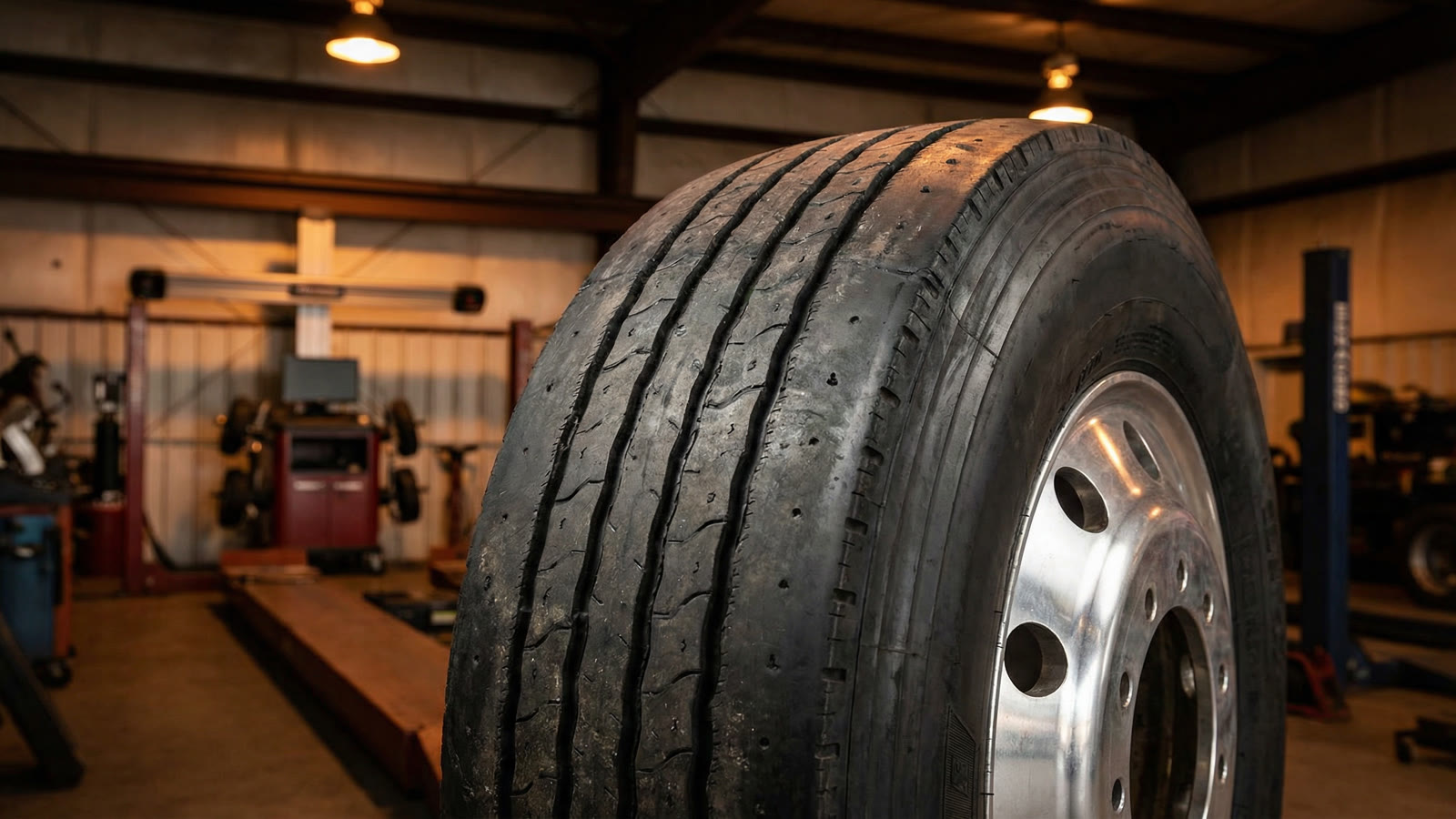
A tire's wear pattern can warn you that something is wrong before the truck starts vibrating, pulling, or eating another tire. Inflation, alignment, balance, suspension and component play can leave similar marks, so the pattern guides the diagnosis—it does not replace one.
For an owner-operator or small fleet, catching the pattern early can prevent installing a new tire without correcting what damaged the old one. The practical question is not only “Does it still have tread?” It is also “Is it wearing evenly, and what changed on the truck?”
What Each Tire-Wear Pattern Can Mean
Both Shoulders Wearing Faster
When both edges wear faster than the center, one possible cause is running too little pressure for the load. Also check for slow leaks, valve problems, heat and whether the target pressure matches the actual load. Do not set pressure by appearance alone.
Center Wearing Faster
A center section that is clearly smoother than the shoulders may be related to excess pressure or the wrong pressure-to-load combination. Confirm the cold reading with a dependable gauge and compare it with the tire maker's load-and-inflation guidance for that axle position.
One Shoulder Wearing Faster
Wear concentrated on the inner or outer shoulder may point to alignment angles outside specification, loose or bent components, worn bushings, spring or air-bag problems, or an axle condition. The tire shows the symptom; the inspection must find the cause.
Cupping or Scalloping
High and low spots around the tread may appear with imbalance, weak shocks, wheel-bearing play, worn suspension parts or a combination of conditions. If the truck also vibrates at a certain speed, record when it happens: accelerating, braking, loaded or empty.
Diagonal or Block Wear
Diagonal marks and irregular wear across tread blocks may relate to alignment, load distribution, mechanical play or repeated lateral forces. Checking pressure alone may not be enough.
A Localized Flat Spot
A flat area may follow a skidding stop or a wheel that is not rotating normally. Inspect the braking system and rule out dragging, lockup or damage before returning the truck to service.
Why It Matters for Cost and Safety
A tire wearing unevenly loses useful life even when another part of the tread still looks deep. It may also accompany vibration, unstable steering or components that continue to deteriorate. Replacing the tire without correcting pressure, alignment, balance or suspension can repeat the same expense.
For interstate commercial vehicles, federal rules require at least 4/32 inch of tread depth in the major grooves on front steering-axle tires and 2/32 inch at other positions. That is a legal minimum—not a reason to ignore cracks, bulges, exposed material, leaks or localized wear.
What the Road Hero Should Check
- Cold pressure: measure every tire with the same gauge and compare matching positions.
- Tread depth: take several readings across the shoulders and center, and around the circumference.
- Axle differences: compare left to right and inspect dual pairs.
- Suspension and steering: look for play, damaged bushings, leaking shocks, uneven air bags and loose fasteners.
- Bearings and hubs: check for play, unusual heat, noise and seal leaks.
- Brakes: rule out drag, lockup, unequal adjustment and overheating.
- Alignment: measure it after a hard impact, suspension repair or when the truck pulls.
- Before the route: check pressure, lights, fluid levels, leaks, weather and route conditions; photograph the pattern so you can compare its progress.
Quick Answers for Owner-Operators
What changed? This update organizes diagnosis by wear pattern and separates symptoms from possible causes.
Who is affected? Any operator or fleet seeing uneven tread, vibration, pulling or repeat tire repairs.
When should you act? As soon as a visible difference, repeated pressure loss, new vibration, abnormal heat, structural damage or near-limit tread appears.
What should a carrier do? Measure, document and inspect the complete system before buying another tire.
How can it affect cost? Correcting the cause can keep a replacement tire from developing the same pattern and help protect related components.
How can it affect safety? Uneven wear may accompany steering, suspension, brake or tire-integrity problems that should not be allowed to progress.
Diagnose the Cause, Not Just the Tire
If uneven wear comes with vibration, pulling or repeat repairs, an inspection of the tire, steering and suspension system can separate the symptom from the cause. The Truck Savers offers La Bailada in Houston to check those conditions before parts are replaced without a diagnosis.
The tread tells the story. The problem starts when nobody listens. Metals never lie.