Darlington Is Egg-Shaped Because of a Minnow Pond
Darlington is not symmetrical, and a fish pond is the reason. One end got pinched in 1949.
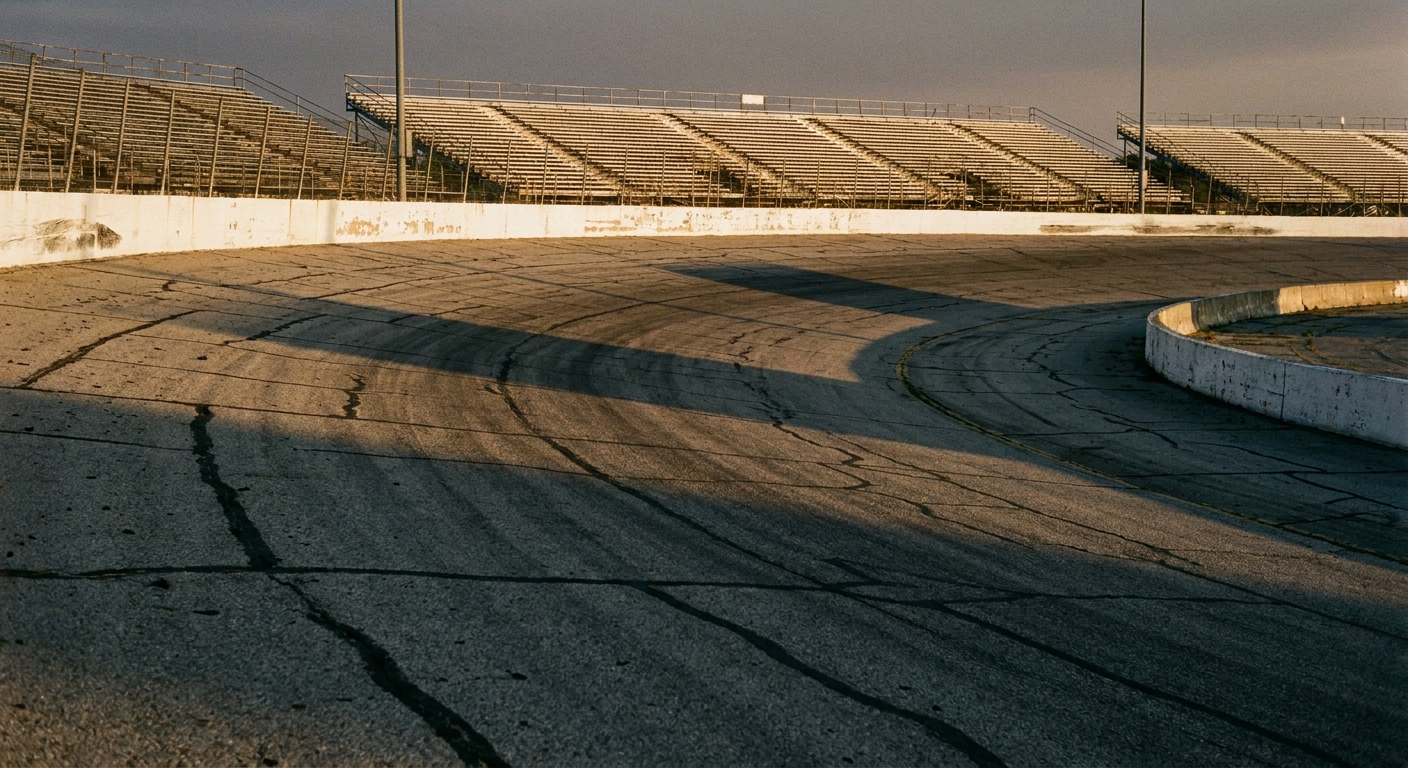
Darlington is not symmetrical, and a fish pond is the reason. One end of the oval is pinched tighter than the other, and it has been that way since 1949 because the man who built it kept a promise.
Harold Brasington went to the Indianapolis 500 in 1948, looked at roughly two hundred thousand people in the grandstands, and decided South Carolina could have one too. He came home and bought seventy acres from a farmer named Sherman Ramsey.
The promise that bent the track
Ramsey sold the land on one condition: leave the minnow pond alone. It sat at the western end of the property, and Brasington had given his word.
So when the oval would not fit, he did not move the pond. He pinched that end of the track instead. Ground broke in 1949, the place opened in 1950, and the shape that came out of that compromise is still there.
It is the only major American oval whose geometry was decided by a handshake with a farmer.
What "not symmetrical" actually means
Darlington today measures 1.366 miles, up from the 1.25 it started at. The banking is where the asymmetry lives:
- Turns one and two — 25 degrees.
- Turns three and four — 23 degrees.
- The straights — 6 degrees.
Two degrees does not sound like much written down. On track it means the two ends of the same lap ask different things of the same car, and a setup that is right at one end is a compromise at the other. That is the whole reason for the nickname the place earned.
Every other big oval in the country was drawn on paper first and then built. This one was built around something that was already there, and the drawing had to give way. Seventy-six years later nobody has straightened it, because straightening it would make it an ordinary track.
The first Southern 500 was a spectacle
Labor Day, 1950. The purse was $25,325. Twenty-five thousand people showed up. Eighty-two drivers came to run it, seventy-five actually started, and by the end only twenty-nine cars were still going.
Johnny Mantz won it nine laps ahead of Fireball Roberts. Nine laps. It remains one of the widest margins in the sport's history, and it happened because the surface ate tires and Mantz had planned for that when almost nobody else had.
Darlington is the second oldest track in NASCAR and the oldest superspeedway of them all. The Cook Out Southern 500 runs there again on September 7.
Why a truck publication is telling you this
Because the lesson from 1950 is the one we spend all week repeating in the shop, and it has nothing to do with racing.
Mantz did not win on horsepower. He won because he understood that an uneven surface wears tires unevenly, and he planned around it while the rest of the field planned around speed. Everybody else stopped over and over. He kept going.
Your truck runs on a road that is exactly as uneven as that track, just slower. Crown, ruts, a right side that lives on the shoulder, a left side that does not. The road is not symmetrical either, and it wears your equipment the same asymmetric way.
What that looks like on a working unit
- One side wearing faster than the other. That is geometry talking, not luck.
- Feathering on one edge only. Usually toe, and usually on one axle rather than both.
- A truck that pulls only when loaded. The load changes the angles; the alignment done empty does not survive it.
- Steer tires that finish at different depths. Two tires, same road, different lives — the difference is under them, not on them.
The preventive read
Darlington got its shape from a promise and never stopped punishing anyone who treats both ends of the lap the same way. Nobody argues with the track; they measure it and set up accordingly.
A truck deserves the same courtesy. Both sides of an axle look identical and almost never wear identically, and the only way to know which one is losing is to measure instead of guessing.
At The Truck Savers that measurement is the free inspection, and it is what tells you which corner of your unit is paying for the road. Los fierros nunca mienten.
Original source: South Carolina Encyclopedia — Darlington Raceway.